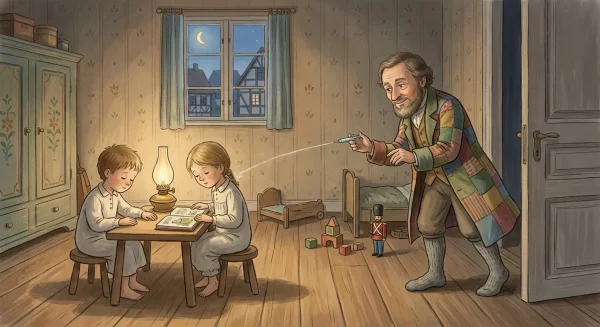
Nobody in the whole world knows as many stories as Ole Lukoie. What a storyteller he is!
In the evening, when the children are sitting quietly at the table or on their little stools, Ole Lukoie arrives. He wears nothing on his feet but his socks, and he climbs the stairs very, very softly; then he opens the door a crack, steps into the room without a sound and squirts a little milk into the children's eyes. He carries a tiny syringe, and the milk comes out of it in the thinnest of streams. Then the children's eyelids begin to stick together, and they can no longer make Ole out, while he creeps up behind them and blows gently on the backs of their necks. One puff, and their little heads grow heavy. It does not hurt at all: Ole Lukoie means no harm; he only wants the children to settle down, and for that they simply must be put to bed! So he puts them to bed, and then he begins to tell his stories. When the children are asleep, Ole Lukoie sits down on the edge of the bed. He is splendidly dressed: he wears a silk coat, but nobody can say what colour it is, for it shimmers now blue, now green, now red, depending on which way Ole turns. Under each arm he carries an umbrella. One has pictures on it, and he opens it over good children, and then they dream the most wonderful stories all night long. The other is quite plain and smooth, and he opens that one over naughty children; they sleep all night like logs, and in the morning it turns out they have dreamed nothing at all!
So let us hear how Ole Lukoie came every evening to a little boy called Hjalmar and told him stories! There will be seven stories in all, for there are seven days in a week.
Monday
"Now then," said Ole Lukoie, once he had put Hjalmar to bed, "let's decorate the room!"
In the blink of an eye all the house plants grew into great trees that stretched their long branches along the walls right up to the ceiling, and the whole room turned into the loveliest arbour. The branches were covered with flowers; every flower was prettier and sweeter-smelling than a rose and tasted sweeter than jam, and the fruit shone like gold. There were buns growing on the trees too, so full of raisins they were nearly bursting. It was simply wonderful! Suddenly there came a dreadful groaning from the table drawer where Hjalmar kept his school things.
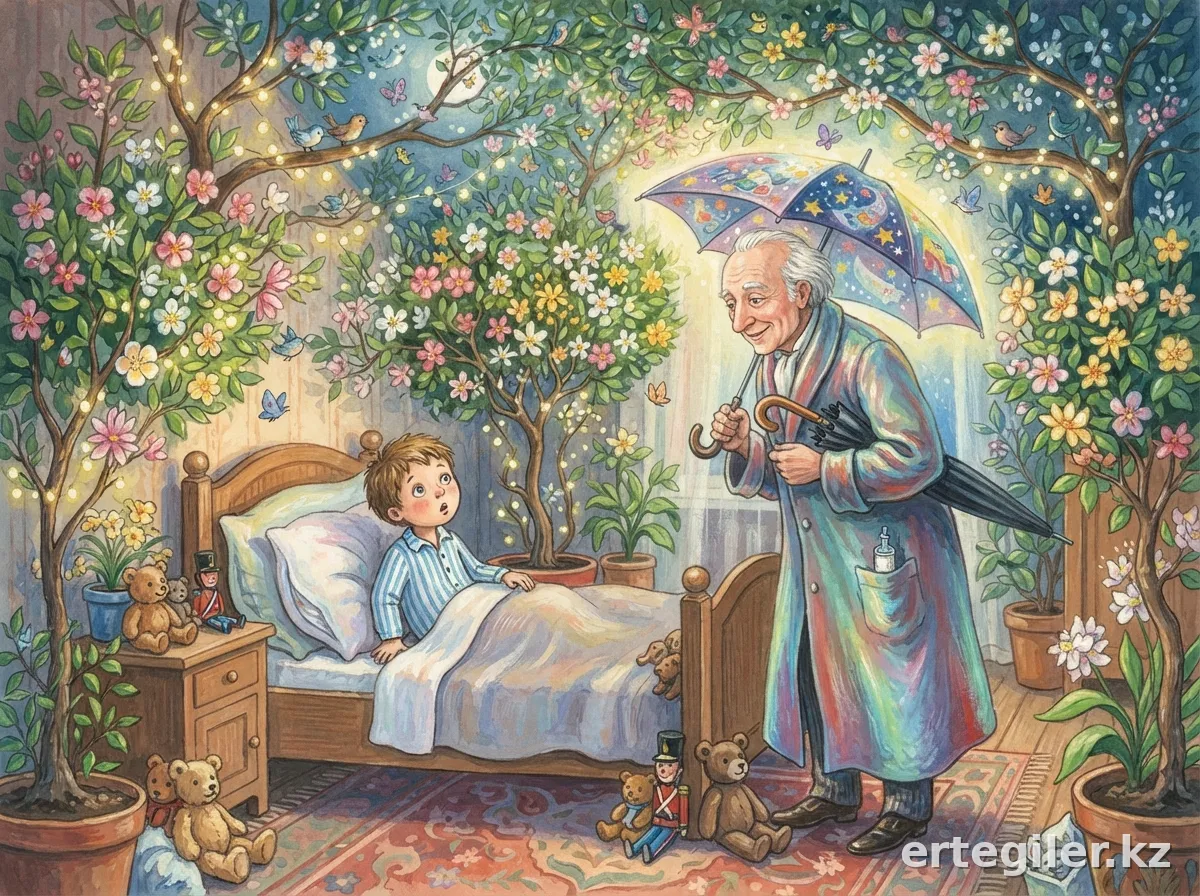
"What's all this?" said Ole Lukoie, and he went and pulled the drawer open.
It was the slate, raging and storming: a mistake had crept into the sum written on it, and the whole calculation was about to fall to pieces. The slate pencil was hopping and jumping on its string like a little dog; it wanted very much to help, but it couldn't. Hjalmar's copybook was groaning loudly as well; it was dreadful to hear! At the start of every line on every page stood beautiful big letters with little ones beside them — that was the copy to follow; and next to them stood other letters that thought they were standing just as firmly. Hjalmar had written those himself, and they looked as if they were tripping over the lines they were supposed to stand on.
"This is how you should stand!" said the copy. "Like this, leaning slightly to the right!"
"Oh, we'd love to," answered Hjalmar's letters, "but we can't! We're so feeble!"
"Then I'll give you some nasty medicine!" said Ole Lukoie.
"Oh no, no!" they cried, and they stood up so straight it was a joy to see!
"Well, there's no time for stories now!" said Ole Lukoie. "Let's drill! One, two! One, two!"
And he drilled Hjalmar's letters until they stood as straight and brisk as any copy. But when Ole Lukoie had gone and Hjalmar woke up in the morning, they looked just as sorry as before.
Tuesday
As soon as Hjalmar was in bed, Ole Lukoie touched the furniture with his magic syringe, and at once all the things began to chatter with one another — all except the spittoon, which kept quiet and was cross with them for being so vain: they talked only about themselves and never gave a thought to the one who stood so modestly in the corner!
Over the chest of drawers hung a large painting in a gilded frame. It showed a beautiful landscape: tall old trees, grass, flowers and a wide river that flowed past splendid palaces, beyond the forest and into the distant sea.
Ole Lukoie touched the painting with his magic syringe, and the birds in it began to sing, the branches of the trees began to sway, and the clouds sailed across the sky; you could even see their shadows gliding over the picture.
Then Ole lifted Hjalmar up to the frame, and the boy stepped straight into the tall grass. The sun shone down on him through the branches; he ran to the water and sat down in a little boat that was rocking by the bank. The boat was painted red and white, its sails shone like silver, and six swans wearing golden crowns, with bright blue stars on their heads, drew it along past green forests, where the trees told of robbers and witches, and the flowers told of lovely little elves and of what the butterflies had told them.
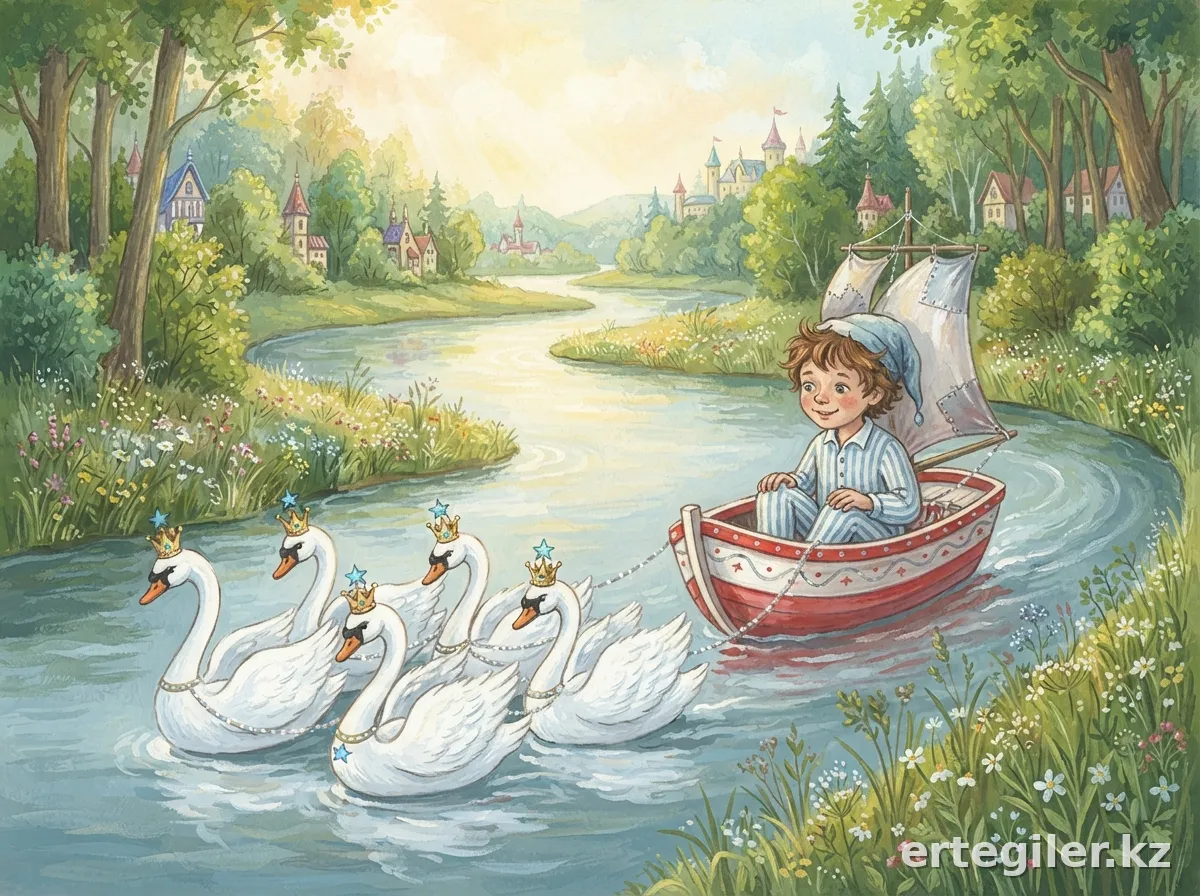
The most wonderful fish with silver and gold scales swam after the boat, diving and splashing their tails in the water; red and blue birds, big and small, flew after Hjalmar in two long lines; the gnats danced and the cockchafers hummed — everyone wanted to see Hjalmar on his way, and each of them had a story ready for him.
Now that was a voyage!
Sometimes the forests grew thick and dark, sometimes they were like the most wonderful gardens, full of sunshine and flowers. Along the banks of the river stood great palaces of crystal and marble; princesses stood on their balconies, and they were all girls Hjalmar knew and often played with.
They all held out their hands to him, and each held in her right hand a fine sugar-coated gingerbread pig. As Hjalmar sailed past, he caught hold of one end of the gingerbread, the princess held the other end tight, and the gingerbread broke in two — each got a share, but Hjalmar got the bigger piece and the princess the smaller. Little princes stood on guard at every palace; they saluted Hjalmar with their golden swords and showered him with raisins and tin soldiers — that's what real princes are like!
Hjalmar sailed through forests, through great halls and towns… He sailed through the town where his old nurse lived, the one who had looked after him when he was a baby and loved him dearly. And there she was: she bowed, blew him kisses and sang a pretty little song that she had made up herself and sent to Hjalmar:
My Hjalmar, I think of you daily,
Each hour, each day that goes by!
I long so to see you, my darling,
Just once more before I say goodbye!
I rocked you to sleep in your cradle,
I taught you to walk and to speak,
I kissed you on forehead and cheek —
So how could I not love you so?
I love you, my angel, my own precious one!
May God keep you safe in the light of the sun!
And the birds sang along with her, the flowers danced, and the old willows nodded their heads, as if Ole Lukoie were telling them a story too.
Wednesday
How the rain poured down! Hjalmar could hear the terrible noise even in his sleep, and when Ole Lukoie opened the window, the water had risen right up to the sill. A whole lake! But a magnificent ship had moored right beside the house.
"Would you like a sail, Hjalmar?" asked Ole. "You'll visit foreign lands tonight and be back home by morning!"
And so Hjalmar, dressed in his Sunday best, found himself on board the ship. At once the weather cleared, and they sailed through the streets and past the church — all around was one great lake. At last they sailed so far that the land vanished from sight. High in the sky a flock of storks was flying; they too were on their way to warm foreign lands, flying in a long line, one after the other. They had been travelling for many, many days, and one of them was so tired that his wings would hardly carry him. He flew behind all the others, then fell behind and began to sink lower and lower on his outspread wings; he flapped them once or twice more, but it was no use! Soon he struck the ship's mast, slid down the rigging and — bump! — landed right on the deck.
The cabin boy caught him and put him in the coop with the hens, ducks and turkeys. The poor stork stood there looking miserably about him.
"Look at him!" said the hens.
The turkey cock puffed himself up as much as he could and asked the stork who he was, while the ducks backed away, nudging each other and quacking.
The stork told them about hot Africa, about the pyramids and the ostriches that race across the desert as fast as wild horses, but the ducks understood none of it and started nudging each other again:
"Isn't he silly?"
"He certainly is!" said the turkey cock, and gobbled crossly. The stork fell silent and thought about his Africa to himself.
"What wonderful thin legs you have!" said the turkey cock. "How much are they a yard?"
"Quack! Quack! Quack!" giggled the ducks, but the stork seemed not to hear.
"You might laugh with us!" the turkey cock said to the stork. "That was very funny! But oh no, that's probably too low for him! You can't say he's quick on the uptake! Well, we'll amuse ourselves!"
And the hens clucked and the ducks quacked, and they found it all terribly amusing.
But Hjalmar went to the coop, opened the little door and called the stork, and the stork hopped out onto the deck beside him — by now he had had a good rest. Then the stork seemed to bow to Hjalmar to say thank you, spread his broad wings and flew away to the warm countries. The hens clucked, the ducks quacked, and the turkey cock puffed himself up so much that his comb turned bright red.
"Tomorrow they'll make soup out of you!" said Hjalmar, and he woke up again in his own little bed.
What a fine journey he and Ole Lukoie had made that night!
Thursday
"Do you know what?" said Ole Lukoie. "Only don't be frightened! I'm going to show you a mouse!" And sure enough, he was holding a very pretty little mouse. "She has come to invite you to a wedding! Two mice are getting married tonight. They live under the floor of your mother's pantry. A lovely place, they say!"
"But how will I get through that little hole in the floor?" asked Hjalmar.
"Leave that to me!" said Ole Lukoie. "I'll make you small."
And he touched the boy with his magic syringe. Hjalmar began to shrink and shrink, until at last he was no bigger than a finger.
"Now we can borrow a uniform from one of the tin soldiers. I think that will suit you nicely: a uniform always looks smart, and you're going to a party!"
"All right!" said Hjalmar, and he was dressed up as the finest tin soldier you ever saw.
"Would you be so kind as to sit in your mother's thimble?" the mouse said to Hjalmar. "I shall have the honour of driving you."
"Oh, are you really going to trouble yourself, miss?" said Hjalmar, and off they went to the mouse wedding.
They slipped through the hole the mice had gnawed in the floor and came first to a long, narrow passage, just wide enough for the thimble to pass. The passage was lit with glowing rotten wood.
"Doesn't it smell lovely?" asked the mouse who was driving. "The whole passage has been greased with bacon fat! What could be better?"
At last they reached the hall where the wedding was being held. On the right stood all the lady mice, whispering and giggling together, and on the left stood the gentlemen mice, twirling their whiskers with their paws. Right in the middle, on a hollowed-out cheese rind, stood the bride and groom, kissing in front of everyone — after all, they were engaged and about to be married.
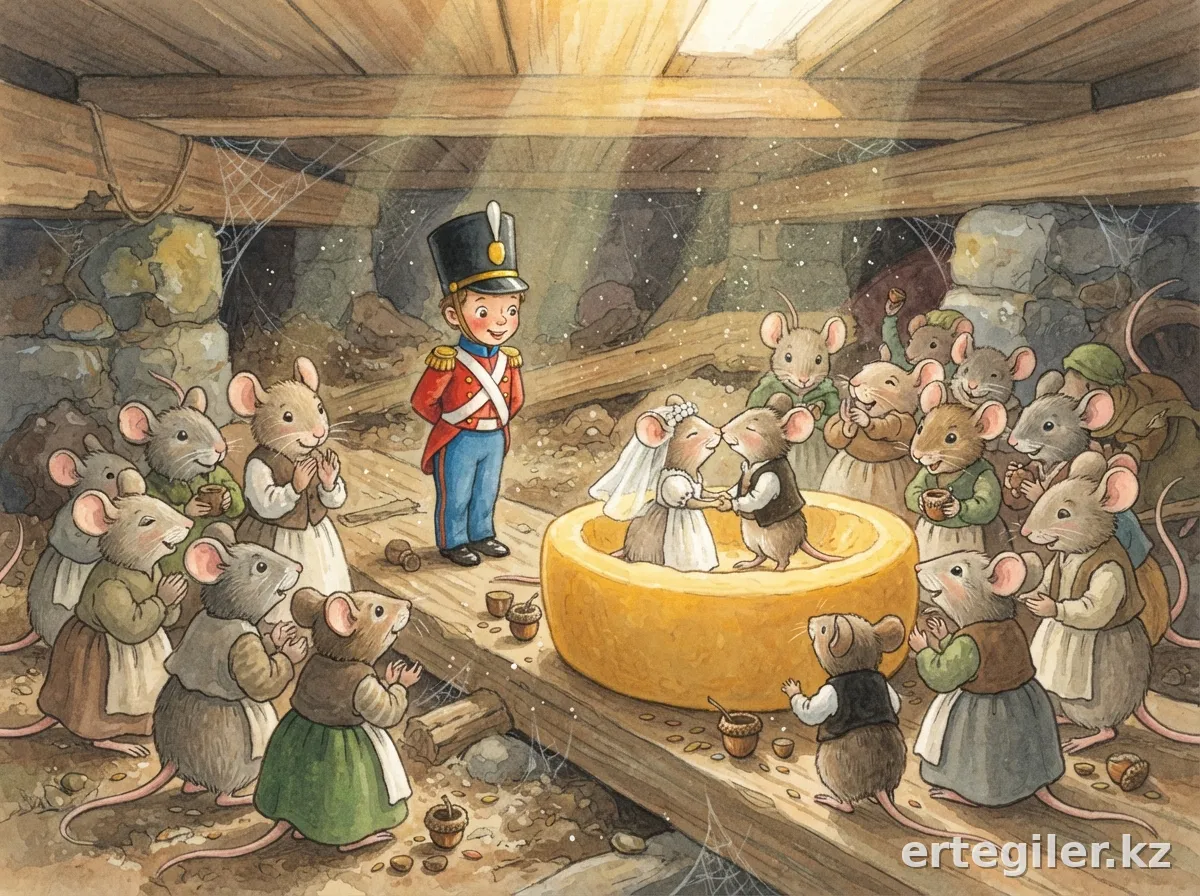
More and more guests kept arriving; the mice nearly squashed each other flat, and the happy couple ended up standing right in the doorway, so that nobody could get in or out. The hall, like the passage, was greased all over with fat; there was nothing else to eat, and for dessert a pea was passed round, on which a relative of the bride and groom had nibbled their names — well, only the first two letters, of course. A marvel, and that's all there is to it!
All the mice declared that it had been a splendid wedding and a most enjoyable evening.
Hjalmar drove home. He too had been in very fine company, though he had had to shrink a great deal and squeeze into a tin soldier's uniform.
Friday
"You wouldn't believe how many grown-ups are dying to have me visit them!" said Ole Lukoie. "Especially those who have done something wrong. 'Dear, kind Ole,' they say to me, 'we simply can't close our eyes; we lie awake all night and see all our bad deeds around us. They sit on the edge of the bed like nasty little trolls and splash us with boiling water. We would gladly pay you, Ole,' they add with a deep sigh. 'Good night, Ole! The money is on the windowsill!' But what do I want with money! I never come to anyone for money!"
"What shall we do tonight?" asked Hjalmar.
"Wouldn't you like to go to another wedding? Not like yesterday's, though. Your sister's big doll, the one dressed as a boy and called Hermann, wants to marry the doll Bertha. Besides, it's the doll's birthday today, so lots of presents are being got ready!"
"I know, I know!" said Hjalmar. "Whenever the dolls need new clothes, my sister has a birthday or a wedding for them. It's happened a hundred times already!"
"Yes, and tonight will be the hundred and first time, which means the last! That's why something very special is being prepared. Just look!"
Hjalmar looked at the table. There stood a little cardboard house with its windows lit up, and all the tin soldiers were presenting arms. The bride and groom were sitting on the floor, leaning against the table leg, deep in thought — and they had plenty to think about! Ole Lukoie, dressed in Grandmother's black skirt, married them, and then all the furniture in the room sang a funny song to the tune of a march. The pencil had written it:
Let's sing a song together,
Let it blow like the wind!
Though our couple, I'll wager,
Won't answer us a thing.
They're both made of leather,
They stand stiff on their sticks,
But their clothes are so splendid —
A feast for the eyes!
So let's sing them our praises:
Hooray for the bride and groom!
Then the newlyweds were given presents, but they refused anything to eat: their love was all the food they needed.
"Well, shall we go to the country now, or travel abroad?" asked the bridegroom.
The swallow and an old hen who had hatched five broods of chicks were invited to give advice. The swallow told them about the warm countries where heavy, juicy bunches of grapes ripen, where the air is so soft and the mountains are painted in colours nobody here can even imagine.
"But they don't have our green cabbage there!" said the hen. "Once I spent a summer in the country with all my chicks. There was a big heap of sand where we could scratch and dig as much as we liked! And we were allowed into the cabbage garden too! Oh, how green it was! I can't think of anything lovelier!"
"But one cabbage looks just like another, like two drops of water!" said the swallow. "Besides, the weather here is so often bad."
"Well, you get used to that!" said the hen.
"And how cold it is here! You could freeze stiff! It's dreadfully cold!"
"That's just what's good for the cabbage!" said the hen. "And besides, it gets warm here too! Four years ago summer lasted a whole five weeks! And how hot it was! Everybody was gasping for breath! And by the way, we don't have the poisonous creatures you have over there! No robbers either! Anyone who doesn't think our country is the best in the world must be a good-for-nothing! Such a creature doesn't deserve to live here!" And the hen burst into tears. "I've travelled too, you know! I went twelve whole miles in a barrel! There's no pleasure at all in travelling!"
"Yes, the hen is a most sensible person!" said the doll Bertha. "I don't like travelling in the mountains either — up and down, up and down! No, we'll move to the country, where there's a sand heap, and go for walks in the cabbage garden."
And so it was decided.
Saturday
"Will you tell me a story tonight?" asked Hjalmar, as soon as Ole Lukoie had put him to bed.
"No time tonight!" answered Ole, and he opened his beautiful umbrella over the boy. "Just look at these Chinese people!"
The umbrella looked like a big Chinese bowl painted with blue trees and narrow little bridges, with little Chinese figures standing on them, nodding their heads.
"Tonight the whole world must be made ready for tomorrow!" Ole went on. "Tomorrow is a holiday, Sunday. I have to go up the bell tower and see whether the church goblins have polished all the bells, or they won't ring well tomorrow. Then I must go out into the fields and see whether the wind has swept the dust off the grass and leaves. But the hardest job is still to come: I have to take all the stars down from the sky and polish them. I collect them in my apron, but I have to number every star and every little hole it sat in, so that I can put them back properly afterwards — otherwise they won't hold firm and will drop out of the sky one after another!"
"Now listen here, Mr Ole Lukoie!" said an old portrait hanging on the wall. "I am Hjalmar's great-grandfather, and I am very grateful to you for telling the boy stories, but you must not muddle his ideas. Stars cannot be taken down from the sky and polished. Stars are heavenly bodies just like our Earth, and that is exactly what makes them so fine!"
"Thank you, great-grandfather!" answered Ole Lukoie. "Thank you! You are the head of the family, the 'old head', but I am older than you all the same! I am very, very old: the Romans and the Greeks called me the god of dreams! I have been welcome in the grandest houses and still am, and I know how to talk to great and small alike! Now you can tell the stories yourself!"
And Ole Lukoie went away with his umbrella under his arm.
"Well, it seems one can't even give one's opinion!" said the old portrait.
And then Hjalmar woke up.
Sunday
"Good evening!" said Ole Lukoie.
Hjalmar nodded to him, jumped up and turned his great-grandfather's portrait to face the wall, so that it wouldn't interrupt again.
"Now tell me the stories about the five green peas that were born in one pod, about the cock's leg that courted the hen's leg, and about the darning needle that thought it was a sewing needle."
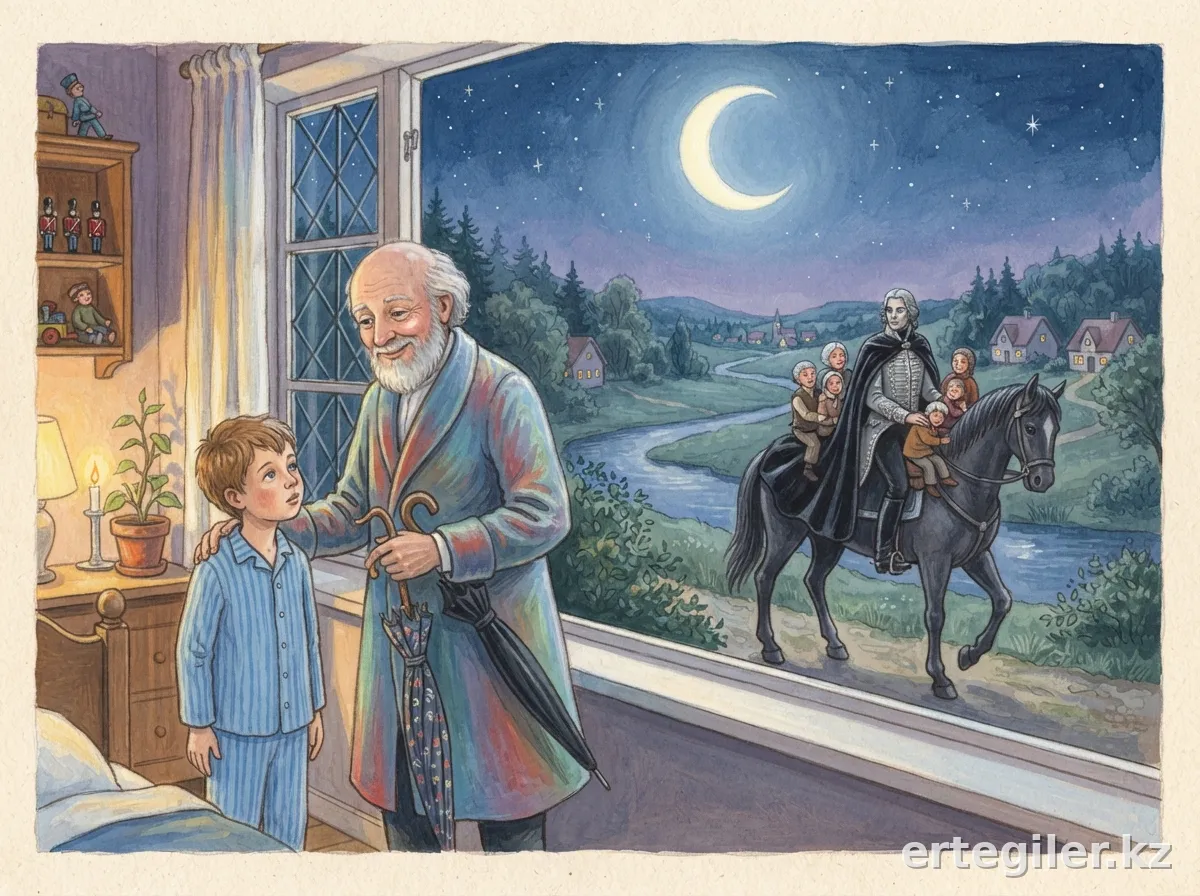
"Too much of a good thing!" said Ole Lukoie. "I'd rather show you something. I'll show you my brother. He is called Ole Lukoie too, but he never visits anyone more than once in a lifetime. When he does come, he takes the person up on his horse and tells them stories. He knows only two: one is so marvellously beautiful that nobody can even imagine it, and the other is so terrible that… no, it's impossible even to say how!"
Then Ole Lukoie lifted Hjalmar up, carried him to the window and said:
"Now you'll see my brother, the other Ole Lukoie. People also call him Death. You see, he isn't nearly as frightening as he looks in pictures! His coat is embroidered all over with silver, like a hussar's uniform, and a black velvet cloak flutters behind him! Look how he gallops!"
And Hjalmar saw the other Ole Lukoie riding at full speed and taking old and young up onto his horse. Some he seated in front of him, others behind, but first he always asked:
"What marks have you got for behaviour?"
"Good ones!" they all answered.
"Show me!" he would say.
They had to show him, and those with excellent or good marks he seated in front of him and told them a wonderful story, while those with fair or poor marks he put behind him, and they had to listen to the terrible story. They shook with fright and cried and wanted to jump off the horse, but they couldn't: they stuck fast to the saddle at once.
"But Death is the most wonderful Ole Lukoie!" said Hjalmar. "And I'm not a bit afraid of him!"
"And there's no need to be!" said Ole. "Only make sure you always have good marks for behaviour!"
"Well, now that is instructive!" muttered the great-grandfather's portrait. "So it does no harm to give one's opinion now and then!"
And he was very pleased.
There you have the whole story of Ole Lukoie! And tonight let him tell you something more himself.
Well done! The story is over!
You reached the end of the story. Great job!



Every day at 8:30 pm we'll send one bedtime tale. Just one notification a day.
On iPhone: tap Share → Add to Home Screen, open the site from that icon and turn it on here.
Done! Look out for a tale this evening 🌙
Something went wrong. Please try again later.
5 stories with your name and your picture. Show your parents!
For parents: a tale about your child for 390 ₸ — a trial week of Premium →Hans Christian Andersen 14 people viewed

iPhone and Android app
All the tales, right on your phone
Read and listen at home or on the road. Free, with no ads.
- Audio tales keep playing with the screen off
- Pick up reading exactly where you stopped
- Find tales by age and by whether they have audio
- Night background and a comfortable text size

Sign in to keep reading
Today's free tales are over — 3 more are available tomorrow. Sign in with Google to continue — it is free and takes a second.
Sign in with GoogleHave an Android phone? In the app all tales are open without signing in.
Have an iPhone? In the app all tales are open without signing in.
Read in the app
Пікір қалдыру (0 пікір бар)
Әзірге пікір ешкім қалдырмаған!
Пікір қалдыру