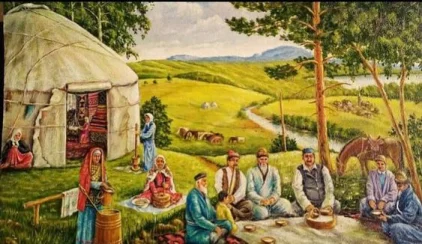
Ayaz Bi
Kazakh folk tales
Audio in KazakhHow was the narration?
Thank you! This helps us make the narration better.
You listened to 30 seconds for free
Sign in to keep listening
Sign in with Google to listen to full fairy tales
Sign in with Google ★ Narrator voice — PremiumLong ago there lived a khan named Madan. Being a khan, he had forty viziers. One day, while holding council with his viziers, the khan said:
"My viziers! Each of you is known as a man of rare wisdom. I am giving you a task: find me the worst person in the world, the worst grass and the worst bird. I give you eleven months. If you do not find them in eleven months, you will be punished!" When the khan commands, there is nothing to be done! The viziers talked it over and set out to search. They searched long and hard and found a plant called shengel. "It is all thorns, it tears your clothes if you walk through it, and cattle will not eat it. This must be the worst grass," they said, and took the shengel. They found a pheasant. "It has hardly any feathers and looks unsightly. This must be the worst bird," they said, and shot the pheasant. But they could not find the worst person. As the forty viziers rode along, they saw a man at the foot of a mountain, tending five or ten sheep, in a torn sheepskin coat and an old fur hat. Just as the viziers were saying, "Surely this is the worst of people," the man spoke:
"Good day to you, sirs, and a safe journey!" The viziers told him about the task the khan had given them: they had found the worst grass and the worst bird, but could not find the worst person. Then Zhaman — for that was his name, which means "the bad one" — said:
"I see! If you need the worst of people, I will be him." "Well, then, so be it," said the viziers. They seated Zhaman behind one of them on a horse and set off to the khan. On the way, Zhaman said:
"You have found the worst person, but you have not found the worst grass or the worst bird. The worst grass is the bulrush, and the worst bird is the magpie." He had the viziers throw away the pheasant and the shengel and take a bulrush and a magpie instead. When the viziers asked what he meant by it, he answered:
"I will explain in front of the khan," and said no more. When the viziers arrived, the khan looked at the man they had brought and said:
"The man you have brought will do. For now, take him to the cook and have him given soup and bread. Tomorrow we will bring him out and have some fun with him." And he sent Zhaman to the kitchen.
"But," the khan went on, "you did not find the worst bird or the worst grass. The worst bird is the pheasant and the worst grass is the shengel. You knew this, so why did you bring these?" And he began to grow angry with his viziers. The viziers replied:
"My lord! You are right! We did take the shengel as the worst grass and the pheasant as the worst bird. But on the way that bad fellow said, 'The worst grass is the bulrush and the worst bird is the magpie,' and he made us throw ours away and take a bulrush and a magpie." The khan paused for a moment.
"Well, what could this Zhaman possibly know? How does he know that the worst grass is the bulrush and the worst bird is the magpie? Bring him here! Let us ask him," he ordered. Zhaman was brought before the khan. The khan looked him in the face and said, "I thought the worst bird was the pheasant and the worst grass was the shengel, yet you had my viziers throw them away. How do you know that the worst grass is the bulrush and the worst bird is the magpie?"
"My lord khan! I did not become worthless at fifty — I have been worthless since I was young. My whole life has gone by in service at other people's doors, carrying firewood and water. In those days, when I brought shengel and lit a fire with it, a fire lit in the evening would glow until morning like saxaul embers. Back then I thought, 'Shengel tears clothes and cattle won't eat it, but it is useful as fuel.' But when I put bulrush on the fire, it would not burn. When I blew on it, the flame and the embers went out together, and the ash flew up and filled the whole house. Since it would not burn, I gave it to the cattle, but every animal turned up its nose and would not eat it. Then I thought, 'Bulrush is a grass of no use at all.' That is how I learned that bulrush is the worst," said Zhaman. "And how do you know that the magpie is the worst?" asked the khan.
"The pheasant has wings, and even with few feathers it is a bird that is useful to people. If someone is unsightly, that is how they were made. The pheasant's only fault is its looks. But the magpie is as mottled inside as its feathers are outside: there is no harmony in it. Two magpies never fly together and never perch together, and the bird is of no use to people. That is why I think the worst bird is the magpie," said Zhaman.
"You have explained the magpie and the bulrush. Now, how do you know that you yourself are the worst?" asked the khan.
"Oh, my lord! I am fifty years old. People my age have married and raised children; they give chores to their daughters-in-law and enjoy their lives. But wherever I go, I still ride behind someone else and serve other people. So am I not bad, but good?" said Zhaman, looking at the khan. The khan shook his head.
"How I wish this fellow really were worthless," he thought, and said aloud: "You have given proof about the bird, the grass and yourself. Very well. Now, I have a fine racehorse, a tulpar. Will you test it for me?"
"Very well, I will test it," said Zhaman. When the tulpar was brought, Zhaman looked it over from front to back and said:
"I can find no flaw in your horse's looks. Now I would like to ride it." He asked the khan's permission, mounted the tulpar, crossed the river in front of the gate and back again, then returned and said:
"My lord! I found no other flaw in your horse. Only, there is something of a cow in it."
"Well, I never! How did you know? You are right. I have an in-law, Aksha Khan. I asked him for a mare that gives birth to tulpars. When the mare's time came, she could not foal and was about to die. So I said, 'Let the mare die, as long as the foal lives,' and the foal was cut out of her. That foal is this horse, and until it was old enough to eat grass, I raised it on cow's milk. But how did you know it has something of a cow in it?" asked the khan in amazement. "When your horse crossed the river and back, it dipped its muzzle into the water and shook its hind legs. You may water a cow forty times a day, but when you drive it across water, it will always dip its muzzle and shake its hind legs. That is how I knew," said Zhaman. The people were astonished and looked at one another. The khan sat thinking for a while and then said:
"Now, I have a precious diamond. That stone has a magic power like Solomon's ring, Moses's staff and David's saddlebag. Find out what power my stone has." And he had the stone brought from his treasury. Zhaman took the stone, weighed it in his hand, looked at it closely and said:
"Your stone is indeed a magic stone. But in two years its power will run out. Inside the stone are two white worms with black heads. The wall of the stone is now only as thick as the back of a knife. In two years the worms will bore through it and come out, and then your stone will be useless." The people did not know what to say. Some said, "If it will be useless in two years anyway, let us split it open." Others said, "Let us not lose the stone because of what some worthless fellow says." In the end they decided to split it. When they broke the stone open, they found two white worms with black heads inside; they had eaten out the middle and were close to boring through.
"How did you know there were worms in the stone?" asked the khan.
"A stone with such power should also have great weight. But the stone had become light. That is how I knew there were worms inside," he answered.
"Well, well, you are not worthless at all! You may even be a sage! Now test me myself. For how many generations have my ancestors been khans?" asked the khan. Zhaman thought for a moment.
"Very well!" he said. He walked around the khan sitting on his throne, came up in front of him and looked him straight in the face.
"My lord khan! Your mind is second to none, but the khanship is yours alone. You were born a commoner and became a khan; your father was no khan," he said. Before Zhaman could finish, the khan cut him off:
"No, you are wrong! I am a khan of the seventh generation. Even if you leave me out, where will you put my six ancestors?" he shouted. Zhaman was not alarmed. "No, my lord! Apart from you, there has been no khan in your line. You are the true son of a baker." The khan did not know what to say. He turned to the people:
"Good heavens, what is this Zhaman saying! My people, I have always believed I was a khan's son. Call my mother!"
"Let her not go to the next world with someone's blood on her conscience and stand disgraced before God. Let her tell the truth, whatever it may be. Otherwise, in my anger, I will cut off this Zhaman's head!" said the khan. When his mother came, the khan told her what Zhaman had said. His mother sighed deeply and began:
"Oh, my dear, now that I am eighty, why should I take anyone's blood on my conscience? There was a secret that only God and I knew. Since this Zhaman of yours has found it out, I will tell it now. Your father was Zarly Khan, the Cruel Khan. Before me he had married nineteen wives, and because all of them gave birth only to daughters, he killed them all by cutting them open. That is why the people called him Zarly Khan. He took me as his twentieth wife. When I was with child, fearing for my only life, I had the healers examine me, and they said, 'Yours will be a girl too.' I grieved: 'If I have a daughter, he will kill me as well!' At that very time the wife of the baker who cooked for us was also with child. I had her pulse taken too, and they said, 'Hers will be a boy.' To save my only life, an idea came to me. I called that woman aside in secret, told her all my sorrow, gave her a whole platter of gold from the treasury and begged her: 'Let us be friends for life. If you have a son, give your son to me and take my daughter. But let no one ever know this secret!' The woman took the platter of gold, and, pitying me as well, she gave her word then and there. When our time came, Zarly Khan had gone hunting. Our pains began on the same day and we gave birth in the same hour. So that no one would learn the secret, we let no one near us: we cut each other's babies' cords, and with my left hand I gave away my daughter and with my right hand I took you, my dear! And now this Zhaman has found it out. If God has decreed that the secret be revealed, what can I do?" And without finishing, his mother burst into tears. Then the khan said:
"There is no arguing with a word well found! If that is so, I am not worthy of the throne. You, who discovered all this with your mind, are the worthy one." The khan stepped down from his throne and offered it to Zhaman. Zhaman said:
"No, my lord! Only yesterday, when you asked for 'a bad person', I came riding on the back of someone else's horse — I will not sit on the throne today. It is enough for me to walk in your shadow. Take your throne," and he would not accept. The khan sat back on the throne and asked:
"Well, I never — how did you know that I am a baker's son?" Then Zhaman said:
"Good or bad, I came to your house as a guest. Yet as soon as I arrived, instead of the fine dishes that khans eat — fatty horse meat and zhaya — you sent me to the cook to be given bread and soup. You took after your own kind. That is how I saw that you were not a khan of noble lineage," said Zhaman. The gathered people were amazed. And so the khan went on ruling. Zhaman became a good vizier to him. He won the khan's heart with his wisdom and wit, and the forty viziers were left on the sidelines. One day, when Zhaman went outside, he saw a white six-panel yurt standing in the middle of the town, and a crowd of people around it waiting for their turn to go in. Zhaman went back in and asked the khan:
"What is that gathering?" The khan said:
"There is a rich man in town called Ualibai. Though he is a commoner, he is as rich as I am. This Ualibai has a daughter named Mendy. Since she was fifteen, she has been choosing a husband, saying, 'I will only marry a man who is wiser than me.' She has been at it for twenty years and is now thirty-five. So far no one has proved wiser than her and become her husband. They all go to her, fail to answer her and come back. That gathering is of rich young lords hoping to win the girl." Zhaman thought, "Why don't I try too?" In the evening, when people had settled down for the night, he quietly went to the girl's house. He knocked on the door, and a beautiful young woman came out.
"What do you want?" she asked.
"My business is not with you, but with the girl. Go and tell her!" he said. The young woman laughed, went to the girl and said:
"Oh, miss, with all this choosing of a husband you have let people get above themselves! Some miserable-looking fellow says he has business with you. I suppose he has hopes of you too!" she joked. The girl smiled.
"He may look poor, but how do you know what kind of man he is? Take him these," she said, and gave her zhenge a diamond, a knife, a plate and a whetstone. When the zhenge brought him these things, Zhaman took them in his hands, looked at them and said, "Go and bring the tools for these."
"Oh my! That poor fellow says, 'Bring the tools for these,'" the zhenge said, going back to the girl. The girl said:
"Very well," and gave her zhenge a hammer and an anvil. When Zhaman got the hammer and the anvil, he put the whetstone on the anvil and split it in the middle with the hammer, smashed the plate, broke the knife in two and split the diamond in half.
"Here, take these to the young lady!" he said, handing them to the young woman. When the girl saw the broken things, she sprang to her feet:
"If he is not a devil but a man, he is the very one I will marry. Bring him in!" The zhenge, not knowing what to make of it, brought Zhaman in. The girl received him with honour… Before this, many sons of rich men and sons of khans had come. The girl had given each of them those same things. And each of them had gone away angry, saying, "Have I no knife at home, no diamond in my treasury? Can I not find a whetstone?" That very day the girl's brothers had talked it over: "How can this be? Our sister is thirty-five. She keeps choosing a husband but has married no one. She must have some other sweetheart. If there is such a man, let us catch him." And they posted guards. When dawn broke and Zhaman was leaving the girl's house, the guards seized him and handed him over to the rich man's sons. Shaking with rage, they dragged Zhaman to the khan:
"We have caught this vizier of yours. He has disgraced us!" they said. The khan took Zhaman aside and questioned him.
"Did you go to the girl's house?"
"No!"
"But they say they caught you?"
"They are lying and slandering me. They caught me out in the open."
"I respected your mind and even offered you my throne. When you would not take the throne, I made you my closest vizier. Uali is not dearer to me than you. Tell me the truth and I will get you the girl," said the khan. But Zhaman would not tell the truth. The khan grew angry and ordered his executioners to hang Zhaman. At the khan's command, the executioners took Zhaman to the gallows, put a noose around his neck, pulled the rope and hoisted him up. Zhaman said his last prayer and wheezed, and just as his breath was about to stop, a rider on a grey horse, dressed all in white, with a veil over the face, broke through the crowd, cut the rope with a sword, laid the sword across the chest of Zhaman as he lay on the ground, and rode away. Zhaman wheezed for a while, came to his senses, and when the executioners were about to hang him again, he begged, "Now take me to the khan." The executioners brought him back to the khan. The khan roared:
"Why have you not killed him yet? Did you disobey my order?!" The executioners told him what had happened and said that if he ordered it, they were ready to hang him again. The khan looked at Zhaman:
"Why did you ask to come to me? Or have you come to tell the truth you would not tell before?"
"Yes, my lord, I have come to tell the truth."
"So is it true that you went to the house of Ualibai's daughter?" asked the khan.
"It is true," answered Zhaman.
"Did you promise to marry her?"
"I did."
"Then why did you not say so before?" asked the khan.
"My lord! This is why I did not say so before. When I went and sent word to Ualibai's daughter, she sent me a plate, a whetstone, a knife and a diamond. By this she meant: 'He who keeps a secret even if he is ground down like a whetstone, smashed like a plate and has his head cut off as if with a knife — he will win me, splitting me open like this diamond.' And I swore: 'I will not tell, even if my head is cut off!' — and I broke the knife at the hilt; 'even if I am ground down!' — and I crushed the whetstone; 'even if I am smashed!' — and I broke the plate; 'I will split you like a diamond and win you!' — and I split the diamond in half. That is why I did not tell the truth before. It was the girl herself who took pity on me: she rode a grey horse, covered her face with a veil, cut the rope of the gallows and laid a sword across my chest. By this she meant: 'Do not die innocent for my sake; I have seen your courage. They say an oath does not hold under a sword — take back your oath.' Since she herself has released me, I am telling the truth," said Zhaman, finishing his story. The khan was convinced that Zhaman's words were true. He gathered the people, held thirty days of games and forty days of feasting, and won the girl for Zhaman. With his wit Zhaman won the khan's favour, and the two became friends. Then one day the forty viziers held council and said, "This Zhaman is the very worthless fellow we brought on the back of a horse when we were looking for the worst person. Now the khan has made him his closest friend and found him a wife, and he takes no account of us. No, this cannot go on! Let us make the two of them quarrel. Let us praise Zhaman's wife to the khan, take him to Zhaman's house as a guest and show her to him. That way we will light a fire between them." As agreed, they praised Zhaman's wife to the khan.
"My lord, truly, that woman is worthy of you!" they said, tempting the khan. The khan went to Zhaman's house, saw the woman and her fine manners with his own eyes, and thought, "Truly, she is a woman worthy of me." He came home and held council with the forty viziers.
"It was you who put this idea into my head. Now what trick will you find for me to get this woman?" he asked. The viziers talked it over:
"Very well, my lord! Summon Zhaman! We will send him to Barsakelmes — 'go and you will not come back'. He will die there, and when he is dead, you will easily take the widow!" they said. The khan sent a young man to summon Zhaman. When the young man arrived and peeked into the house, he saw Zhaman lying on the bed in the place of honour. His wife was looking into a round mirror, marvelling at her own beauty and talking to Zhaman:
"I marvel at the works of God. If only He matched everyone with their equal. But He joins together people as different as earth and sky — great is the power of God. When I look at myself, I am like the moon on its fourteenth night; when I look at you, you are like a lake gone dry, like a pail with all the butter scraped out," she said. Zhaman raised his head:
"No, that is not so! When our forefather Adam was being driven out of paradise, God said to him: 'O Adam, paradise was created for you, and you are leaving it because you were led astray by Satan. Now take with you from paradise whatever you wish.' Adam said, 'O God! How am I to know which of your treasures is the most precious?' And God said, 'I have three treasures that are useful to mankind: one is abundance, another is happiness and the third is reason. Take one of them.' And Adam chose reason. Then abundance and happiness said, 'Where reason does not stay, we cannot stay either,' and they followed reason. In the same way, you were red gold in a treasury, and I was reason. You did not marry me for my dark face or my old age — you married my mind," he said, and laughed heartily. His wife laughed at Zhaman's words and turned around, and her veil was off. The young man coming in through the door saw her face, lost his senses and fell down. They splashed water on his face, helped him up and asked him why he had come. The young man gave his message and went back. When he returned, the khan said:
"You have been gone a long time. I had people sitting here waiting — where did you go?" When the young man told him what had happened to him, the khan, who was already in love with the woman, longed for her even more. After the young man had left, Zhaman asked his wife's advice:
"Should I go to the khan?" His wife said:
"Go. I have long sensed that he would send you to Barsakelmes. Agree to it, but do not take a fiery racer or a smooth ambler for the road — take the fattest horse in the herd. The forty viziers will see you off for three days' journey. Once they are out of sight, turn back too. Take your horse into the forest, slaughter it and bring the meat home. We will live on it and lie low," she said. When Zhaman came to the khan, the khan began:
"I am sending you on a long journey. In sending you, I am counting not on your bravery but on your wisdom. If you agree to go, I will tell you."
"Very well, I will go," Zhaman agreed. "In the land called Barsakelmes there is a sheep called the pearl sheep," the khan said. "One hair of its fleece is gold and the next is silver, and when it is slaughtered, its skin makes a coat for one person. I want to wear its skin. There is also a duck called the pearl duck: its wings are silver and the rest of it is gold. I want to wear it as a crown. And they say a giant has a black pearl argamak that covers a hundred versts in one gallop. I want to ride it. These are the things you are going for." And so the khan sent Zhaman after nothing but fairy tales. Zhaman chose a fat horse from the khan's herd, mounted it and set off. The forty viziers saw him off for three days' journey and then turned back. Right after the viziers, Zhaman turned back too. He took his horse to a forest called Karatogai, slaughtered it, brought a cart from home, carried the meat away and salted it. Under his bed he dug a pit as deep as a man is tall: by day he hid there, and at night he slept beside his wife. A month went by, a year went by. One day the khan came to Zhaman's house to offer his condolences to his "widow". When they had eaten, the khan began:
"When I asked for the worst person, the worst grass and the worst bird, it was Zhaman that my viziers brought me. Bad as he was, I was so pleased with his wisdom that I even offered him my throne. Thanks to his wisdom he won you, too. Trusting in that wisdom, I sent him on a task, and the time for his return has long passed. It must have been the will of God… I will not leave you alone in hardship. As they say, 'When an elder brother dies, his wife becomes the younger brother's.' I will take you in and look after you," he coaxed. The woman said:
"Well, if it is the will of God, what can be done? But before that, you had a precious stone, and on his word you split it, and once it was split, the stone was of no more use. In the same way, everything has its time. Had I still been a girl, it would be another matter, but now I am like that split stone. I could not please you, so do not trouble yourself," she said. Defeated by the woman, the khan went home. When the khan had gone, the wife called her husband: "Go now and give the khan your answer yourself," she said, and let him go. The khan came and sat on his throne, and Zhaman came in and greeted him. The khan was flustered:
"Oh, when did you get back? Well, tell me your story!" Zhaman said:
"It is not a long story. After the viziers had seen me off, a hungry lion would not stop following me. I said to myself, 'Before I go to Barsakelmes and defeat the enemy there, let me defeat this enemy!' So I drew my sword and chased it. I drove it to my own village and shut it in, but it got out. I am wondering whether it has slipped into your palace," he said. The khan did not know what to say. He turned red, then pale, and wished the earth would swallow him. At last he said:
"I am to blame. I made a mistake and followed Satan's temptation, and the cause of it is these viziers. Now they will do harm either to you or to me. Pack up and move to another land." Zhaman agreed to move. The khan had several camels loaded with household goods and treasures and moved Zhaman to the land of Aksha Khan. Zhaman lived there as a respected man. Days went by, but Zhaman's words would not leave the khan's mind. One day he was lying on his back, staring up at the shanyrak and thinking, when the forty viziers came in. The khan raised his head:
"The enemy has attacked, the land is ruined, disaster has struck. Work out what this means! Otherwise I will punish you," he said. The viziers talked it over, and when they could not work it out themselves, they found Zhaman and told him what the khan had said. Zhaman received the forty viziers with honour and then said:
"Very well, I will give you the answer. The khan must have been lying there thinking of me and grieving, remembering all sorts of things, and he must be cross with you too. While he lay like that, one end of a kuldreuish — the frame pole of his yurt — must have come loose. 'If it were Zhaman, he would say something about this. Let me test them,' he thought, and said those words to you. Go and put the end of the kuldreuish back in place, and the khan's task will be done," he advised. The viziers came to the khan:
"My lord! The top of this kuldreuish of yours has come loose. Let us put it back," they said, asking permission. When the khan gave permission, they put the end of the kuldreuish back. The khan laughed:
"Who taught you this?" he asked. The viziers told him the truth, and the khan said to them:
"Bad as his name was, he was a wise man, a sage who could find a way out in times of trouble. He was useful to everyone. You were jealous of him and in the end drove us apart. Had he not found an answer for you, you would have died. There is a proverb: 'Do not dig a pit for someone else, or you will fall into it yourself.'" The forty viziers tried hard to please the khan and held games and feasts every day, but the khan was not content. He missed Zhaman. None of them could be like Zhaman. One day, out of boredom, the khan went hunting with his viziers. While looking for game, they met an old man grazing sheep at the foot of a mountain. The khan greeted him and asked:
"Grandfather, how many years has frost covered the top of this mountain?"
"About twenty years, I should think," said the old man.
"How many years has frost covered the foot of this mountain?" asked the khan.
"Fifteen years," said the old man.
"How many years has a spring flowed from the top of this mountain?" asked the khan.
"That too must be about ten years," said the old man. The khan thought for a moment and asked again:
"Grandfather, how many of you are there?"
"Oh, my dear, when we lie down there are two of us, and when we get up there are four."
"Grandfather, I have forty tame geese. Is there anyone who can pluck them without anyone noticing, cook them without singeing them and slaughter them without shedding blood?" asked the khan. The old man said:
"If you find the right person, he will do even more than you ask." The khan was satisfied with the old man's words, turned his horse and went home. When he got home, he said to his viziers:
"What did I say, and what did the old man say? Work it out. I give you a month to work it out. If you cannot, all forty of you will die." The viziers were alarmed, and when they could not work it out themselves, they all went to that same Zhaman and told him what the khan had said. Then Zhaman said:
"This is no easy matter. Your heads are already tied to death. Well, there is nothing for it — I will find a way once again. Leave one horse and slaughter the rest of your horses. Burn your clothes and cook the meat of one horse on that fire. I will ride the remaining horse and drive you naked to the khan. If you do not feel ashamed and do not hold it against me, I will save you in front of the khan." The viziers answered with one voice:
"Oh, sir, we will not be ashamed! As long as we keep our lives — our khan is very angry with us," they said, agreeing gladly. Then and there they slaughtered thirty-nine horses, leaving one, cooked the meat of one of the slaughtered horses on a fire made of their own clothes, and ate it. When they had eaten, Zhaman mounted the piebald bobtailed horse they had left, took a kuryk lasso pole in his hand and drove the barefoot, bareheaded viziers to the khan. Hearing that Zhaman was coming, the khan took forty young men, silk carpets and a silk tent, rode out half a day's journey to meet him, and, not letting his feet touch the ground, honoured Zhaman by seating him on a silk carpet. The khan forgot all about the viziers. There were thirty days of games and forty days of feasting. One day there was grumbling among the viziers: "The khan is busy enjoying himself. He seems to have forgotten what he said the other day." Zhaman heard this, called the viziers and said in front of all the gathered people:
"That old man was wiser than anyone. The khan sensed his wisdom and greeted him and spoke with him, thinking, 'Perhaps he will set my forty viziers straight with his advice.' When the khan asked, 'How many years has frost covered the top of this mountain?' he meant, 'How many years have you had grey hair?' The old man said, 'My hair turned grey twenty years ago.' When the khan asked, 'How many years has frost covered the foot of this mountain?' he meant, 'How many years have you had grey in your beard?' The old man said, 'That too was fifteen years ago.' When the khan asked, 'How many years has a spring flowed from the top of this mountain?' he meant, 'How many years have tears flowed from your eyes?' The old man said, 'That too is about ten years.' When the khan asked, 'Grandfather, how many of you are there?' he meant, 'How many souls are there in your home?' The old man's answer, 'When we lie down there are two of us, and when we get up there are four,' meant: 'My first wife died, and my present wife's husband died. When we lie down at night there are two of us, but in the daytime, when I am out with the sheep, I miss my late wife, and my wife sits at home thinking of her late husband.' That is what 'two when lying down, four when standing up' meant. When the khan said, 'I have forty tame geese. Is there anyone who can slaughter them without shedding blood, pluck them without anyone noticing and cook them without singeing them?' he meant, 'I have forty foolish viziers. Is there anyone who can set them straight without beating them?' When the old man said, 'If you find the right person, he will do more than you ask,' he was passing the riddle on to me. When you came looking for me, I had the clothes you were wearing burned in the fire — that was 'plucking them without anyone noticing' and 'cooking them without singeing'. And when I drove you naked and on foot before me to the khan, that was 'slaughtering without shedding blood'. Well, now, surely the khan's task is done?" said Zhaman, finishing his words. Then the khan said:
"I forgive my viziers' wrongs. Many times they stirred up trouble between the two of us and made you leave and move to another land. Angry at that, I said to myself, 'Let them be utterly defeated and admit their guilt!' My wish has come true. And now, my people, I have been khan for a while and enjoyed it. I now give my khanship to this friend of mine. And you, do not hold back any longer: the time has come for you to take the throne. For the rest of my life I will serve you and enjoy seeing you rule," said the khan, and he took Zhaman by the arm, led him over and seated him on the khan's throne. The people held thirty days of games and forty days of feasting, set Zhaman on a white felt mat and raised him up as khan. Zhaman brought his household over from the land of Aksha Khan. They say that once Zhaman took the throne, he united the lands of five khanates without any war and brought friendship among the peoples. If anyone in another khan's land could not find justice at home, they would come to him and join his people. From that time on, for his fairness, the people of the five khanates called Zhaman "Ayaz Bi", and that name stayed with him until he died. Ayaz Bi was just. He judged fairly and looked after the poor. He nailed his old torn coat and shabby hat above the entrance to his palace. And whenever power went to his head and he was tempted to stray from the straight path, he would look at the coat and hat nailed there and calm himself: "Hey, Ayaz, do not grow proud because you are rich, do not grow arrogant because you are khan! Ayaz, know your measure; ant, know your path!"
Heroes of this tale



Well done! The story is over!
You reached the end of the story. Great job!






Every day at 8:30 pm we'll send one bedtime tale. Just one notification a day.
On iPhone: tap Share → Add to Home Screen, open the site from that icon and turn it on here.
Done! Look out for a tale this evening 🌙
Something went wrong. Please try again later.
5 stories with your name and your picture. Show your parents!
For parents: a tale about your child for 390 ₸ — a trial week of Premium →Ханның уәзірлері қандай жамандықтарды іздеуі керек?
Share your opinion!
Kazakh folk tales 130 193 people viewed

iPhone and Android app
All the tales, right on your phone
Read and listen at home or on the road. Free, with no ads.
- Audio tales keep playing with the screen off
- Pick up reading exactly where you stopped
- Find tales by age and by whether they have audio
- Night background and a comfortable text size

Sign in to keep reading
Today's free tales are over — 3 more are available tomorrow. Sign in with Google to continue — it is free and takes a second.
Sign in with GoogleHave an Android phone? In the app all tales are open without signing in.
Have an iPhone? In the app all tales are open without signing in.
Read in the app
Маған бұл ертегі қатты ұнады
Бұл ертегі туралы мен адамның киіміне емес ішкі жан дүниесіне қарау керек екенін түсіндім
Мәәә өте күшті ертегі екен ертпң осы ертегіден жарыс күшті дайындалып алдым рахметтт
Ертеги оте кызык,узак болса да 😆
Рахмет оте кушти. Мен озим 6 сыныптамын маған қызықты болды
масқара ұзаққо
Мә өте кушты
узааааак слишком
Жаман көп қо аузым ауырып кетті
Бұл өте ұзақ ертегі екен😨