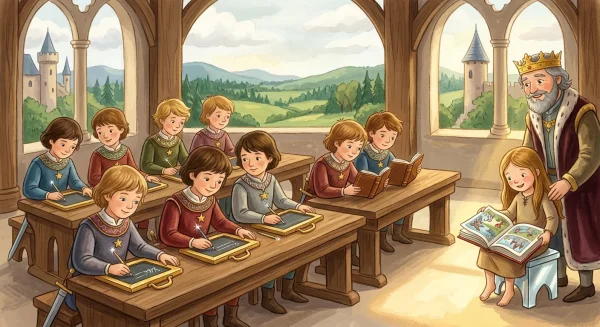
Far, far away, in the land where the swallows fly when it is winter here, there lived a king. He had eleven sons and one daughter, Eliza.
The eleven princes already went to school. Each wore a star on his chest and a sword at his side; they wrote on golden slates with diamond pencils, and they could read beautifully, from a book or by heart — it made no difference. You could tell at once that they were real princes! Their little sister Eliza sat on a little stool of mirror glass, looking at a picture book that had cost half a kingdom.
Yes, the children had a happy life — but not for long!
Their father, the king of that land, married a wicked queen who did not like the poor children at all. They found that out on the very first day. There was a feast at the palace, and the children wanted to play at having visitors; but instead of the cakes and baked apples they always had plenty of, their stepmother gave them a teacup full of sand and told them they could pretend it was a treat.
A week later she sent little Eliza away to the country to be brought up by some peasants, and before long she had told the king so many bad things about the poor princes that he did not want to see them any more.
"Fly away and look after yourselves!" said the wicked queen. "Fly off like great birds without a voice, and fend for yourselves!"
But she could not do them as much harm as she would have liked: they turned into eleven beautiful wild swans, flew out of the palace windows with a cry and swept away over the parks and woods.
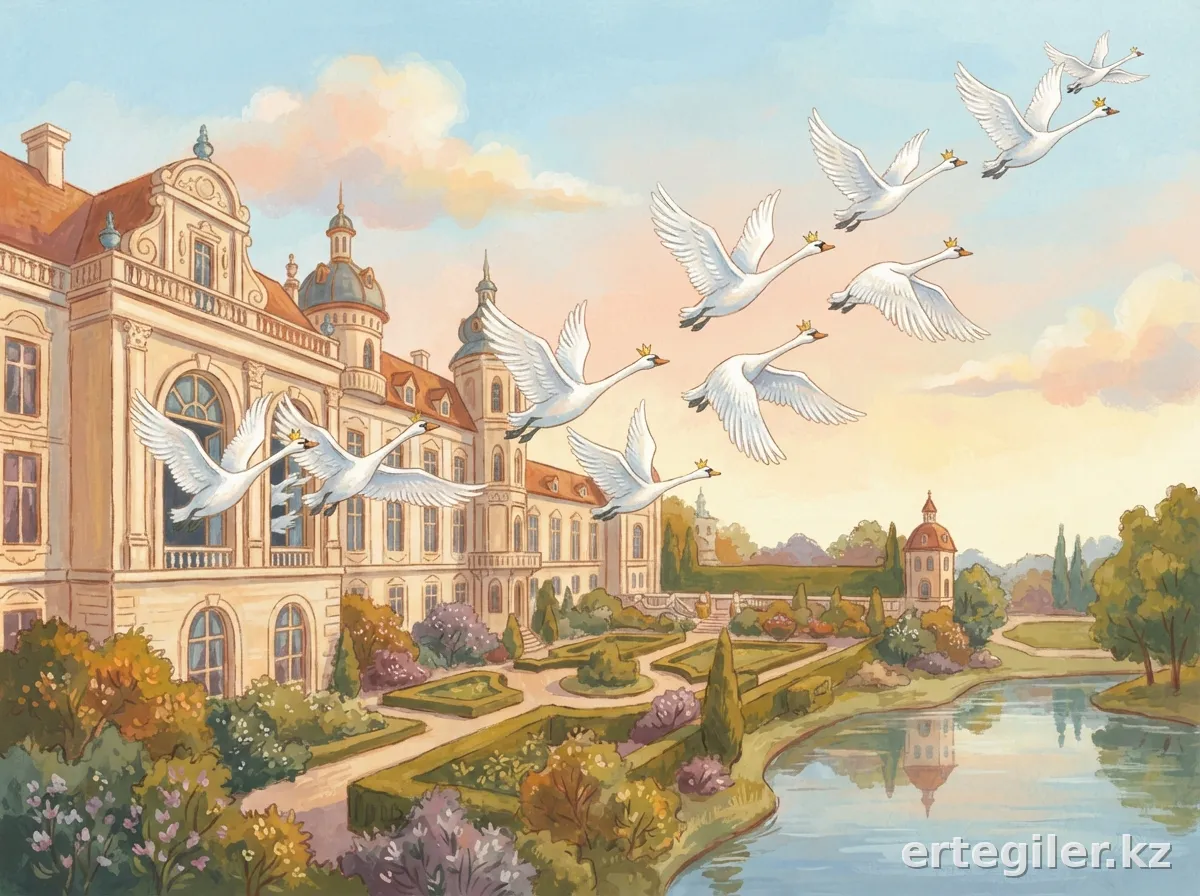
It was early morning when they flew past the cottage where their sister Eliza still lay fast asleep. They circled over the roof, stretching their long necks and beating their wings, but nobody heard or saw them, and so they had to fly away again. Up, up they soared, right to the clouds, and away to a great dark forest that stretched all the way to the sea.
Poor little Eliza stood in the peasants' cottage playing with a green leaf — she had no other toys. She poked a little hole in the leaf and looked through it at the sun, and it seemed to her that she could see her brothers' bright eyes; and whenever the warm sunbeams touched her cheek, she remembered their tender kisses.
The days went by, one just like another. When the wind rustled the rose bushes by the house and whispered to the roses, "Is anyone more beautiful than you?" the roses shook their heads and said, "Eliza is." When an old woman sat at her door on a Sunday reading her prayer book and the wind turned the pages and asked the book, "Is anyone more devout than you?" the book answered, "Eliza is!" And the roses and the prayer book both spoke the plain truth.
When Eliza turned fifteen, she was sent home. When the queen saw how lovely she was, she grew angry and hated her stepdaughter. She would gladly have turned her into a wild swan too, but she could not do it straight away, because the king wanted to see his daughter.
So early in the morning the queen went into the marble bathing room, which was furnished with beautiful carpets and soft cushions. She took three toads, kissed each one and said to the first:
"Sit on Eliza's head when she comes into the bath, so that she becomes as dull and lazy as you! And you sit on her forehead," she said to the second, "so that Eliza becomes as ugly as you, and her father won't know her! And you lie on her heart," the queen whispered to the third toad, "so that she becomes wicked and suffers for it!"
Then she put the toads into the clear water, which at once turned green. She called Eliza, undressed her and told her to step into the water. Eliza obeyed, and one toad sat on the crown of her head, another on her forehead and the third on her breast; but Eliza did not even notice. As soon as she stepped out of the water, three red poppies were floating on its surface. If the toads had not been poisoned by the witch's kiss, they would have turned into red roses from lying on Eliza's head and heart; the girl was so good and innocent that no magic could harm her.
When the wicked queen saw this, she rubbed Eliza with walnut juice until she was quite brown, smeared her pretty face with a foul-smelling ointment and tangled her lovely hair. Now nobody would have known the pretty Eliza. Even her father was frightened and said she was not his daughter. Nobody recognised her except the watchdog and the swallows — but who listens to poor dumb creatures?
Eliza wept and thought of her banished brothers. She slipped secretly out of the palace and walked all day across fields and marshes towards the forest. She did not really know where she ought to go, but she missed her brothers so much — they too had been driven from home — that she made up her mind to search for them everywhere until she found them.
She had not been in the forest long when night fell, and Eliza lost her way completely. So she lay down on the soft moss, said her evening prayer and laid her head on a tree stump. The forest was quiet, the air was warm, and hundreds of glow-worms twinkled in the grass like little green lights; when Eliza brushed a bush with her hand, they showered down into the grass like falling stars.
All night Eliza dreamed of her brothers. They were all children again, playing together, writing with their pencils on the golden slates and looking at the wonderful picture book that had cost half a kingdom. But they no longer wrote lines and noughts on the slates as before — no, they wrote down everything they had seen and done. All the pictures in the book were alive: the birds sang, and the people stepped out of the pages and talked to Eliza and her brothers; but whenever she wanted to turn a page, they jumped back in, so that the pictures would not get muddled.
When Eliza woke, the sun was already high. She could not see it properly through the thick leaves, but its rays slipped between the branches and danced like golden sparks on the grass. The green leaves smelled wonderful, and the birds almost perched on Eliza's shoulders. Nearby she could hear the splashing of water: several big streams flowed there into a pond with a lovely sandy bottom. The pond was surrounded by a thick hedge, but in one place the wild deer had broken a wide path through it, and Eliza was able to go right down to the water. The water was clean and clear; if the wind had not stirred the branches of the trees and bushes, you might have thought they were painted on the bottom, so clearly were they reflected in the mirror of the water.
When Eliza saw her face in the water, she was quite frightened, it was so dark and ugly. So she scooped up a handful of water and rubbed her eyes and forehead, and her fair, delicate skin shone again. Then Eliza undressed and stepped into the cool water. You could have searched the whole world and not found a lovelier princess!
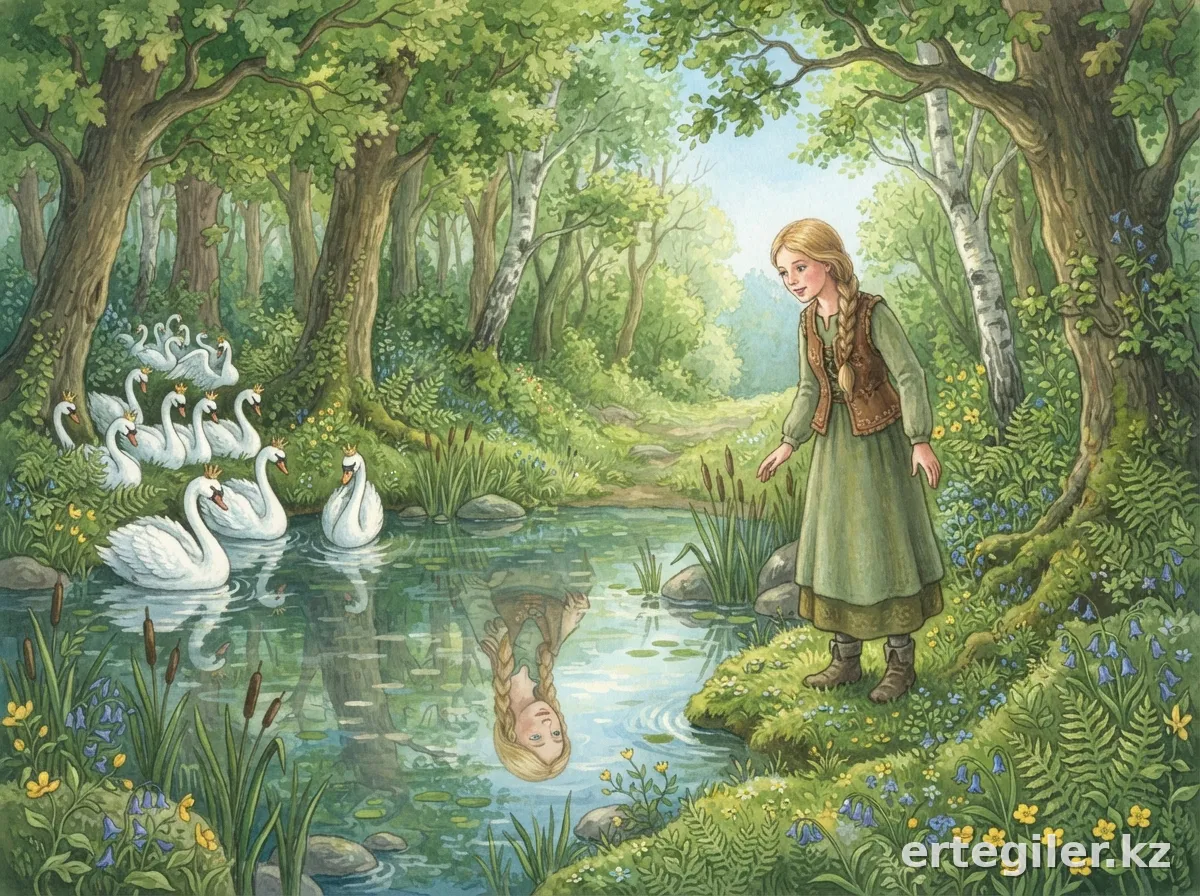
When she had dressed and plaited her long hair, she went to the bubbling spring, drank from her cupped hands and then wandered on through the forest, not knowing where she was going. She thought of her brothers and trusted that God would not forsake her: it was He who made the wild apples grow in the forest to feed the hungry, and He showed her one such apple tree whose branches were bent with the weight of its fruit. When she had eaten her fill, Eliza propped up the branches with sticks and went on into the very heart of the forest. It was so quiet there that Eliza could hear her own footsteps and the rustle of every dry leaf under her feet. Not a single bird flew into that wilderness, not a single sunbeam slipped through the thick roof of branches. The tall trunks stood in close rows like walls of logs. Eliza had never felt so lonely.
At night it grew darker still; not a single glow-worm shone in the moss. Sadly Eliza lay down on the grass, and suddenly it seemed to her that the branches above her parted and God Himself looked down at her with kind eyes, and little angels peeped out from behind His head and under His arms.
When she woke in the morning, she did not know whether it had been a dream or real.
Going on, Eliza met an old woman with a basket of berries. The old woman gave her a handful, and Eliza asked whether eleven princes had ridden through the forest.
"No," said the old woman, "but yesterday I saw eleven swans with golden crowns on the river here."
And the old woman led Eliza to a steep bank with a river flowing below it. Trees grew on both banks, stretching their long, leafy branches towards each other. Where a tree could not reach to twine its branches with those of its brothers on the other bank, it stretched out over the water so far that its roots came out of the ground — and still it got its way.
Eliza said goodbye to the old woman and walked along the river to where it flowed out into the open sea.
And there before the young girl lay the wonderful, endless sea. But on all its wide expanse not a sail could be seen, not a single boat in which she might go on her way. Eliza looked at the countless stones the sea had washed up on the shore: the water had worn them perfectly smooth and round. Everything else the sea had thrown up — glass, iron and stones — bore the marks of that polishing too, and yet the water was softer than Eliza's own gentle hands. And the girl thought: "The waves roll in one after another without ever tiring, and in the end they smooth even the hardest things. I too will work without tiring! Thank you for the lesson, bright, swift waves! My heart tells me that one day you will carry me to my dear brothers!"
On the dry seaweed washed up by the sea lay eleven white swan feathers. Eliza gathered them and tied them into a bunch; drops still glistened on them — dew or tears, who can say? The shore was lonely, but Eliza did not feel it: the sea was never the same from one moment to the next. In a few hours you could see more there than in a whole year on the shores of a quiet inland lake. When a big black cloud rolled across the sky and the wind grew stronger, the sea seemed to say, "I can turn black too!" and it began to churn and heave and was covered with white horses. But when the clouds were pink and the wind dropped, the sea looked like a rose petal. Sometimes it turned green, sometimes white; but however still the air and however calm the sea, there was always a gentle movement along the shore — the water rose and fell softly, like the breast of a sleeping child.
When the sun was about to set, Eliza saw a line of wild swans with golden crowns flying towards the shore. There were eleven swans, and they flew one behind another like a long white ribbon. Eliza climbed up the bank and hid behind a bush. The swans landed close by and flapped their great white wings.
The very moment the sun sank beneath the water, the swans' feathers fell away, and there on the ground stood eleven handsome princes — Eliza's brothers! Eliza cried out. She knew them at once, though they had changed a great deal; her heart told her it was them! She threw herself into their arms and called each of them by name, and how glad they were to see and recognise their little sister, who had grown so tall and so lovely! Eliza and her brothers laughed and cried, and soon they had told each other how cruelly their stepmother had treated them.
"We brothers," said the eldest, "fly as wild swans all day long, from sunrise to sunset; but when the sun goes down, we take our human shape again. So at sunset we must always have solid ground under our feet: if we turned into men while we were flying up among the clouds, we would fall from that terrible height. We don't live here. Far, far away across the sea lies a land as lovely as this one, but the way there is long. We have to fly across the whole sea, and there is not a single island on the way where we could spend the night. Only in the very middle of the sea a small lonely rock juts out, and there we can just about rest, huddled close together. When the sea is rough, the spray flies right over our heads, but we thank God even for such a shelter: without it we could never visit our dear homeland at all. Even so, we have to choose the two longest days of the year for the flight. We are allowed to come home only once a year. We can stay here for eleven days and fly over this great forest, from which we can see the palace where we were born and where our father lives, and the church tower where our mother lies at rest. Here even the bushes and trees seem like our own; here the wild horses we saw as children still run across the plains, and the charcoal burners still sing the songs we danced to when we were little. This is our homeland; our hearts draw us here — and here we have found you, our dear, darling little sister! We can stay two more days, and then we must fly away across the sea to a foreign land! How can we take you with us? We have neither ship nor boat!"
"How can I break the spell on you?" their sister asked.
They talked like that almost all night and slept for only a few hours.
Eliza was woken by the sound of swans' wings. Her brothers had turned into birds again and were flying round in great circles; then they vanished from sight. Only the youngest brother stayed with Eliza. The swan laid his head in her lap, and she stroked his feathers. They spent the whole day together; in the evening the others came back, and when the sun had set they all took their human shape again.
"Tomorrow we must fly away from here, and we can't come back until next year, but we won't leave you here!" said the youngest brother. "Have you the courage to fly with us? My arms are strong enough to carry you through the forest — surely all of us together can carry you across the sea on our wings?"
"Yes, take me with you!" said Eliza.
They spent the whole night weaving a net from pliant willow and rushes. The net was big and strong, and they laid Eliza in it. At sunrise the brothers turned into swans, seized the net in their beaks and soared up to the clouds with their dear sister, who was still fast asleep. The sun shone straight into her face, so one of the swans flew above her head and shaded her with his broad wings.
They were already far from land when Eliza woke. She thought she must be dreaming, it was so strange to be flying through the air. Beside her lay a branch of lovely ripe berries and a bunch of tasty roots. The youngest brother had gathered them and laid them there, and she smiled at him gratefully — she guessed it was he who was flying above her, shading her from the sun with his wings.
They flew so high that the first ship they saw on the sea looked like a seagull floating on the water. Behind them stood a great cloud — a real mountain! — and on it Eliza saw the gigantic moving shadows of the eleven swans and her own. What a sight that was! She had never seen anything like it! But as the sun rose higher and the cloud fell further and further behind, the shadows in the sky faded away.
All day the swans flew on like an arrow shot from a bow, but more slowly than usual, for now they were carrying their sister. Evening drew near, and the weather turned stormy. Eliza watched the sun sinking with fear in her heart; the lonely rock was still nowhere to be seen. It seemed to her that the swans were beating their wings harder and harder. Oh, it was her fault that they could not fly faster! When the sun set they would turn into men, fall into the sea and drown! And she prayed to God with all her heart, but still the rock did not appear. The black cloud came closer, strong gusts of wind warned of a storm, and the clouds gathered into one great threatening leaden wave rolling across the sky; flash after flash of lightning lit it up.
One edge of the sun was almost touching the water. Eliza's heart trembled. Suddenly the swans dived downwards so fast that she thought they were all falling — but no, they flew on again. The sun was half under the water when at last Eliza saw the rock below her, no bigger than a seal with its head out of the water. The sun was fading fast; now it looked like a small shining star. Then the swans set foot on solid ground, and the sun went out like the last spark of burnt paper. Eliza saw her brothers standing round her, arm in arm; there was barely room for them all on the tiny rock. The sea crashed furiously against it and drenched them with a shower of spray; the sky blazed with lightning, and the thunder rolled every minute. But the sister and brothers held hands and sang a hymn, which filled their hearts with comfort and courage.
At dawn the storm died down, and it was clear and calm again. At sunrise the swans flew on with Eliza. The sea was still rough, and from high above they watched the white foam floating on the dark green water like countless flocks of swans.
When the sun rose higher, Eliza saw ahead of her a mountainous land that seemed to float in the air, with masses of glittering ice on its cliffs. Among the cliffs rose a huge castle with bold, airy galleries of columns winding round it; below it palm forests swayed, and splendid flowers as big as millwheels. Eliza asked whether this was the land they were flying to, but the swans shook their heads: what she saw was the wonderful, ever-changing cloud castle of the fairy Morgana, and they dared not bring a single human soul there. Eliza gazed at the castle again, and the mountains, forests and castle all slid together and became twenty stately churches, all alike, with bell towers and pointed windows. She even thought she could hear an organ playing, but it was only the sound of the sea. Now the churches were quite close — but suddenly they turned into a whole fleet of ships. Eliza looked more closely and saw that it was only sea mist rising from the water. Yes, before her eyes were pictures in the air that changed and changed again! But at last the real land they were flying to came into sight. There were lovely mountains, cedar forests, towns and castles.
Long before sunset Eliza was sitting on a rock outside a big cave, which was so overgrown with delicate green creepers that it looked hung with embroidered green carpets.
"Let's see what you dream about here tonight!" said the youngest brother, and he showed his sister where she would sleep.
"Oh, if only I could dream how to break the spell on you!" she said, and she could think of nothing else.
Eliza prayed earnestly to God and went on praying even in her sleep. And she dreamed that she was flying high, high through the air to the castle of the fairy Morgana, and that the fairy herself came out to meet her, so bright and beautiful, and yet wonderfully like the old woman who had given Eliza berries in the forest and told her about the swans with golden crowns.
"Your brothers can be saved," she said. "But have you the courage and the strength? The water is softer than your gentle hands, and yet it smooths the stones; but it does not feel the pain your fingers will feel. The water has no heart to ache with fear and suffering as yours will. Do you see the nettles in my hand? Nettles like these grow here by the cave, and only these, and the nettles that grow in churchyards, will do for you — remember that! You must pick these nettles, though your hands will be covered with burning blisters. Then you must crush them with your feet and spin long threads from the fibre, and from the threads you must weave eleven shirts of mail with long sleeves and throw them over the swans; then the spell will be broken. But remember: from the moment you begin your work until you finish it, even if it takes years, you must not say a single word. The very first word that slips from your lips will pierce your brothers' hearts like a dagger. Their life and death will be in your hands! Remember all this!"
And the fairy touched Eliza's hand with the stinging nettle. Eliza felt a pain like a burn and woke up. It was already broad daylight, and beside her lay a bunch of nettles exactly like the ones she had just seen in her dream. She fell to her knees, thanked God and went out of the cave to begin her work at once.
With her tender hands she picked the cruel, stinging nettles, and her hands were covered with big blisters, but she bore the pain gladly — if only she could save her dear brothers! Then she crushed the nettles with her bare feet and began to spin the green fibre.
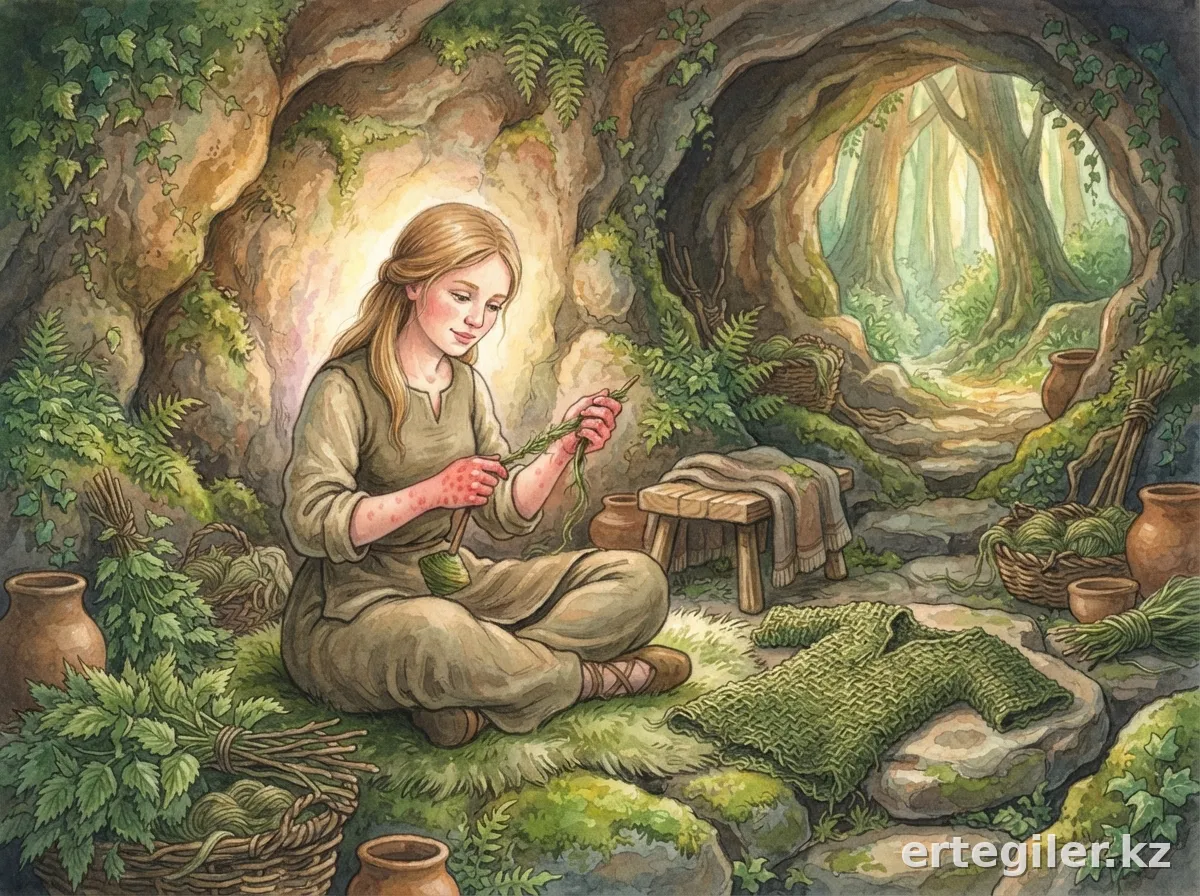
At sunset her brothers came back and were very frightened to find that she had become dumb. They thought it was some new spell of their wicked stepmother's; but when they saw her hands, they understood that she had fallen silent to save them. The youngest brother began to cry. His tears fell on her hands, and wherever a tear fell, the burning blisters vanished and the pain stopped.
Eliza spent the night at her work; she did not think of resting, only of how to free her dear brothers as soon as she could. All the next day, while the swans were away, she was all alone, yet time had never passed so quickly for her. One shirt of mail was finished, and she began the next.
Suddenly hunting horns sounded in the mountains. Eliza was frightened. The sound came nearer and nearer, and then she heard dogs barking. She hid in the cave, tied all the nettles she had gathered into a bundle and sat on it.
At that moment a big dog bounded out of the bushes, then another and a third; they barked loudly and ran to and fro. A few minutes later all the huntsmen had gathered at the cave. The handsomest of them was the king of that country. He came up to Eliza — never had he seen such a beautiful girl!
"How did you come here, lovely child?" he asked; but Eliza only shook her head. She dared not speak: her brothers' lives and their rescue depended on her silence. She hid her hands under her apron so that the king would not see how she was suffering.
"Come with me!" he said. "You can't stay here! If you are as good as you are beautiful, I will dress you in silk and velvet, put a golden crown on your head, and you shall live in my splendid palace!" And he lifted her onto his saddle in front of him. Eliza wept and wrung her hands, but the king said, "I only want you to be happy. One day you will thank me for this!"
And he carried her off over the mountains, with the huntsmen galloping behind.
Towards evening the king's magnificent capital came into view, with its churches and domes, and the king led Eliza into his palace, where fountains splashed in high marble halls and the walls and ceilings were covered with paintings. But Eliza looked at nothing; she only wept and grieved. She let the maids do as they wished with her, and they dressed her in royal robes, wove strings of pearls into her hair and drew fine gloves over her burnt fingers.
The rich clothes suited her so well, and she looked so dazzlingly lovely in them, that the whole court bowed before her, and the king proclaimed her his bride — though the archbishop shook his head and whispered to the king that the beautiful girl from the forest must be a witch who had cast a spell over everyone's eyes and bewitched the king's heart.
But the king would not listen. He signalled to the musicians, ordered the loveliest dancers to be brought in and costly dishes to be served, and he himself led Eliza through fragrant gardens into splendid rooms. Still she remained sad and sorrowful. Then the king opened the door of a little room right next to her bedroom. It was hung all over with green carpets and looked just like the cave in the forest where she had been found. On the floor lay the bundle of nettle fibre, and from the ceiling hung the shirt of mail Eliza had woven; one of the huntsmen had brought it all back from the forest as a curiosity.
"Here you can think of your old home," said the king. "And here is your work. Perhaps among all this splendour you will sometimes like to amuse yourself with memories of the past!"
When Eliza saw the work so dear to her heart, she smiled and blushed. She thought of saving her brothers and kissed the king's hand, and he pressed her to his heart and ordered all the bells to be rung for the wedding. The silent girl from the forest became queen.
The archbishop went on whispering evil words to the king, but they did not reach his heart, and the wedding took place. The archbishop himself had to put the crown on the bride's head; out of spite he pressed the narrow golden band down so tightly on her forehead that it would have hurt anyone. But she did not even notice: what was bodily pain to her, when her heart ached with longing and pity for her dear brothers! Her lips stayed closed, not a single word escaped them — she knew her brothers' lives depended on her silence — but in her eyes shone a warm love for the good, handsome king who did everything he could to make her happy. Every day she grew fonder of him. Oh, if only she could have trusted him and told him of her suffering! But alas, she had to be silent until her work was done. At night she would slip quietly out of the royal bedroom into her secret little room that looked like a cave, and there she wove one shirt of mail after another. But when she started on the seventh, she ran out of fibre.
She knew she could find the right nettles in the churchyard, but she had to pick them herself. What was she to do?
"Oh, what is bodily pain compared with the sorrow that tears at my heart!" thought Eliza. "I must be brave! God will not forsake me!"
Her heart shrank with fear, as if she were going to do something wrong, as she crept out into the garden on a moonlit night, and from there along the long avenues and empty streets to the churchyard. On the broad gravestones sat hideous witches. They had thrown off their rags as if they were going bathing and were digging up the fresh graves with their bony fingers, doing dreadful things. Eliza had to walk right past them, and they glared at her with their wicked eyes — but she said a prayer, gathered the nettles and went home.
Only one person was awake that night and saw her: the archbishop. Now he was sure he had been right to suspect the queen. So she was a witch, and that was how she had bewitched the king and all the people!
When the king came to him for confession, the archbishop told him what he had seen and what he suspected. Evil words poured from his tongue, and the carved figures of the saints shook their heads as if to say, "It isn't true — Eliza is innocent!" But the archbishop explained it his own way, saying that even the saints were bearing witness against her by shaking their heads in disapproval. Two big tears rolled down the king's cheeks, and doubt and despair filled his heart. That night he only pretended to sleep; in truth sleep would not come. And he saw Eliza get up and slip out of the bedroom. The same thing happened the next night and the next; he followed her and saw her vanish into her secret little room.
The king's face grew darker and darker. Eliza saw it but did not understand why; her heart ached with fear and with pity for her brothers. Bitter tears ran down onto the royal purple and glittered like diamonds, and the people who saw her rich clothes wished they were in the queen's place! But soon, very soon, her work would be done; only one shirt was missing — and then Eliza ran out of fibre again. Once more, for the last time, she had to go to the churchyard and pick a few handfuls of nettles. She thought with horror of the lonely churchyard and the dreadful witches, but her resolve to save her brothers was as firm as her faith in God.
Eliza went. But the king and the archbishop were watching her and saw her disappear through the churchyard gate. When they came closer, they saw the witches sitting on the gravestones, and the king turned back: for among those witches, he thought, was the very one whose head had just been resting on his breast!
"Let the people judge her!" he said.
And the people sentenced the queen to be burned at the stake.
Eliza was taken from the splendid royal rooms to a gloomy, damp dungeon with iron bars on the windows, through which the wind whistled. Instead of velvet and silk they gave the poor girl the bundle of nettles she had gathered in the churchyard: that stinging bundle was to be her pillow, and the hard shirts of mail she had woven were to be her bed and blankets. But they could have given her nothing more precious, and with a prayer on her lips she went back to her work. From the street she could hear the jeering songs of the boys who mocked her; not a single living soul spoke a word of comfort or kindness to her.
In the evening there was a sound of swans' wings at the bars — it was the youngest brother, who had found his sister. She sobbed aloud for joy, though she knew she had only one night left to live; for her work was almost finished, and her brothers were near!
The archbishop came to spend her last hours with her — he had promised the king he would — but she shook her head and begged him with her eyes and gestures to go away. That night she had to finish her work, or else all her suffering and tears and sleepless nights would have been for nothing! The archbishop went away cursing her, but poor Eliza knew she was innocent and went on working.
To help her a little, the mice that scurried about the floor gathered up the scattered nettle stalks and brought them to her feet, and a thrush sitting outside the barred window cheered her with its merry song.
At dawn, shortly before sunrise, Eliza's eleven brothers appeared at the palace gate and demanded to see the king. They were told that this was quite impossible: the king was still asleep, and nobody dared to disturb him. They went on pleading, and then began to threaten; the guards came, and then the king himself came out to see what was the matter. But at that moment the sun rose, and the brothers were gone — eleven wild swans soared up over the palace.
The people streamed out of the town in crowds to watch the witch being burned. A wretched old nag pulled the cart in which Eliza sat. She had been dressed in a cloak of coarse sacking; her lovely long hair hung loose over her shoulders, there was not a drop of colour in her face, her lips moved softly in prayer, and her fingers were weaving the green yarn. Even on the way to her death she did not put down her work; ten shirts of mail lay finished at her feet, and she was weaving the eleventh. The crowd jeered at her.
"Look at the witch! Listen to her muttering! That's no prayer book in her hands — no, she's still busy with her witchcraft! Let's snatch it from her and tear it to shreds!"
And they pressed round her, ready to tear the work from her hands — when suddenly eleven white swans flew down, settled on the sides of the cart and beat their mighty wings. The frightened crowd drew back.
"It's a sign from heaven! She's innocent!" many whispered, but they dared not say it aloud.
The executioner seized Eliza by the hand, but she quickly threw the eleven shirts over the swans, and… there before her stood eleven handsome princes. Only the youngest had a swan's wing instead of one arm: Eliza had not had time to finish the last shirt, and one sleeve was missing.
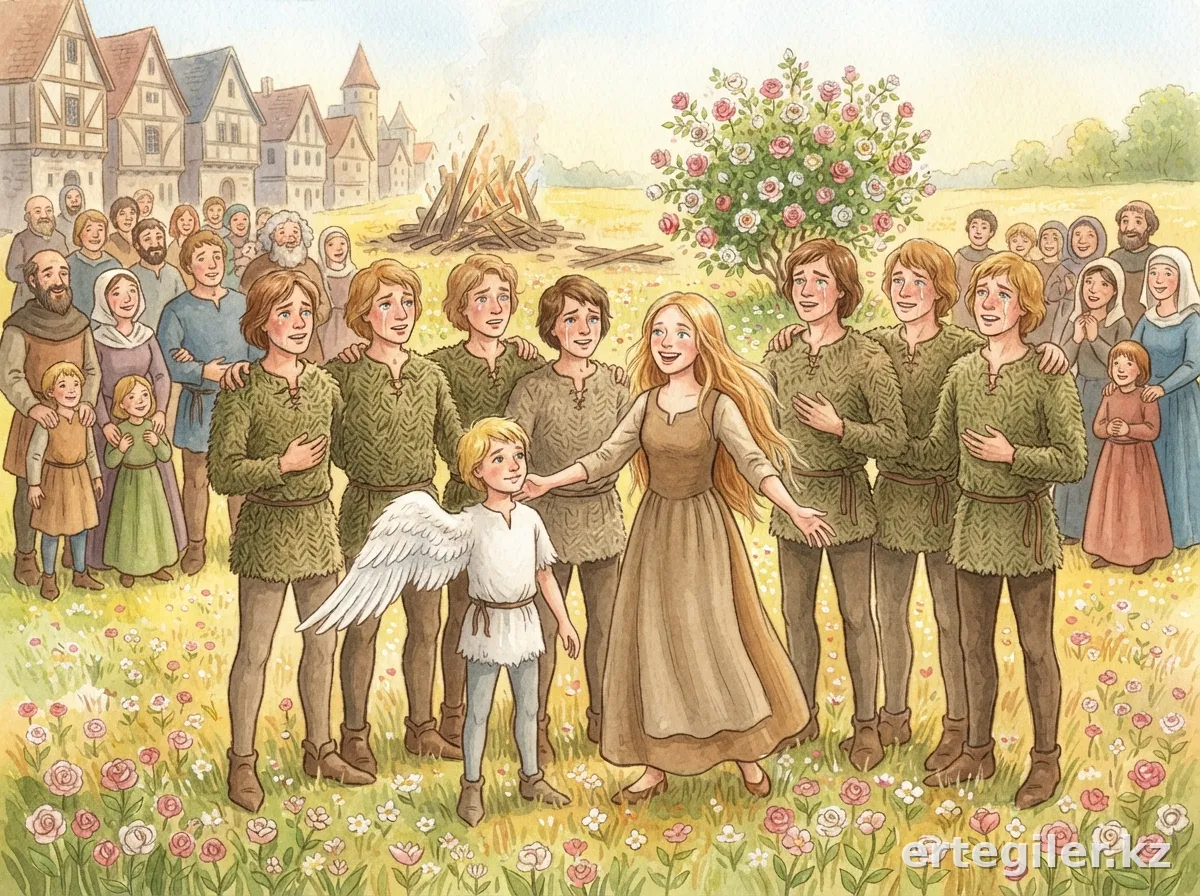
"Now I may speak!" she said. "I am innocent!"
And the people, who had seen everything, bowed down before her as if she were a saint; but she fell fainting into her brothers' arms — so worn out was she by all her labour, fear and pain.
"Yes, she is innocent!" said the eldest brother, and he told them everything just as it had happened. And while he was speaking, a fragrance spread through the air as if from a thousand roses: every stick of wood in the pyre had put out roots and shoots and grown into a tall, sweet-smelling hedge covered with red roses. And right at the top of it, shining like a star, was a dazzling white flower. The king picked it and laid it on Eliza's breast, and she came to herself, full of joy and happiness!
All the church bells began to ring of their own accord, birds came flying in great flocks, and such a wedding procession made its way back to the palace as no king had ever seen before!
Well done! The story is over!
You reached the end of the story. Great job!









Every day at 8:30 pm we'll send one bedtime tale. Just one notification a day.
On iPhone: tap Share → Add to Home Screen, open the site from that icon and turn it on here.
Done! Look out for a tale this evening 🌙
Something went wrong. Please try again later.
5 stories with your name and your picture. Show your parents!
For parents: a tale about your child for 390 ₸ — a trial week of Premium →Hans Christian Andersen 12 people viewed

iPhone and Android app
All the tales, right on your phone
Read and listen at home or on the road. Free, with no ads.
- Audio tales keep playing with the screen off
- Pick up reading exactly where you stopped
- Find tales by age and by whether they have audio
- Night background and a comfortable text size

Sign in to keep reading
Today's free tales are over — 3 more are available tomorrow. Sign in with Google to continue — it is free and takes a second.
Sign in with GoogleHave an Android phone? In the app all tales are open without signing in.
Have an iPhone? In the app all tales are open without signing in.
Read in the app
Пікір қалдыру (0 пікір бар)
Әзірге пікір ешкім қалдырмаған!
Пікір қалдыру