
In China, as you know, the emperor is Chinese, and so are all his subjects. This happened long ago, and that is exactly why it is worth hearing before it is quite forgotten! There was no finer palace in the whole world than the emperor's. It was made entirely of precious porcelain, but it was so fragile that you were afraid to touch it. The most wonderful flowers grew in the garden, and the loveliest of them had little silver bells tied to them, so that their tinkling would make every passer-by notice the flowers. That was how cleverly it was all thought out! The garden stretched so far, far away that even the gardener did not know where it ended. From the garden you could walk straight into a thick forest; deep lakes lay hidden in it, and it went all the way down to the deep blue sea. Ships sailed beneath the treetops that hung over the water, and in their branches lived a nightingale that sang so beautifully that even the poor fisherman, weighed down with cares, would stop and listen and forget his nets. "Heavens, how lovely!" the fisherman would say at last, but then the poor man would go back to his work and forget about the nightingale; and the next night he would listen to it again and say the very same thing: "Heavens, how lovely!"
Travellers came from every corner of the world to the emperor's capital. They all marvelled at the magnificent palace and the garden, but when they heard the nightingale they said, "That is the best of all!"
When they got home, the travellers told about everything they had seen. Learned men wrote books about the capital, the palace and the emperor's garden, but they never forgot to mention the nightingale, and they even placed it above everything else; and poets wrote the most beautiful poems about the winged singer who lived in the forest on the shore of the deep blue sea.
The books went all over the world, and some of them reached the emperor himself. He sat in his golden chair and read and read, nodding his head every minute — he was very pleased to read such praise of his capital, his palace and his garden. "But the nightingale is the best of all!" it said in the book.
"What's this?" said the emperor in surprise. "A nightingale? I don't even know it! How can it be? Such a remarkable bird lives in my empire, even in my own garden, and I have never heard of it! I had to read about it in a book!"
And he sent for his First Lord-in-Waiting, who was so grand that whenever anyone of lower rank dared to speak to him or ask him something, he only answered "Pf!" — which means nothing at all.
"It seems we have a remarkable bird here called a nightingale. They say it is the greatest wonder of my great empire!" said the emperor. "Why has nobody ever told me about it?"
"I have never even heard of it!" answered the First Lord-in-Waiting. "It has never been presented at court!"
"I wish it to come here and sing for me this very evening!" said the emperor. "The whole world knows what I have, and I don't know it myself!"
"I have never heard of such a bird!" repeated the First Lord-in-Waiting. "But I shall find it!"
That was easy to say! But where was he to find it?
The emperor's First Lord-in-Waiting ran up and down stairs, through halls and corridors, but nobody he met and asked had ever heard of the nightingale. The First Lord-in-Waiting went back to the emperor and reported that the nightingale must have been invented by the people who write books.
"Your Majesty must not believe everything that is written in books: it is all made up — black magic, so to speak!.."
"But this book was sent to me by the mighty Emperor of Japan himself, so there can be nothing untrue in it! I want to hear the nightingale! It must be here this very evening! I grant it my most gracious favour! And if it is not here at the appointed time, I shall have every courtier thumped on the stomach after supper!"
"Tsing-pe!" said the First Lord-in-Waiting, and off he ran again, up and down the stairs, through the corridors and halls; and half the court ran with him, for nobody wanted to be thumped. Everyone was asking the same question: what was this nightingale that the whole world knew about, but not a single soul at court?
At last, in the kitchen, they found a poor little girl who said:
"Oh goodness! Of course I know the nightingale! How it sings! In the evenings I'm allowed to take the scraps from the table to my poor sick mother. She lives right by the sea, and on my way back, when I sit down to rest in the forest, I always hear the nightingale sing! The tears come into my eyes, and I feel as happy as if my mother were kissing me!.."
"Little kitchen maid!" said the emperor's First Lord-in-Waiting. "I will get you a permanent position in the kitchen and permission to watch the emperor eat his dinner if you will take us to the nightingale! It is invited to court this evening!"
So they all set off for the forest where the nightingale usually sang; nearly half the court went along. On and on they went, and suddenly a cow began to moo.
"Oh!" said the young courtiers. "There it is! What power! And from such a tiny creature! We have certainly heard it before!"
"That's a cow mooing!" said the girl. "We've still a long way to go."
Then the frogs began to croak in a pond.
"Lovely!" said the court chaplain. "Now I hear it! Just like our little temple bells!"
"No, those are frogs!" said the girl again. "But I think we'll hear it soon now!"
And then the nightingale began to sing.
"That's the nightingale!" said the girl. "Listen, listen! And there it is!" And she pointed to a little grey bird sitting up in the branches.
"Is it possible!" said the emperor's First Lord-in-Waiting. "I never imagined it would look like that! How very plain it is! It must have lost all its colour at the sight of so many distinguished people!"
"Little nightingale!" the girl called out loudly. "Our gracious emperor would like you to sing for him!"
"With the greatest pleasure!" answered the nightingale, and it sang so that it was a joy to hear.
"Just like little glass bells!" said the First Lord-in-Waiting. "Look how its little throat trembles! It's strange that we've never heard it before! It will be a great success at court!"
"Shall I sing once more for the emperor?" asked the nightingale. It thought the emperor was there too.
"Incomparable little nightingale!" said the emperor's First Lord-in-Waiting. "I have the pleasant task of inviting you to a court festival this evening. I have no doubt you will enchant His Majesty with your wonderful singing!"
"My song sounds much better in the green forest!" said the nightingale; but when it heard that the emperor had invited it to the palace, it gladly agreed to go.
At court everything was being made ready for the festival. The light of countless golden lanterns gleamed in the porcelain walls and floors; the corridors were lined with the loveliest flowers with little bells, which, with all the running and bustle and the draughts, tinkled so loudly that you could not hear yourself speak. In the middle of the great hall where the emperor sat stood a golden perch for the nightingale. The whole court was there, and the little kitchen maid was allowed to stand by the door — for now she had been given the title of Court Cook. Everyone was dressed in their very best, and they could not take their eyes off the little grey bird, to whom the emperor graciously nodded.
And the nightingale sang so beautifully that tears came into the emperor's eyes and rolled down his cheeks. Then the nightingale sang even louder and sweeter; its song went straight to the heart. The emperor was so pleased that he said the nightingale should wear his golden slipper round its neck. But the nightingale thanked him and declined, saying it had been rewarded enough already.
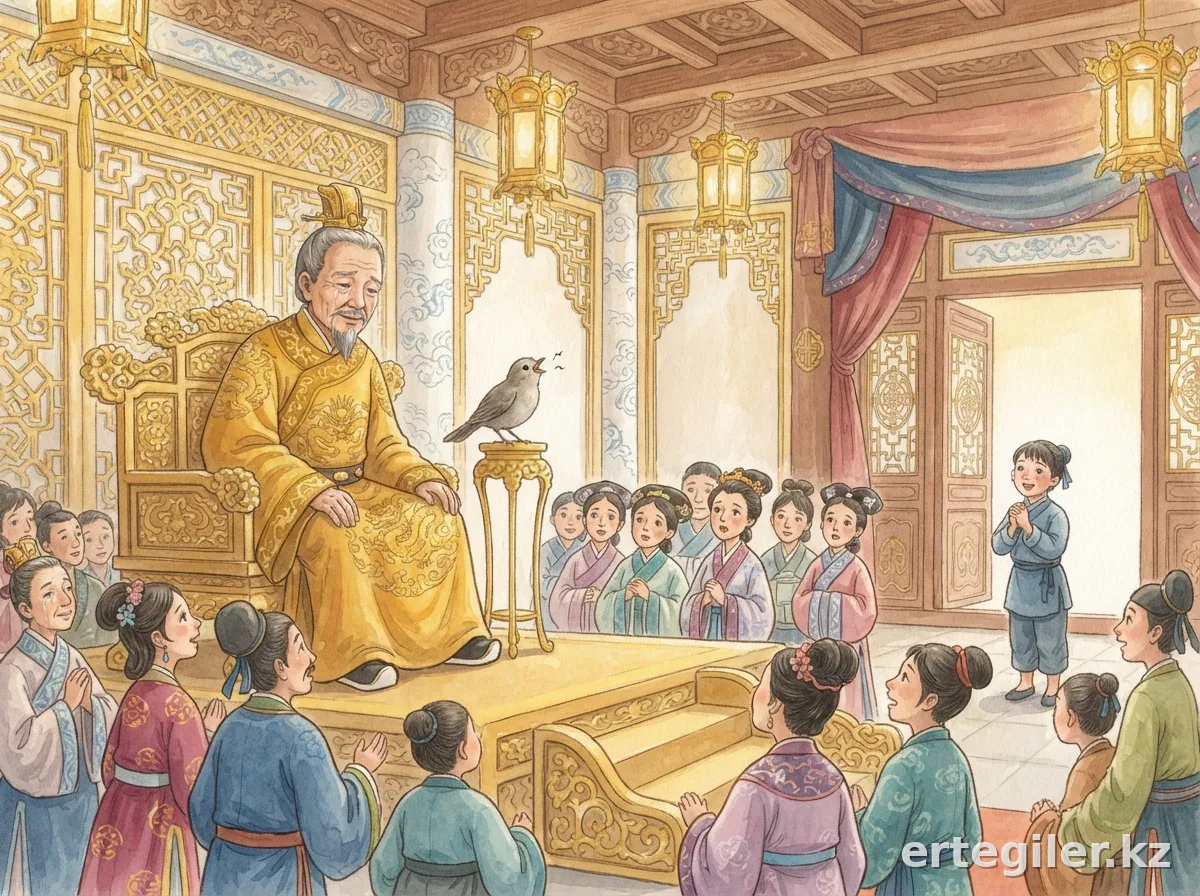
"I have seen tears in the emperor's eyes — what greater reward could I wish for! An emperor's tears have a wonderful power! Heaven knows I have been rewarded more than enough!"
And its sweet, wonderful voice rang out again.
"What charming coquetry!" said the court ladies, and they began taking water into their mouths so that it would gurgle in their throats when they spoke to anyone. They thought that would make them like the nightingale. Even the footmen and chambermaids declared they were very pleased, and that is saying a great deal, for everyone knows they are the hardest people of all to please. Yes, the nightingale was a real success.
It was to stay at court and have a little room of its own; it was allowed to go out twice a day and once at night, with twelve servants to attend it, each holding on to a silk ribbon tied to its leg. There was not much pleasure in a walk like that!
The whole town talked about the wonderful bird, and whenever two acquaintances met in the street, one would say "Nightin-", and the other would answer "-gale", and then they would both sigh, understanding each other perfectly.
Eleven shopkeepers' sons were named after the nightingale, but not one of them could sing a note.
One day a big parcel was delivered to the emperor, with "Nightingale" written on it.
"Well, here is another new book about our famous bird!" said the emperor.
But it was not a book. It was a clever little thing: in a box lay an artificial nightingale that looked like the real one, but was covered all over with diamonds, rubies and sapphires. As soon as you wound it up, it sang one of the real nightingale's songs and wagged its tail, which glittered with gold and silver. Round its neck hung a ribbon that said: "The Emperor of Japan's nightingale is a poor thing compared with the nightingale of the Emperor of China."
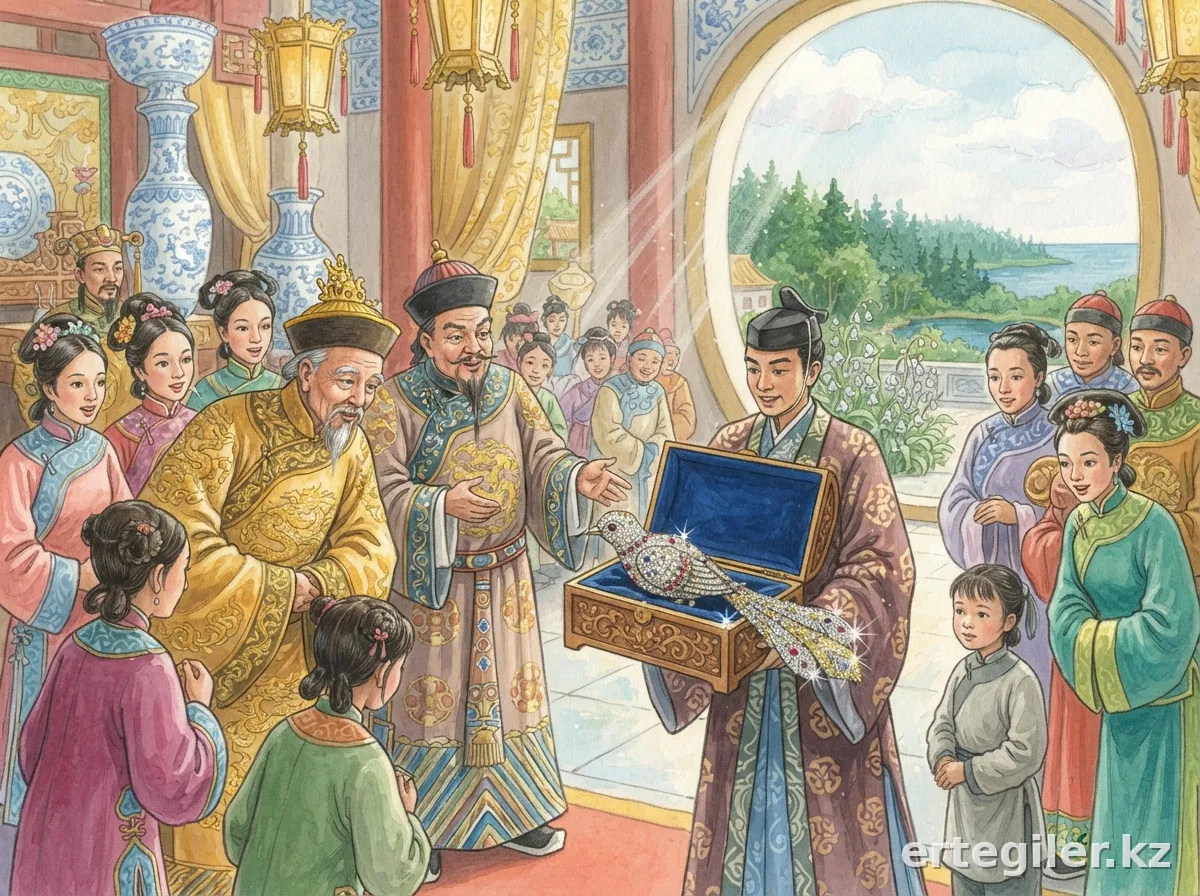
"How lovely!" said all the courtiers, and the messenger who had brought the bird from the Emperor of Japan was at once given the title of Imperial Nightingale-Bringer-in-Chief.
"Now let them sing together — what a duet that will be!"
But it did not go well: the real nightingale sang in its own way, and the artificial one sang like a wound-up barrel organ.
"It's not the new bird's fault!" said the court music master. "It keeps perfect time and sings exactly according to my method."
So the artificial nightingale was made to sing alone. It was just as great a success as the real one, and it was much prettier to look at — it sparkled all over with jewels!
Thirty-three times it sang the same tune, and it never got tired. Everyone would gladly have heard it once more, but the emperor thought the living nightingale should sing something too. But where had it gone?
Nobody had noticed it fly out of the open window and away to its green forest.
"What is the meaning of this?" said the emperor, upset, and the courtiers called the nightingale an ungrateful creature.
"Well, we've still got the best bird!" they said, and the artificial nightingale had to sing the same tune for the thirty-fourth time.
Still, nobody had managed to learn the tune by heart, it was so difficult. The music master praised the artificial bird and declared that it was better than the real one, not only for its fine feathers and diamonds, but for what was inside it too.
"For you see, my noble lord and gracious ladies and gentlemen, with the living nightingale you can never tell beforehand what it is going to sing, but with the artificial one everything is settled in advance! You can account for everything it does; you can open it up and show its whole inner workings — the fruit of human reason — how the cylinders are placed and how they turn, everything, everything!"
"That is exactly what I think!" said every one of them, and the music master was given permission to show the bird to the people the very next Sunday.
"The people must hear it too!" said the emperor.
The people heard it and were as pleased as if they had drunk their fill of tea — which is a very Chinese thing to be. Everyone said "Oh!" with delight, held up their forefingers and nodded. But the poor fishermen who had heard the real nightingale said:
"It's not bad, and it's quite like it, but it's still not the same! Something is missing from its song, but we can't say what!"
The living nightingale was banished from the empire.
The artificial bird was given a place on a silk cushion beside the emperor's bed. All the jewels it had been given were laid out round it. Its title now was "First Imperial Bedside Singer on the Left" — for the emperor considered the side where the heart is to be the more important, and the heart is on the left even in an emperor. The music master wrote twenty-five volumes about the artificial nightingale, very learned indeed and full of the most difficult Chinese words.
The courtiers all said they had read and understood every word, for otherwise they would have been called fools and thumped on the stomach.
So a whole year went by. The emperor, the court and all the people knew every note of the artificial nightingale's song by heart, and that was exactly why they liked it so much: now they could sing along with it themselves. The street boys sang "Tsee-tsee-tsee! Kluk-kluk-kluk!" and the emperor sang it too. Oh, it was delightful!
But one evening, just as the artificial bird was singing its best for the emperor as he lay in bed, something inside it went "whizz!", something buzzed, all the wheels spun round, and the music stopped.
The emperor jumped out of bed and sent for his court physician, but what could he do? Then they sent for a watchmaker, and after a great deal of talking and examining he managed to mend the bird after a fashion, but he said it must be handled very carefully: the little cogs were worn, and it was impossible to put in new ones so that the music would play as before. What a sorrow! The bird could only be wound up once a year. It was very sad, but the music master made a short speech, full of difficult words, proving that the bird was not a bit worse than before. So of course it wasn't.
Five more years went by, and a great sorrow fell upon the land: everyone loved the emperor, and now, people said, he was dying. A new emperor had already been proclaimed, but the people crowded in the street and asked the First Lord-in-Waiting how their old ruler was.
"Pf!" said the First Lord-in-Waiting, and shook his head.
Cold and pale, the emperor lay in his magnificent bed; the whole court thought he was dead, and everyone hurried off to pay their respects to the new emperor. The footmen ran to and fro, passing on the news, and the chambermaids spent a pleasant time chatting over cups of tea. Carpets had been laid in all the halls and corridors so that no footsteps could be heard, and the palace was deathly still. But the emperor was not dead yet, although he lay quite still and deathly pale in his magnificent bed under a velvet canopy with golden tassels. Through the open window the bright moon shone down on the emperor and the artificial nightingale.
The poor emperor could hardly breathe; he felt as if someone were sitting on his chest. He opened his eyes a little and saw that it was Death sitting on his chest. Death had put on the emperor's crown, and held his golden sword in one hand and his splendid banner in the other. Strange faces peered out from the folds of the velvet canopy: some ugly and horrible, others kind and gentle. They were the emperor's bad deeds and good deeds, looking at him while Death sat on his chest.
"Do you remember this?" they whispered one after another. "Do you remember that?" And they told him so much that cold sweat stood on his forehead.
"I never knew that!" said the emperor. "Music, bring music! The great Chinese drums! I don't want to hear what they're saying!"
But they went on and on, and Death nodded at everything they said, the way the Chinese do.
"Music, bring music!" cried the emperor. "You sing, at least, my dear, precious golden bird! I gave you gold and jewels, I hung my golden slipper round your neck — sing, sing!"
But the bird was silent; there was nobody to wind it up, and without that it could not sing. Death went on staring at the emperor with its great empty eye sockets. The room was very, very still.
Suddenly a wonderful song rang out just outside the window. It was the living nightingale, which had heard that the emperor was ill and had come to comfort him and give him hope. As it sang, the ghostly faces grew paler and paler, and the blood flowed faster and faster to the emperor's heart; even Death listened to the nightingale and kept saying, "Sing, sing on, little nightingale!"
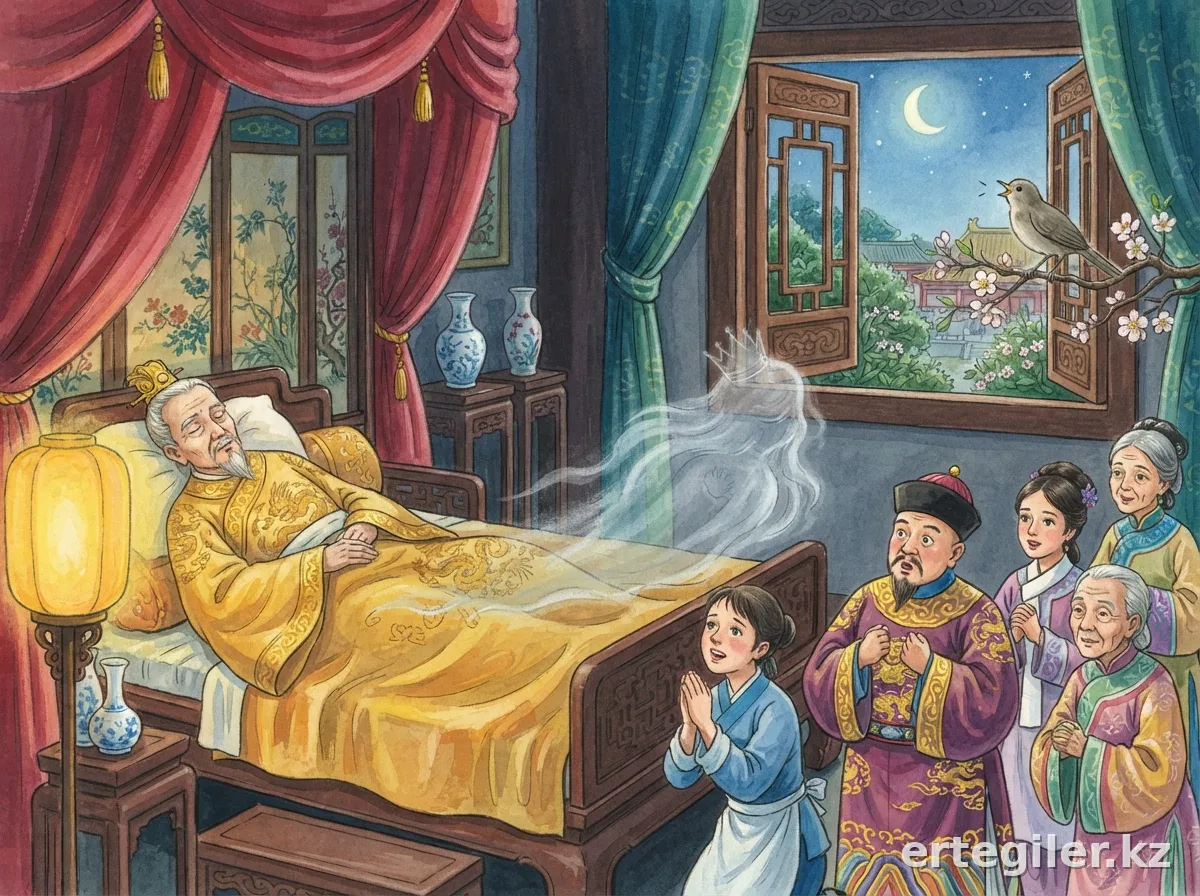
"Will you give me the precious sword for it? And the splendid banner? And the crown?" asked the nightingale.
And Death gave up one treasure after another, and the nightingale sang on. At last it sang about the quiet churchyard where white roses bloom, where the elder tree smells sweet, and where the fresh grass is watered by the tears of those who mourn the dead… Then Death was filled with such a longing for its own garden that it drifted out of the window like a cold white mist.
"Thank you, thank you, dear little bird!" said the emperor. "I remember you! I banished you from my empire, and yet you have driven those dreadful faces from my bed — you have driven away Death itself! How can I reward you?"
"You have rewarded me once and for all!" said the nightingale. "I saw tears in your eyes the first time I sang for you — I shall never forget that! Tears are the most precious reward a singer's heart can have. But sleep now, and wake up well and strong! I will sing you to sleep!"
And it sang again, and the emperor fell into a sweet, healing sleep.
When he woke, the sun was shining through the windows. None of his servants had come to see him; they all thought he was dead. Only the nightingale sat by the window, singing.
"You must stay with me for ever!" said the emperor. "You shall sing only when you want to, and I will smash the artificial bird to pieces!"
"Don't do that!" said the nightingale. "It did all the good it could! Keep it as before! But I cannot live in a palace. Only let me come to you whenever I like. Then I will sit by your window every evening and sing to you; my song will make you glad and make you think. I will sing to you of those who are happy and those who suffer, of the good and the evil that are hidden all around you.
"A little songbird flies everywhere — to the roof of the poor fisherman and the farmer, who live far away from you. I love your heart more than your crown, and yet there is something special and sacred about a crown! I will come and sing to you! But you must promise me one thing!.."
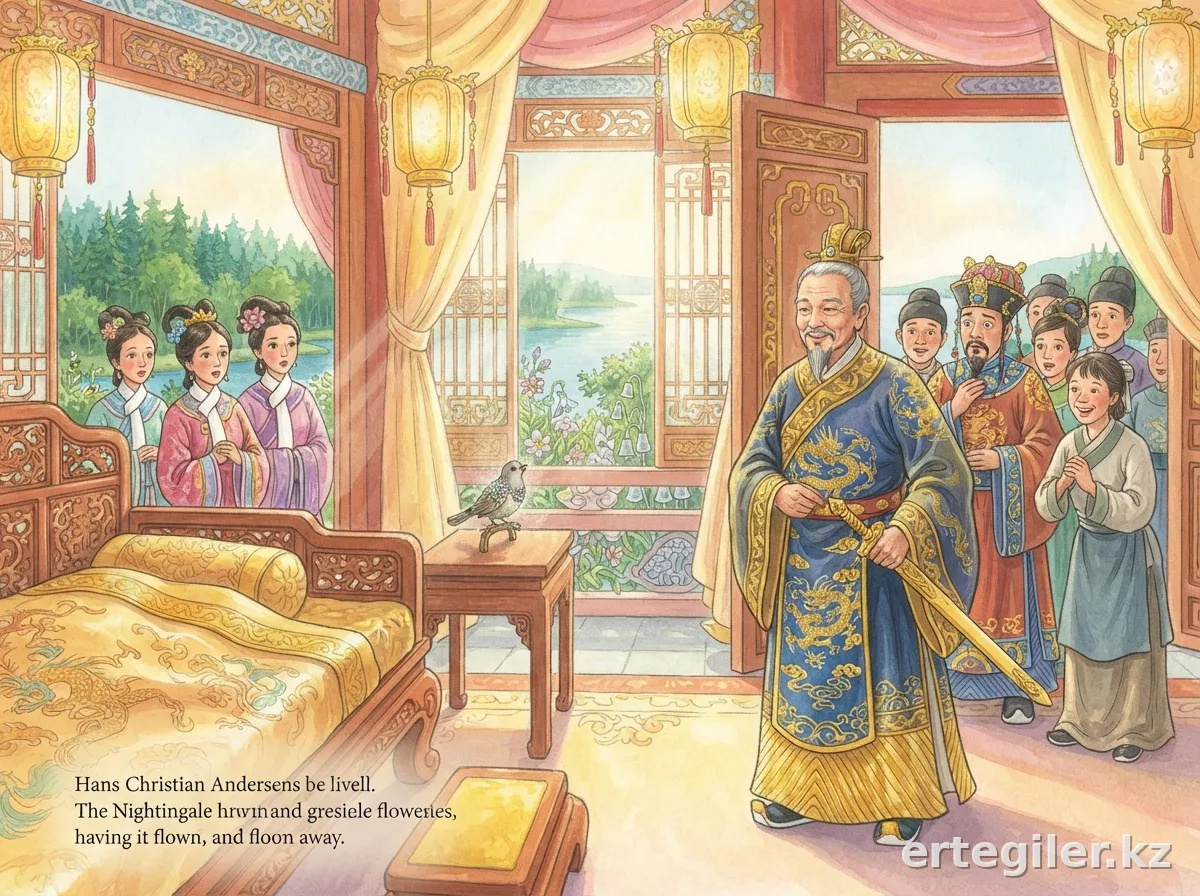
"Anything!" said the emperor, and he stood up in all his royal splendour; he had already put on his imperial robes, and he was pressing the heavy golden sword to his heart.
"I ask only one thing of you — don't tell anyone that you have a little bird who tells you everything. It will be better that way!"
And the nightingale flew away.
The servants came in to look at their dead emperor — and stopped short in the doorway, and the emperor said to them:
"Good morning!"
Well done! The story is over!
You reached the end of the story. Great job!












Every day at 8:30 pm we'll send one bedtime tale. Just one notification a day.
On iPhone: tap Share → Add to Home Screen, open the site from that icon and turn it on here.
Done! Look out for a tale this evening 🌙
Something went wrong. Please try again later.
5 stories with your name and your picture. Show your parents!
For parents: a tale about your child for 390 ₸ — a trial week of Premium →Hans Christian Andersen 13 people viewed

iPhone and Android app
All the tales, right on your phone
Read and listen at home or on the road. Free, with no ads.
- Audio tales keep playing with the screen off
- Pick up reading exactly where you stopped
- Find tales by age and by whether they have audio
- Night background and a comfortable text size

Sign in to keep reading
Today's free tales are over — 3 more are available tomorrow. Sign in with Google to continue — it is free and takes a second.
Sign in with GoogleHave an Android phone? In the app all tales are open without signing in.
Have an iPhone? In the app all tales are open without signing in.
Read in the app
Пікір қалдыру (0 пікір бар)
Әзірге пікір ешкім қалдырмаған!
Пікір қалдыру