The Vizier's Son
Kazakh folk tales
How was the narration?
Thank you! This helps us make the narration better.
You listened to 30 seconds for free
Sign in to keep listening
Sign in with Google to listen to full fairy tales
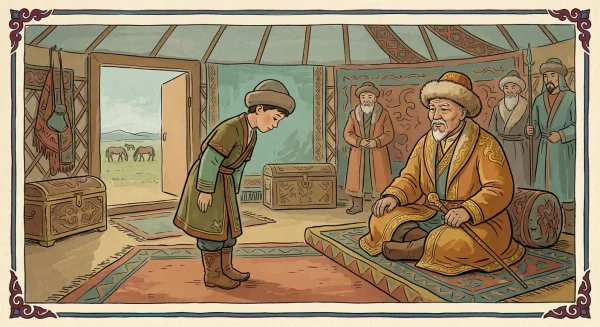
Sign in with GoogleLong, long ago there lived a padishah. This padishah had a good vizier. When his hour came, the vizier died. The dead vizier left behind a fine son. The padishah called the boy to him and said:
"Could you serve me in your father's place and become my vizier?"
The boy stood up and answered:
"If you think me worthy to be vizier, I will do."
The padishah accepted him, and the boy stayed on as vizier. He served the padishah, bowing to him ninety times a day. Whatever task he was given, he did it even better than his father had, and the padishah was pleased with him.
One day the boy was walking along the shore of a lake, hunting ducks. He saw a duck whose feathers shimmered in ninety patterns, but just as he raised his gun, the duck began to speak:
"Oh, vizier, don't shoot me! I am the daughter of the king of the peris. I was bathing in this lake, lost my father and mother, and I have lived here ever since. If you don't shoot, I will be your beloved bride," she begged.
The young man said:
"If you take the shape of a girl, I won't shoot."
The duck turned into a beautiful girl, came out onto the shore and married the boy. The two of them built a house and settled there.

When the boy stopped coming to the padishah, the padishah sent two other viziers to look for him. The two viziers searched until they came to a house on the riverbank. They looked in, and there sat the vizier, with a golden chest lying beside him. It was the boy's wife, the peri girl: she had known they were coming to look for him and had turned herself into a golden chest. The two viziers went to the padishah and said:
"Your vizier is hugging a golden chest finer than yours!"
The padishah gave the order:
"Bring him here!"
The young wife said to her husband:
"The padishah may send for you. Act hurt and tell him: 'For so many days I lay sick, and you did not send a single person to ask how I was. You could at least have dropped in on your way and seen for yourself how I was doing.'"
The two viziers came and took the boy to the padishah. The padishah asked him why he had not come. The boy stood up and said:
"For so many days I lay sick, and you did not once ask after me. That is why I took offence."
"I have heard that you found gold finer than mine. In such-and-such a city there is an eagle whose feathers shimmer in ninety colours. Bring me that eagle within a week. If you don't bring it, I'll have your head," said the padishah.
The young vizier went home and told his wife what had happened. His wife whispered a spell over a kerchief and blew on it. The kerchief became an eagle. The vizier took it to the padishah.
The padishah gave a second command:
"In such-and-such a city there is a bear whose fur shimmers in ninety colours. Bring it to me within a week, not a day later. If you are late, I'll have your head."
The boy went home and told his wife what had happened. His wife said a prayer and turned the kerchief into a bear. On the appointed day the boy brought the bear to the padishah. The padishah took the bear without a word, called his viziers and said:
"There were two roads of no return. I sent my vizier down them to punish him. But he has done every task I gave him. Now you find me a road where I can send him. If he doesn't bring back what I ask for, I'll have his head. If he runs away and never comes back, let him go and good riddance. But if you can't find a road of no return for me to send him down, I'll have your heads instead."
Frightened of the padishah, the viziers took two sacks of gold between them, went all round the city and called out:
"Whoever knows the road of no return will get this gold!"
Nobody knew, and they were at their wits' end when a blind man said:
"The road of no return is the one called 'Go-There-Come-Here.' There is none harder."
The two viziers came to the padishah and said:
"The road of no return is a place called 'Go-There-Come-Here.'"
The padishah summoned the young vizier:
"Find the place called 'Go-There-Come-Here.' If you are not back within a year, I'll have your head."
The vizier went home and told his wife the padishah's order. His wife said:
"What a cruel padishah he is!" Then she explained everything to her husband: "Go-There-Come-Here can't be found in the land of men. From now on you will travel through the cities of the peris. Here, I'm giving you this kerchief. Whenever you stay the night in someone's house, don't wipe your hands and face on their towel; wipe them only on this kerchief. Until you come back, I will stand in this house as a stove. If you die, your kerchief will find me, and that is how I'll know."
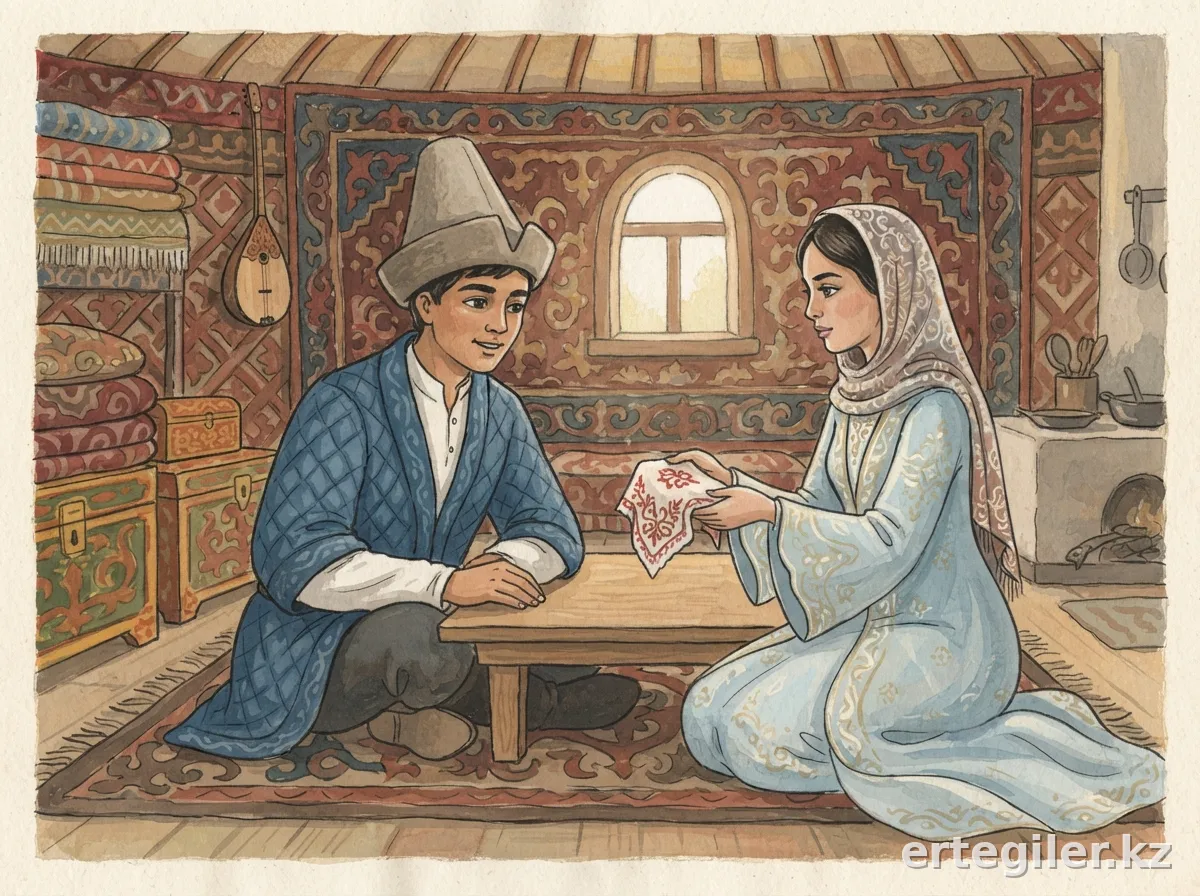
With these words she said goodbye to her husband and stayed behind.
The vizier walked and walked until he came to a city. There was not a soul to be seen in the city. All he could hear was shouting and clamour. The vizier could not tell where the voices were coming from. As he ran down the street, his boot knocked into someone, and that someone fainted. All the peris gathered round, looked in a book and said:
"The cold breath of a human has touched him!" Then they found the vizier where he was hiding and took him to their king.
The king of the peris questioned him.
"I am a poor wretch searching for Go-There-Come-Here at the command of my padishah," said the vizier.
The king of the peris told his servants:
"Feed the boy well and let him go."
Just then the king's wife saw the kerchief the young vizier was wiping his face with, and asked him where he had got it. The vizier said it was his own, but she would not believe him and threatened to cut off his head if he did not tell the truth. The vizier was frightened and told the truth:
"It is my wife's kerchief."
Then the wife of the king of the peris cried:
"Oh, alas! My little sister went missing while she was playing by a lake. So this is her kerchief! Tell me what you have come for."
"I am looking for Go-There-Come-Here," said the boy.
"Wait for your grandfather. He will know. If it is in this city, I'll get it for you; if not, I'll have it searched for," said the queen.
But Go-There-Come-Here was not to be found in that city, and the boy went on his way.
He walked and walked until he came to another city. There was not a soul in this city either. He bumped into a child walking down the street, and at once the peris came crowding round, seized the vizier and took him to their king.
"What kind of man are you, and what are you looking for?" asked the king.
"I am a poor wretch searching for Go-There-Come-Here at the command of my padishah," said the vizier.
The king sent him to his own palace as a guest. The boy came to the palace, sat down to eat and wiped his face with his kerchief. At that the king's wife said:
"Why, that is my sister's kerchief! Where did you get it?"
The young vizier told her the truth.
"It belongs to my little sister, who got lost while bathing in Lake Tomar. Tell me what you have come for," said the queen.
"I, the vizier, am looking for Go-There-Come-Here," he said.
"Wait for your grandfather the khan. If we have it, he'll give it to you; if not, he'll have it fetched," said the queen.
The king of the peris came and heard the whole story.
"Who knows Go-There-Come-Here?" he proclaimed to all his people.
Then a frog that lived down in a well said:
"I know. Give me gold and I'll tell you."
The king poured gold down the well for the frog, and the frog said:
"Have your craftsmen build a ship of diamonds, pearls and mother-of-pearl. On that ship we will sail there and back."
When the king had made ready all she asked for, the frog and the vizier boarded the ship and set off. After several days the frog asked:
"What do your eyes see?"
"Across the river I can see a big crowded town," said the vizier.
"The land you see is a great land. Its padishah has never in his life invited anyone into his home or spoken to anyone. As soon as you get off the ship, go straight to the padishah's palace. When he learns that you are a stranger from foreign parts, the padishah himself will come out. Greet him, and he will welcome you. He will call, 'Go-There-Come-Here!' and a young man will come running with a samovar of tea and a platter of meat. Drink one bowl of tea yourself and give the second bowl to that young man. If he drinks the tea you give him, your journey has succeeded; if he doesn't, you are doomed," said the frog, and she dived into the lake.
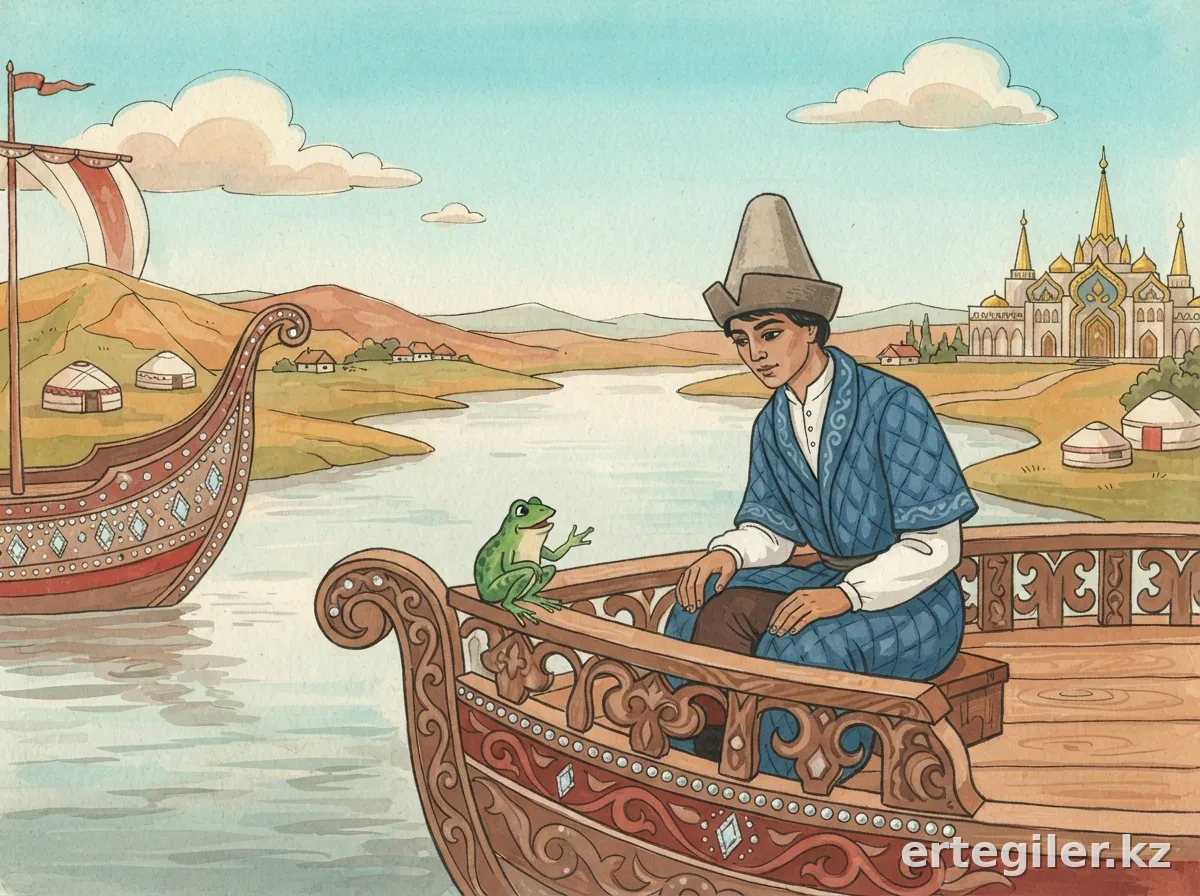
The vizier came to the palace, and the padishah himself came out, welcomed him and led him inside. The padishah called:
"Go-There-Come-Here!" and a young man came running with a samovar of tea and a platter of meat.
The vizier drank one bowl of tea and gave the tea in the second bowl to the young man. When the young man took the tea and drank it, the padishah said:
"Hey, Go-There-Come-Here! This young man has been wronged by his own padishah. Will you go with him?"
Without a moment's thought, Go-There-Come-Here replied:
"My lord! Go-There-Come-Here has served you since the day you were born. You never gave anyone so much as a bowl of water, let alone a bowl of tea. I will go to this young man. He drank one bowl himself and gave the other to me. He has shown me respect."
"This must be no ordinary man," said the padishah, and he put the vizier on his own ship and sent him off, while Go-There-Come-Here meant to follow after him.
When the vizier reached the middle of the river, the young man caught up with him. As the two of them sailed on, a great many ships appeared ahead. Then the young man said to the vizier:
"These nine thousand ships are a caravan closing in around us to stare at us. On each of the nine thousand ships there are a thousand people. Let's treat them all as our guests. If the head of the caravan says, 'Sell him to me,' sell me for the blue chest on the front ship and sail on. By the time you reach your city, I'll be there too. But don't you open the chest."
The two of them feasted all the people on the nine thousand ships with one samovar of tea and one platter of meat. The head of the caravan said to the vizier:
"Will you sell me your young man?"
"I will."
"What do you want for him?"
"I want the blue chest on the front ship."
The head of the caravan wanted to sail on without a word, but his companions raised a clamour:
"We've had our fun with the blue chest for long enough. Now let's have some fun with this young man!"
In the end they gave up the blue chest, took Go-There-Come-Here and sailed away.
The vizier sailed on and on until he came out of the river. He had no horse to ride, no food to eat, no clothes to wear; everything was gone. As he sat there, deep in heavy thoughts, Go-There-Come-Here arrived. The two of them ate and rested, and then the vizier said:
"What wonder is inside this chest? Open it up."
The young man turned the key of the chest once, and rain began to fall. He turned it a second time, and snow fell. He turned it a third time, and a storm rose, and then the sun came out. He turned it once more, and out came a huge army, crying "Where is the enemy?", blowing their karnay horns and beating their drums. The young man said:
"There is no enemy, lie down!" and the army went back into the chest.
He turned the key once more, and there they were at the old house on the riverbank, and the vizier's wife ran out to meet him and threw her arms around him.
At dawn, when people looked, they saw that Go-There-Come-Here had built ever so many wonderful palaces. The padishah saw the shining palaces and said:

"What a marvel! Go and find out about it," and sent two viziers.
When the viziers got there, the people of the palace said:
"Let the padishah come himself, gather all his people, bring them along and enjoy the sight!"
The padishah could not refuse them, so he gathered his people and went. They seated the padishah on a tall golden tower, gave every two guests a samovar of tea and a platter of meat, and served them all alike. When they had shown the padishah all their wonders, Go-There-Come-Here opened the blue chest, and the army cut down all the guests.
"There is no enemy, lie down!" he said, and the soldiers went back into the chest, and all the slain guests came back to life.
The padishah, who had watched it all from a tower, was too frightened to say a word. When he got home, he gathered his people and said:
"Get Go-There-Come-Here for me. If you can't get him for me, I won't be padishah any more."
The people held a long council:
"If we say we'll get him, we'll see a slaughter like the one just now. If we don't, our padishah will be furious with us. We'd better kill the padishah and make that vizier padishah instead."
And so they decided: they killed their padishah, chose the vizier as their padishah, and made Go-There-Come-Here his vizier.
Well done! The story is over!
You reached the end of the story. Great job!





Every day at 8:30 pm we'll send one bedtime tale. Just one notification a day.
On iPhone: tap Share → Add to Home Screen, open the site from that icon and turn it on here.
Done! Look out for a tale this evening 🌙
Something went wrong. Please try again later.
5 stories with your name and your picture. Show your parents!
For parents: a tale about your child for 390 ₸ — a trial week of Premium →Kazakh folk tales 34 people viewed

iPhone and Android app
All the tales, right on your phone
Read and listen at home or on the road. Free, with no ads.
- Audio tales keep playing with the screen off
- Pick up reading exactly where you stopped
- Find tales by age and by whether they have audio
- Night background and a comfortable text size

Sign in to keep reading
Today's free tales are over — 3 more are available tomorrow. Sign in with Google to continue — it is free and takes a second.
Sign in with GoogleHave an Android phone? In the app all tales are open without signing in.
Have an iPhone? In the app all tales are open without signing in.
Read in the app
Пікір қалдыру (0 пікір бар)
Әзірге пікір ешкім қалдырмаған!
Пікір қалдыру