Narik the Hero
Kazakh folk tales
How was the narration?
Thank you! This helps us make the narration better.
You listened to 30 seconds for free
Sign in to keep listening
Sign in with Google to listen to full fairy tales
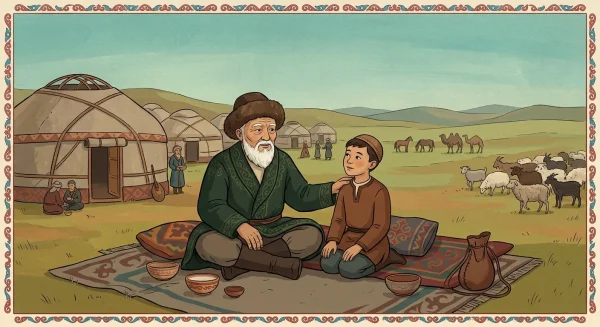
Sign in with GoogleLong ago there lived a hero (batyr) named Narik. He had no children of his own, so he took in a boy named Kulshora and raised him as his son. One day he thought:
"I have no child of my own. There is a saying: 'Another man's child won't stay with you, even in chains.' It seems this is not right for me. Who will look after me when I am old? Who will wash my bones with his own hands and lay me to rest with honour? Better that I pay a bride price: perhaps God Almighty will give me a child too."
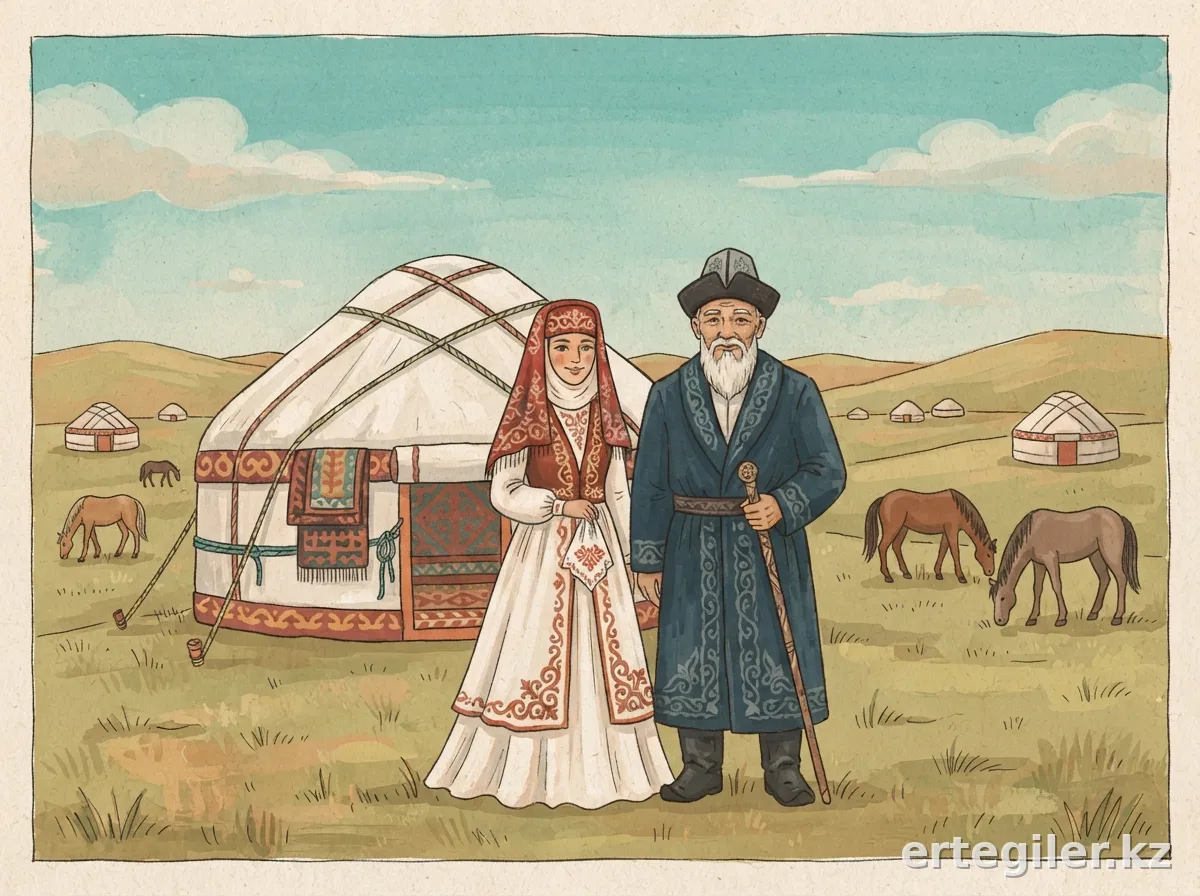
At that time he was ninety years old. He gave many animals and married the sixteen-year-old daughter of a poor man. Her name was Mendisulu.
One day the khan of that land rode out into the steppe with his men to hunt with birds. He let fly his falcon, called Aksunkar, at a bird. But the falcon did not go for the bird; it flew off somewhere else entirely. The khan chased it for a long way but could not catch up. Tired, he stopped and sent one of his men, with two horses, in the direction the bird had gone.
"Find it and bring it back," he said.
The man rode after it and saw a lone yurt standing in the middle of the steppe. The falcon had landed right on its top. The khan's officer rode up to the yurt and called out:
"Is anyone home? Is there anyone here? Get the khan's falcon for me!" There were no strangers there: it was the home of Narik the hero. Mendisulu came out and got the falcon for him. The officer saw how beautiful she was and fainted. He lay there a while, came to his senses, got up, mounted his horse, took the falcon and went back to the khan. The khan asked:
"Why were you so long?"
"The falcon landed on a yurt out in the steppe, and a woman came out and got it for me. I fainted at her beauty and lay there for a while. When I came to, I got on my horse and came back," he said.
Then the khan said, "I will take that woman for myself," and sent a man to her.
But Mendisulu answered:
"Give your khan my greetings! Will a cat take a lion's prey, or a hare take a wolf's?" The man went back and told the khan. The khan thought:
"She called Narik a lion and me a cat. She called Narik a wolf and me a hare. I am no match for Narik the hero; we would never beat him in a fight. Better to call him here, send him off to a certain death, a road of no return, and take his wife that way." And one day the khan took to his bed, saying he was ill.
He called Narik the hero and said:
"Narik the hero, I have fallen ill and I am going to die. The healers say: 'If you drink the milk of the dragon serpent, the aidakhar, you will get well; if not, you will die.' Only you are strong enough to bring the milk of that dragon. No one else can do it. Find it and bring it to me. I will give you a horse that never tires and food that never runs out."
Narik the hero suspected nothing.
"In that case, my lord, I will go. Better that I die than you. If I die, only my own home will be left empty. If you die, the whole people will be left without a ruler and fall prey to other peoples. Today I will go home, and tomorrow I will set off," he said, and went home.
His wife Mendisulu asked, "Why did the khan send for you?"
Narik the hero said:
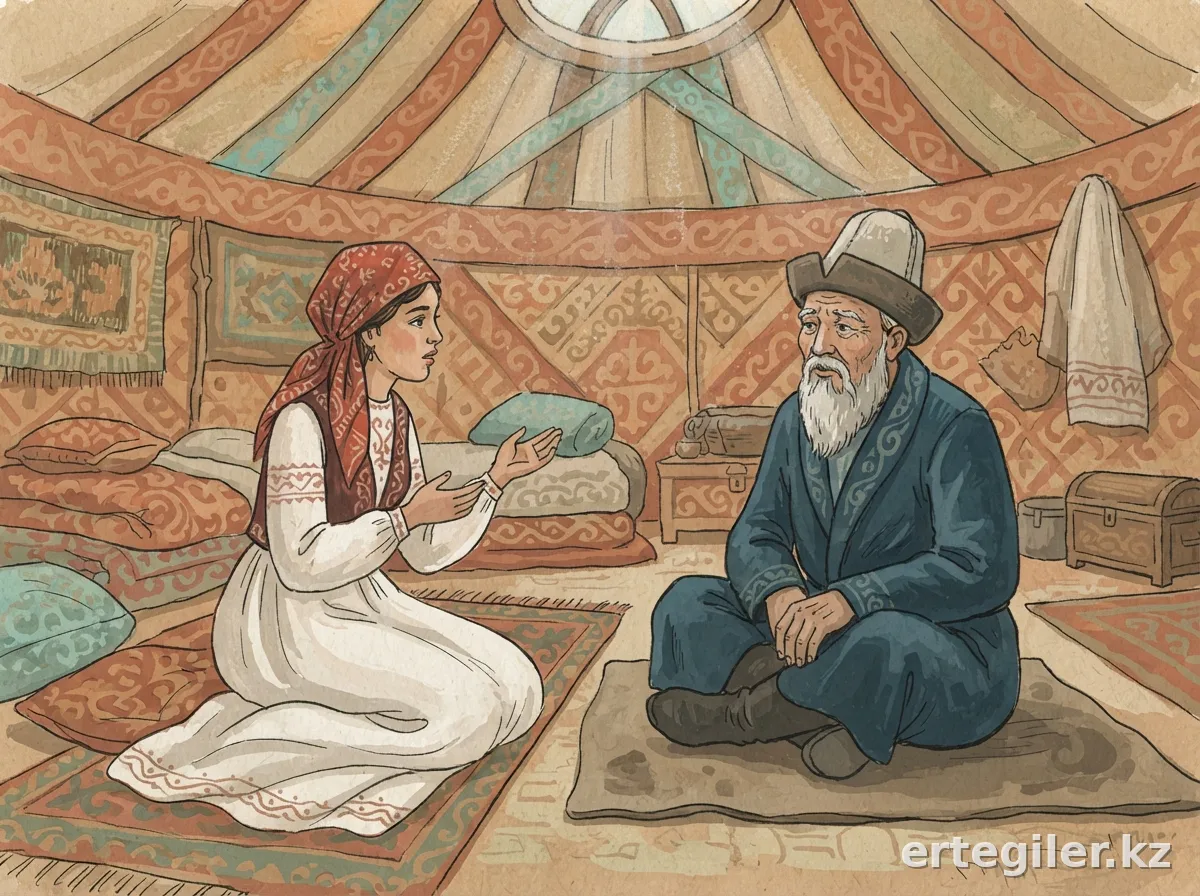
"The khan is very ill. To cure him he needs the dragon's milk. He sent for me so that I would bring it. I am setting off tomorrow, so I came home first."
Then Mendisulu said:
"The khan isn't ill at all; nothing is wrong with him. He wants to send you on a road of no return, and once you're gone, he means to take me. Don't go."
But Narik the hero thought to himself:
"Let me test her. I am a feeble old man of ninety, and he is a khan on a golden throne. Let me watch: maybe she has fallen for the khan herself and is plotting with him in secret. I'll pretend to set off for the dragon, then come back secretly at night and watch the house. If the khan is to blame, then I'll kill the khan." And he took his weapons and food and rode away.
At night he crept back and listened at his yurt. And the khan came into the yurt with several of his men and said to Mendisulu:
"I have come to save you from that doddering old man and take you for myself. Don't let your young life go to waste. Now come to my palace." But Mendisulu answered:
"I told you from the very beginning. He may be an old man of ninety, but God gave him to me. While he lives I will wait for him, and if he dies I will honour his spirit. I don't want a khan. Don't sit here any longer. Leave my home." At that the khan grew angry and left the yurt.
As soon as the khan had gone, Narik the hero came into his home, and he was well pleased with his wife. Then he thought:
"If I kill the khan, his warriors won't stand by and watch. Many people will be killed for nothing, blood will be spilled, and the people will be thrown into turmoil. Better that I go away to other lands myself." And the next morning he took down his yurt and moved away.
"If your mother gives birth to a son before you reach me, come to me yourself and ask for the suyinshi, the gift for good news. If she has a daughter, come on at your own pace," he said, and he rode on ahead.
A few days later Mendisulu went into labour and gave birth to a baby boy. Kulshora hurried after his father to ask for the suyinshi. When he got there, his father was building a house.
"Suyinshi, Father! Mother has had a son!" he said, and Narik answered:
"Ask for anything you want, my dear! What have you named your little brother?"
"I have named Kulshora's little brother Batyr Shora," said Kulshora.
"My dear, here is your suyinshi: if you want to go back to your own people, I will set you free. If you want to stay, I will make you both my sons. You will be the elder brother, and he your little brother," said Narik.
Then Kulshora said, "If you let me go, I will go back to my people." He got off his horse, gave the horse to his father and set off running on foot. He ran a long way, went down behind a hill, and then came back and said:
"Father, where would I go without you? I wanted to see what you would say. I thought: if you really meant to set me free, you would not chase after me, and then I would be your son. But if you did not really mean it, if you only wanted me as your slave and cared only for my work, you would not let me go. Now, if I stay with you, I will be your true son. Give me your blessing." He received his father's blessing, moved his mother there and came to his father. After that they built a house and lived in that place.
Narik had longed for children all his life until he was old, and now he could hardly wait for his son to grow up.
"If I stay at home, time won't pass. I'll go to the land of the Turkmens and have weapons made for the boy. If I could only hear him say 'Father' just once, I could die happy," he said, and off he went. Narik spent seven years in that land.
One day Mendisulu saw him coming home and sent both her sons out to meet him.
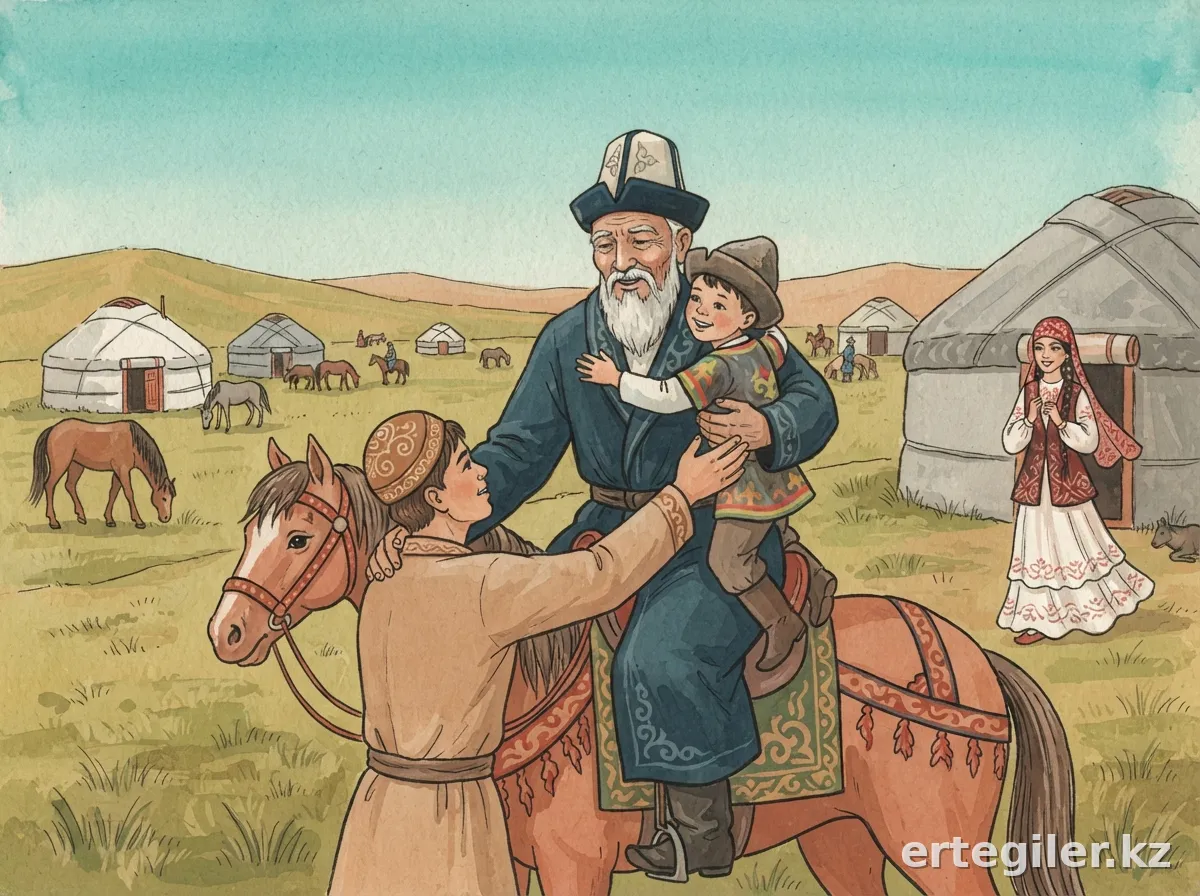
"Your father is coming," she said. Narik hugged and kissed his sons, put one in front of him on the saddle and the other behind him, and rode home.
When Narik got home, rested and got his breath back, he and his wife talked:
"We asked God for a child and have known the joy of it. Now let us pay a bride price, find a bride and have joy in this son as well," said Narik. And one day he took Kulshora with him, asked for the daughter of a rich man who lived nearby to be Kulshora's bride, and the two families became in-laws.
Before they left, Batyr Shora had asked:
"Brother, from wherever you are going, drive home about ten sheep for me. I'll play with them."
From his new in-laws Narik took nothing but ten sheep.
"They are for the boy to play with," he said. His in-laws laughed at that:
"Narik the hero doesn't care for riches, it seems, as long as the boy has something to play with."
One day Batyr Shora was out in the steppe, playing and chasing his ten sheep, when a man came up, driving forty saddled horses. When he saw that it was just a boy, he said:
"What's the use of talking to him?" And he turned and rode on. Shora the hero was angry that the man had ridden past him and taken him for a child. He called out to him, stopped him, rode up, greeted him and said:
"Good journey to you! Who are you?"
"And whose son are you?" the man asked.
"I am the son of Narik the hero," said Shora.
"Is our brother Narik the hero well? I am Kyrym the hero. I took forty men with me and rode out against the Kalmyks in such-and-such a place. My forty companions were killed. I am driving their forty horses home and coming back alone," he said.
Then Shora the hero said:
"In that case, come to our village, see my father, and be our guest before you go."
But Kyrym the hero answered:
"God bless you, my dear, but I am in a hurry. Give our brother my greetings."
Then Shora the hero, Narik's son, said:
"People will say I met Kyrym the hero out in the steppe and couldn't even feed him, but sent him off empty-handed. Get down from your horse. I'll slaughter this sheep and feed you right here." And he would not take no for an answer and made him dismount.
He drove up his sheep and wanted to slaughter all of them, but Kyrym stopped him:
"My dear, one sheep is plenty for a man tired from the road."
Shora cooked one sheep and fed him. When Kyrym the hero was about to set off, he said:
"My dear, pick any horse you like from these horses and keep it."
Then Shora the hero said:
"Among your forty horses I don't see one I would ride. If you can bear to part with it, give me the bay horse you are riding."
Kyrym the hero said:
"My dear, I wouldn't grudge you a horse, but I have ridden this one since I was young. We went against the enemy together; he is my old companion. He has a younger brother from the same mother, a five-year-old bay. If he is not better than this one, he is no worse. Come and take him."
Then Shora the hero said, "I'll come and take him!"
Shora passed on Kyrym the hero's greetings to Narik. After that he went on herding his sheep, as he did every day.
One day Mendisulu said:
"Let's dress you in the clothes your father brought last year, hang your weapons on you, and enjoy the sight."
Narik agreed, and they dressed the boy and hung the weapons on him. Narik was delighted at how well they suited him, and he said:
"Now let's put the golden harness on my dappled steed, sit him on it, and see how the horse suits him." They saddled the horse and put the boy on it. The father and mother were delighted at how well the clothes, the weapons and the harness suited their son, and they said:
"My dear, ride about a little at a walk."
The boy was happy too. As he rode about, thinking of this and that, he remembered Kyrym the hero and the five-year-old bay he had promised to come and fetch. And he realised that the day he had promised was already past. All at once the boy set off at a gallop. His father, his mother and his brother did not know where he had gone. They searched everywhere, couldn't find him, and sat there weeping.
One day Kyrym the hero's lookout came galloping in from the steppe:
"An enemy is coming, so many you can't see from one end to the other!" he said. But Kyrym the hero said:
"Don't be afraid! That's probably not an enemy. It's a little boy of seven. As I reckon it, it's time for Shora the hero, Narik's son, to come for the five-year-old bay. That must be the spirit of Shora the hero. Some speak of it, some see it. None of you go out! I'll go myself. I won't let him into the village. I'll stop him right there, set up a yurt for him, make him my guest, give him the horse and send him on his way." He rode out to meet Shora the hero and said:
"Hero, may your journey go well! The spirits of your ancestors are coming with you in a great host. Don't come into the village; I'll send you on your way from here." And he brought a yurt, set it up, made him his guest, gave him the horse and sent him home.
Shora was well pleased with his horse. Happy, he rode home and thought:
"Let me find out what my father and mother are saying about me. Maybe they are weeping, thinking I'm dead." And he crept up to his home and listened.
As he listened, his father said to his mother:
"You started this nonsense: 'I'll dress him up and make him happy,' and now you've lost your only son."
And his mother answered:
"If I'd only dressed him, where could the boy have gone on foot? You started this disaster, you old fool, saying 'I'll put him on my horse,' and the horse ran off with him."
Just then Shora the hero came in. His father and mother hugged him from both sides and asked:
"My dear, where have you come from?"
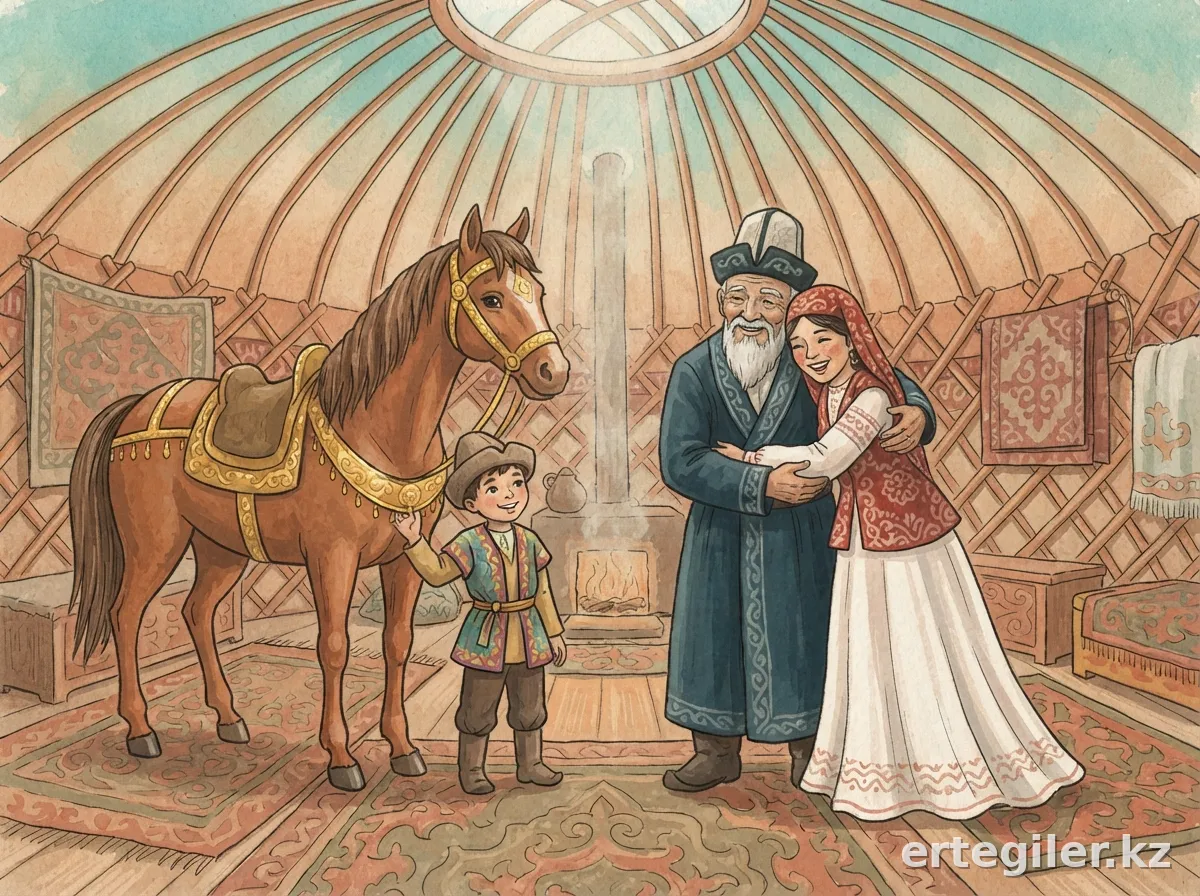
"I went to my brother Kyrym and brought back a five-year-old bay, a horse for going against the enemy. Father, go out and test how many days and nights he can gallop without tiring," he said.
His father went out, tested the horse and said:
"My dear, may your horse bring you luck! This is a true tulpar, a winged steed. Even if the whole world is covered in black fog, even if the earth is full of Kalmyks, he won't break a sweat; he will gallop twelve days and twelve nights without tiring."
"In that case, in twelve days and twelve nights I will beat the enemy, even if they fill the whole world!" said Shora.
Well done! The story is over!
You reached the end of the story. Great job!



Every day at 8:30 pm we'll send one bedtime tale. Just one notification a day.
On iPhone: tap Share → Add to Home Screen, open the site from that icon and turn it on here.
Done! Look out for a tale this evening 🌙
Something went wrong. Please try again later.
5 stories with your name and your picture. Show your parents!
For parents: a tale about your child for 390 ₸ — a trial week of Premium →Kazakh folk tales 45 people viewed

iPhone and Android app
All the tales, right on your phone
Read and listen at home or on the road. Free, with no ads.
- Audio tales keep playing with the screen off
- Pick up reading exactly where you stopped
- Find tales by age and by whether they have audio
- Night background and a comfortable text size

Sign in to keep reading
Today's free tales are over — 3 more are available tomorrow. Sign in with Google to continue — it is free and takes a second.
Sign in with GoogleHave an Android phone? In the app all tales are open without signing in.
Have an iPhone? In the app all tales are open without signing in.
Read in the app
Пікір қалдыру (0 пікір бар)
Әзірге пікір ешкім қалдырмаған!
Пікір қалдыру