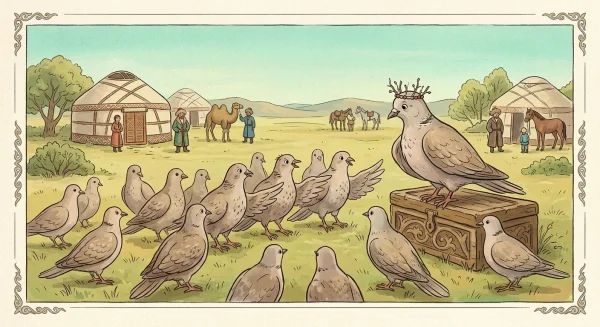
The Council of the Doves
Kazakh folk tales
How was the narration?
Thank you! This helps us make the narration better.
You listened to 30 seconds for free
Sign in to keep listening
Sign in with Google to listen to full fairy tales
Sign in with GoogleLong ago a great many doves lived in one place together with their king. One day a flock of them went off on a long journey and came back. After greeting the doves at home and asking how they had been, the travellers told news of the lands they had visited, and in the course of their talk they said:
"There is a caravanserai, a travellers' inn. The caravan people have moved away, left their inn behind and gone to other lands. The inn has no master now. And in that inn, where people have lived for ages, plenty of grain has been left behind," they said.
When the doves heard this, they wanted to move to that inn, and they came to their king with a request:
"You are our king," they said. "Some of us have been on a journey. These travellers have brought good news. There is a caravanserai whose people have gone away, and it stands empty. They say there is grain sown there in great plenty. So all of us ask you: with your permission, let us move to that inn and make it our home."
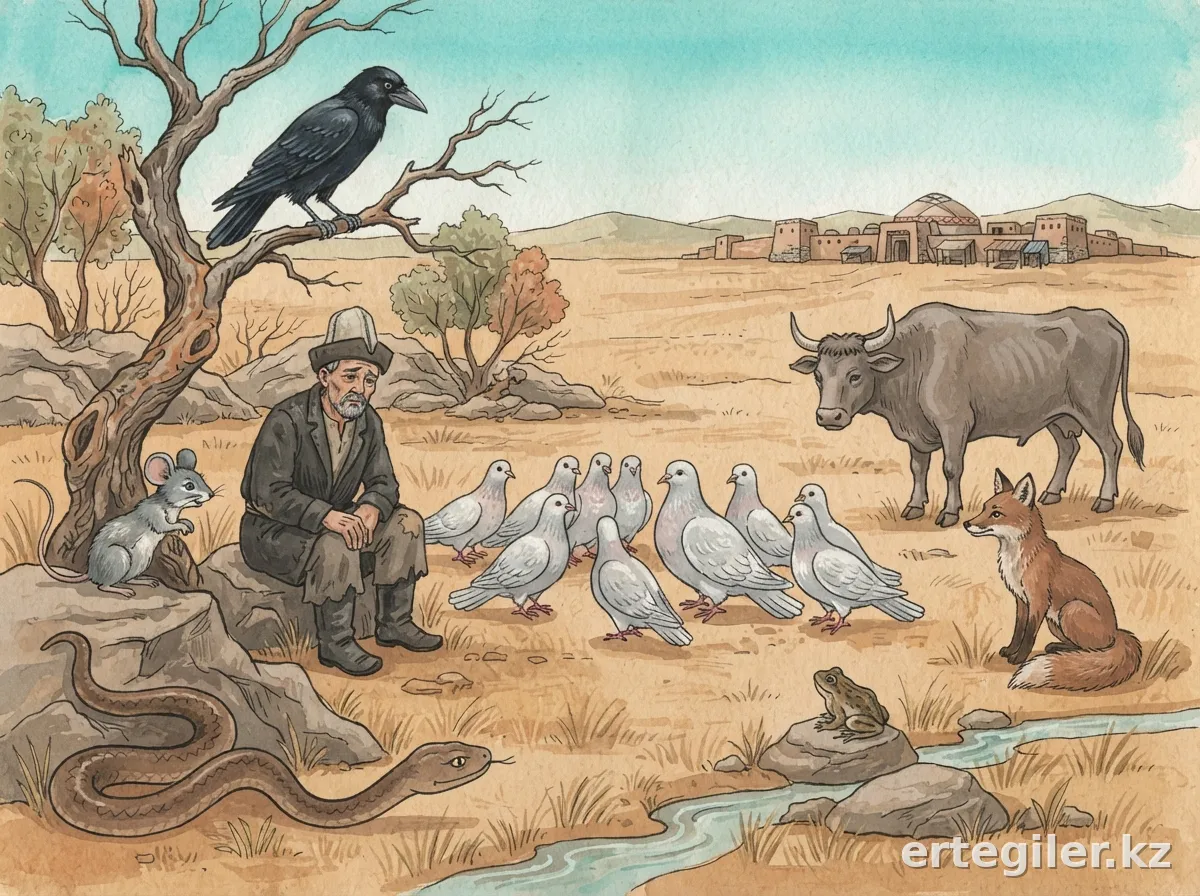
The king answered:
"Leave this talk. Let us stay on in our familiar home. Let us be content with the food we have always had. Let us not be like the proverb: 'They went where gold was said to be, and found nothing at all,'" he said.
But the doves pleaded:
"Our beloved king! We ask you in the name of all your people. The people of that inn have gone. The inn stands empty. Now you and all our people ought to settle there. If we bear the hardship of a three- or four-day journey, we shall find great comfort," they said.
The king said:
"Even though you all want to go, my heart does not like it. But since you have all made up your minds, then let us go." And all agreeing together, they set off towards the caravanserai.
They flew for a day or two, and along the way a fowler had set a snare and scattered plenty of grain. The doves saw the grain, were tempted, crowded into the snare of greed and, with their king at their head, were caught. The fowler who had set the snare was not there at the time. A crow saw it all and flew off cawing to tell the fowler. Hearing the crow cawing, the fowler thought, "The crow is cawing, something must have got into my snare," and ran towards it.
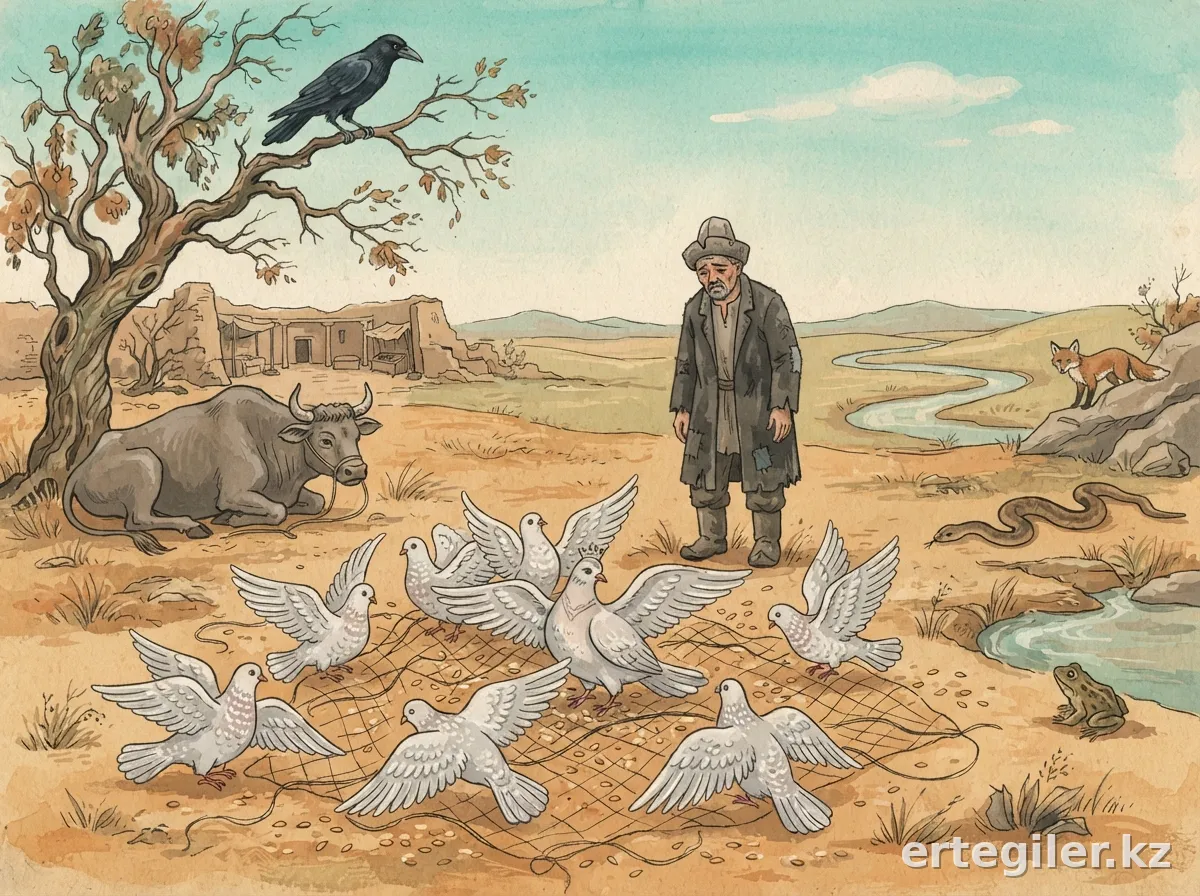
Then the king of the doves said:
"Look now, I told you my heart did not like this. You would not listen, and now we are caught in the snare of greed. Soon the fowler will come, cut off all our heads, eat our meat and stuff a pillow with our feathers."
At that all the doves began to weep, gave up hope of living and grieved together. The king said:
"Now an idea has come to me. Look all together, gather your strength, and all at once beat your wings and rush upward. If we do that, perhaps we can tear the snare loose and carry it away," he said.
Joining their strength, they beat their wings. They tore the snare loose, rose into the sky and flew off towards the caravanserai. The fowler chased after them, ran behind them, but could not catch them and was left behind.
The crow, that same tell-tale, flew after the doves, thinking, "I'll see where these doves land, and then I'll tell the fowler," and it flew along with them. Frightened as they were, the doves did not stop anywhere and flew without rest until they came down at the caravanserai. The crow flew in behind them and perched on the threshold of the inn.
The doves landed inside the inn. The king of the doves said:
"Carry me over to that big burrow-palace you can see there," he said.
So the doves brought their king to the burrow. The king of the doves said:
"Hey, brother mouse, come out of your burrow!" he said.
The king of the mice came out of his burrow. The two kings greeted each other and asked after each other's health, and then the king of the doves said:
"Brother, king of the mice, I and all my doves were caught in the snare of greed and put to shame. Now please help me and free me from this snare of greed," he begged.
Then the king of the mice gave orders to his army; they gnawed through the snare and set the king and the doves free. Once free, the king and the doves said to the king of the mice:
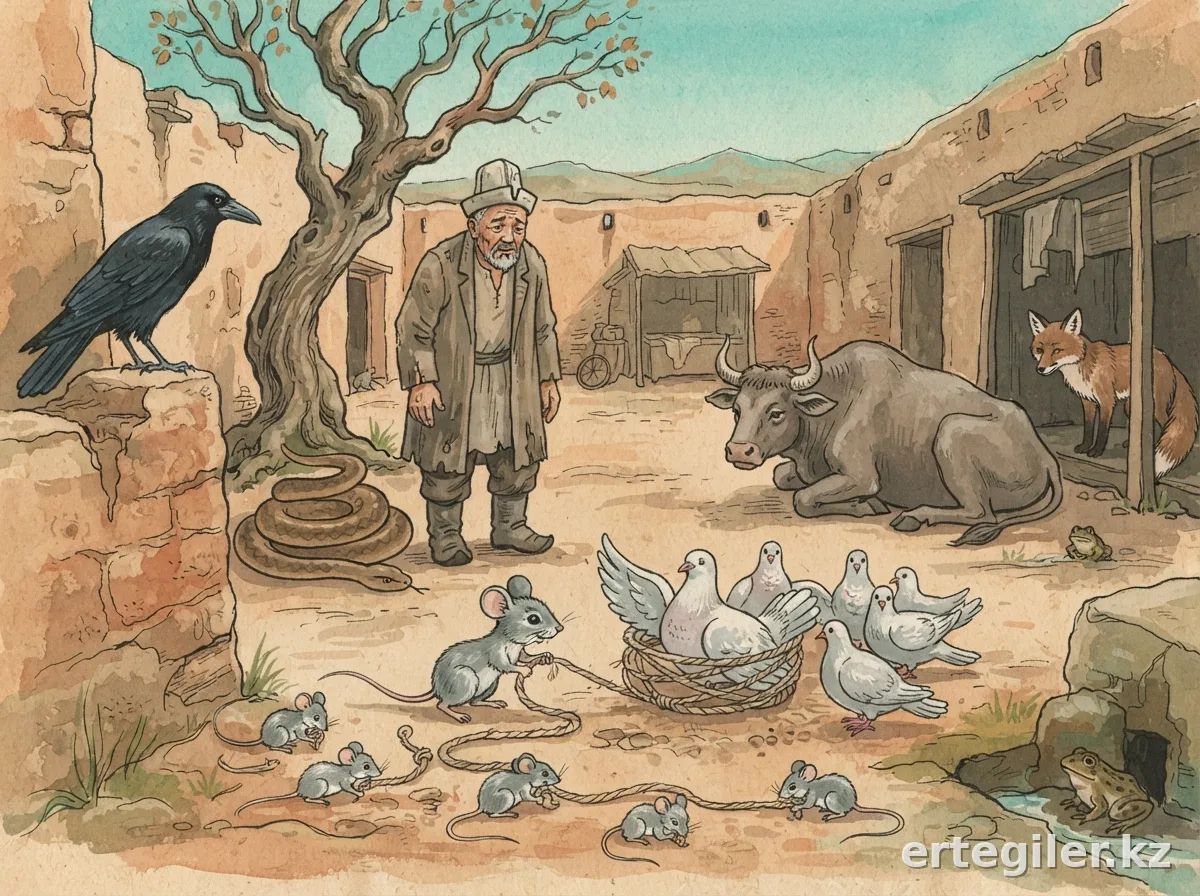
"Brother, king of the mice, we cannot thank you enough. May the good you have done us come back to you with all the treasures of the world. They say one good turn deserves another. I hope to become your friend and do you a good service in return."
Then the king of the mice answered:
"Brother, king of the doves, I do not hold the good I did you as a debt. But I will not be your friend. Because there is also such a thing as evil repaid for good," he said.
The king of the doves said:
"Brother mouse, you are mistaken. You saved me from the misfortune of death. How could I repay that good with evil?" he said.
Then the king of the mice said:
"King of the doves, it seems you have never heard how in days of old good was repaid with evil," he said.
Then the king of the doves said:
"How can good be repaid with evil? Tell me, I will listen."
"In that case I will tell you the whole story from beginning to end, and you listen carefully," he said.
"Very well, beloved king, tell it," said the king of the doves.
And the king of the mice began.
In days of old a group of merchants set out on a journey. Among them was a poor, luckless man whose horse was thin and who was himself an orphan. When they came to a wooded place, the poor man's thin horse grew exhausted and would go no further. Then the merchants travelling with him said:
"Take your time, look after your horse and follow after us. We cannot wait for you," and they left him behind.
When his companions had gone, the poor wretch felt miserable and began to weep:
"If I had the strength, would I have fallen behind my companions?" he said, sitting and lamenting in the empty steppe. Meanwhile the very grove where he sat had caught fire, and the fire was coming closer.
Suddenly there was a loud commotion. "What is that noise?" he wondered, and looked: a big snake, fleeing the fire, had climbed to the top of a tree. The tree was burning from the bottom, and the flames were blazing up towards the top. The snake was afraid of the fire, and it had no wings to fly away. "Now I'm going to die!" it was crying. Then the poor merchant thought, "Oh, this snake is as good as dead," held his saddlebag up to the tree and took the snake into it.
The poor merchant carried the saddlebag to a bare patch of ground where the fire could not reach, and said to the snake:
"Poor snake, now you have escaped the fire. Your life is as dear as my own. Perhaps for saving you some good will come to me. Now come out of the saddlebag."
The snake crawled out of the saddlebag and coiled itself around the poor merchant's neck. The poor traveller said:
"Hey, what is this?"
The snake said:
"I will do to you what I always do: now I will bite you."
The poor merchant said:
"Why will you bite me? For saving you from death?"
Then the snake said:
"Of course, I will bite you for saving me from death. For they say: evil for good."
The merchant said:
"Stop it, snake, good is always repaid with good. Never has good been repaid with evil."
The snake said:
"Good is never repaid with good; it is certain that good is always repaid with evil. If you don't agree, let's ask someone to judge. If they say good comes for good, I'll go my own way. But if they say evil comes for good, you must accept it, and I'll do what I do."
The poor merchant agreed. With the snake around his neck and the saddlebag in his hand, and his horse left somewhere behind, he went in search of some creature to judge between them, grieving bitterly, but no creature could be found anywhere. Worn out, with sweat running down his brow, he leaned against an apricot tree and wept, lamenting:
"My horse is thin, I have fallen behind my companions," he lamented.
Then all of a sudden the apricot tree began to speak:
"In this matter of yours, good will not come for good; evil will come for good," it said.
The poor merchant said:
"You are wrong. Why should evil come for good?"
"I myself am an apricot tree. Every year I used to give so much fruit. The gardener who tended me gathered my fruit and for years rested with his wife and children in the shade of my branches. For two years now I have grown old and withered and could bear no fruit. Yesterday the gardener who tended me came and said, 'There's no more use in it. It must be cut down for firewood,' and went away. And I thought, 'So this is what evil for good means.' For so many years I gave him fruit and did him good, and now he means to throw me in the fire. Couldn't I have fallen and died when my time came? Couldn't he have let me be? Isn't this evil for good?" said the tree.
The poor man would not accept this. "I'll ask someone else," he said, and went on with the snake around his neck. As the poor merchant walked along, he saw a big fat ox grazing. The two of them went up to the ox, laid out their dispute and told it everything from beginning to end.
The ox listened to their dispute and said:
"Evil does come for good. Listen, and I'll tell you the evil that befell me."
"Please tell us," they asked.
Then the ox said:
"I was born to my mother a calf. From the day I was born they gave me no freedom; they tied me up by the neck and milked my mother. Tied up as I was, I could never suckle my mother's milk as much as I wanted. When I was a young bullock, they pierced my nose. They gelded me while I bellowed. Then they broke me in, set their children on my back and put me to work without a moment's rest. When I was a two-year-old ox they set me to ploughing. In summer the shepherd rode me to the pastures. Carrying firewood, hauling water — it all fell on me; they never gave me a moment's peace. No wheat or millet grew without me. Every job got done only with me. In short, I grew old in that toil. For a year now they have not even thought to give me good fodder; they only drive me on. I had thought: I have served well since I was born, so when I grow old they will pity me and let me go. Yesterday my master brought a butcher and asked him, 'Look how fat my ox has grown — how many poods of fat will he give?' Only then did I see that they had been fattening me for slaughter. Isn't this evil for good? After all my service, couldn't they let me go now that I'm old? Couldn't they let me die my own death?" said the ox.
The snake said:
"Well, have you had enough now?"
Then the poor merchant said:
"No, I will ask someone else. If they too say evil comes for good, then I will agree," and he went on with the snake again.
As he walked along, he met a fox.
"Fox, we have a dispute to put to you," he said.
Seeing a human, the fox ran away in fright, climbed onto a hill and answered from there:
"If you have a dispute, say it from where you stand."
"Fox, our dispute is this: is good repaid with good?" he said.
The fox asked:
"What is this about?"
The merchant told it everything that had happened, from beginning to end. The fox said:
"Did you ask anyone before me?"
The merchant said:
"Before you we asked two creatures. They said, 'There is no good for good; evil comes for good.'"
Then the fox thought hard, worked out a trick and asked:
"Will this snake fit back into the very saddlebag it was in?"
"I'll fit," said the snake.
"In that case I'll give my judgment. Get into the saddlebag," said the fox.
The snake agreed, slid off the merchant's neck, got into the saddlebag and stuck its head out.
"Where's your 'I'll fit'? Your head is sticking out."
"My head will fit too," said the snake, and it bent its head down to the bottom of the saddlebag.
Then the fox said:
"Hey, you poor fool of a merchant, why are you standing there gaping? Grab the mouth of the saddlebag tight, smash it against the stone in front of you, and won't you be rid of your trouble?"
The poor merchant did as the fox said: he held the saddlebag shut, smashed the snake against the stone and killed it. And so, thanks to the fox's cunning, the merchant escaped death.
"But had the judgment been fair, evil would surely have come for good," the king of the mice said, finishing his story.
Then the king of the doves said:
"It is true, my lord, what you say is right. And do you know why the owners of this inn, the caravan people, left their inn?"
The king of the mice said that he knew:
"There is a reason why the caravan people left their inn. There was a good man in this inn, a caravan master. Whenever they sat down to eat, we lay in wait, got into their food, did not let them eat and gave them no peace. 'Our food is defiled,' they would say, leave what they were eating and drinking, and sometimes go hungry. One day a guest came to him from far away. As the caravan master was preparing a meal for the guest, he clapped his hands together so that no mice would get into the food.
'Caravan master, in our belief clapping your hands is a bad omen. Why are you clapping?' the guest asked.
'Friend, my guest, let me tell you why. There are mice here with a whole palace underground, and they swarm in and get into the food. I clap my hands so that the mice won't come while you are eating,' he said.
Then the guest said, 'If the mice have a palace, they must have a treasury too. Find as many hoes as you can, gather some young men, dig up their palace and take their treasure.'
So the caravan master did as the guest said: he gathered young men, found hoes, wrecked our palace and took our treasure. Out of spite we gave them no rest day or night, getting into their food again and again... And so they lost their peace, grew angry, saw that they could not beat us — and that is why the caravan people abandoned the inn," he said.
The king of the doves and the king of the mice finished their talk and went off about their own business.
Now the crow that had followed the doves had seen everything from beginning to end: how the dove and the mouse had talked, and how the mice had saved the doves from the snare. The crow said to itself, "I'll make friends with these mice. If I'm ever caught in a snare, the mice will save me." It came to the mouth of the burrow and said:
"Hey, mouse, come out!"
At the crow's voice the mouse came out of its burrow and asked:
"Why did you call me?"
The crow said:
"If I'm ever caught in a snare, it turns out you can save me. Come, let's be friends."
The mouse said:
"Crow, may the Lord keep your face far from me. In all the eighteen thousand worlds no creature has been made blacker than you. Your insides are even blacker than your feathers. May the Lord never make me your friend."
"No, my dear, I will do you no harm. We ought always to have your help."
"Crow! Don't talk so much. May the Lord keep your face far from me," said the mouse, and went back into its burrow.
The crow stayed on in that inn for a whole year. As the mice saw the crow morning and evening, they gradually grew used to one another.
One day, in the course of their talk, the king of the mice said to the crow:
"Crow, I have one dear wish. If you help me with that wish, I will be your friend."
"Tell me, my lord; if I can, I will serve you with all my heart and soul," said the crow.
"Crow, I had a friend. We could not sit still for an hour without seeing each other. Now it is the fourth year since I last saw my friend. We have been left in grief and sorrow. We could not cross that river. What am I to do? If you carry me to my friend, I will be your friend."
"Very well, I take this task upon myself with all my heart and soul," said the crow.
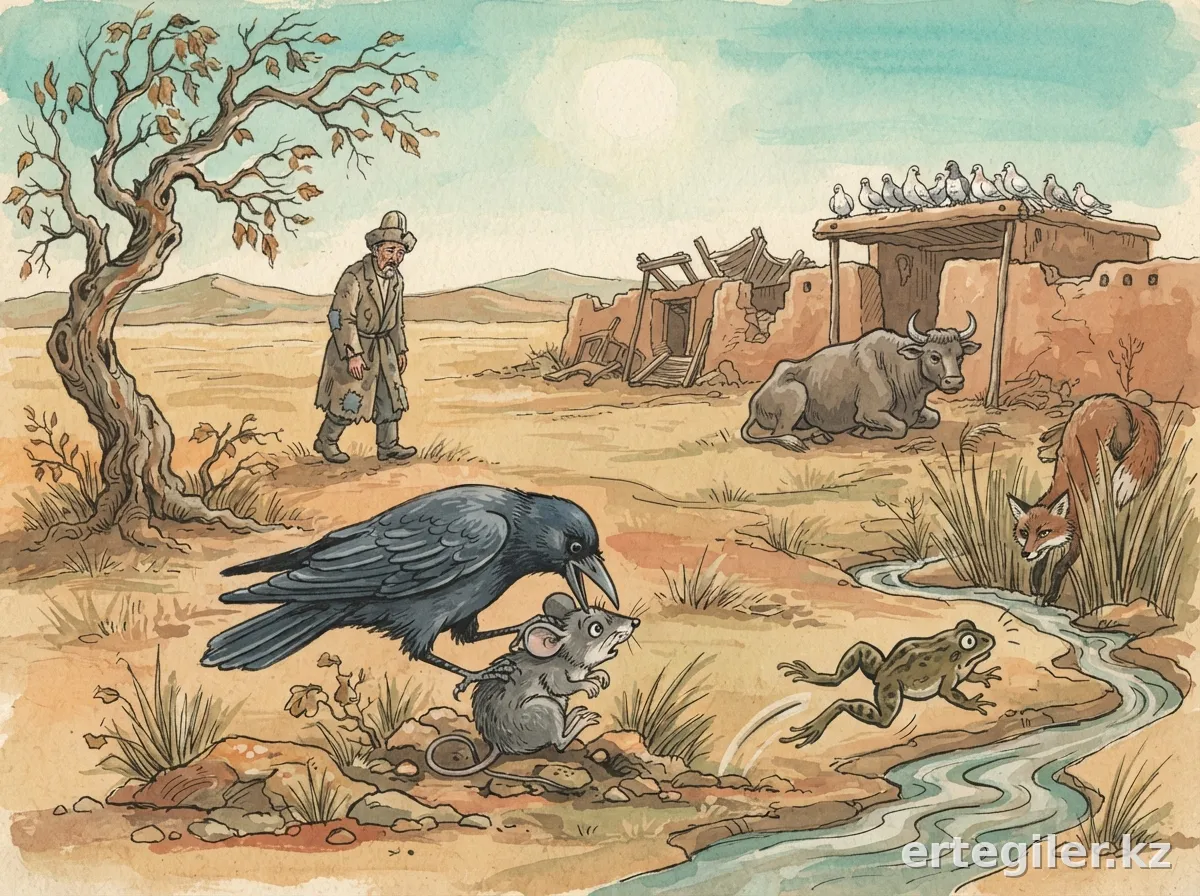
Then the crow put the mouse on its wing and flew off across the river. After flying for several days, the crow's wings grew tired, and it landed on a dry island to rest. While the crow was resting, the king of the mice looked and saw, on the far shore of the island, beside a little stream, his friend the frog. There the two friends met, wept together, embraced, greeted each other again and asked after each other's health, saying, "So the day has come when we see each other again!" When they had talked their fill, the frog asked its friend the mouse how it had come to this place.
"I made friends with a crow and came riding on its wing," said the mouse.
"Oh, my friend, how could you make friends with a crow? In all the eighteen thousand worlds there is no creature made blacker than the crow. A crow's insides are even blacker than its feathers."
"You speak the truth. Even so, I missed you so much that I had no choice but to become its friend. Thanks to that crow, the two of us can see each other."
"You did wrong. Isn't the crow one of those who repay loyalty with harm? Once you are friends, you must be ready to give your life for a friend. But this crow, far from giving its life... Have you never heard of the four friends of old who each would give their life for the other?"
"Tell me, I will listen," said the king of the mice.
"In days of old there were four friends. One was a mouse, one a frog, one a saiga antelope and one a duck. One day the khan's son went hunting with his retinue. Nothing caught their eye. Just then a frog went hopping past in front of them. The khan's son said, 'May it bring us luck, let it be a good omen: catch it and put it in the saddlebag.' His companions caught the frog and put it in the saddlebag. Seeing this, the duck said to the saiga, 'Something terrible has happened. The rich man's son has caught our friend the frog, for whom we would give our lives, and taken it away,' and the three of them held council together.
Then the mouse said: 'Saiga, pretend to be lame and limp past in front of the khan's son. When they see you and say, "There goes a lame saiga," they'll drop their saddlebags and give chase. Then the duck must carry me to the saddlebag; I'll gnaw a hole in it and let the frog out. After that the duck will bring you word, and you'll save yourself and run away.'
They all agreed to this trick, and the saiga pretended to be lame and limped past in front of the khan's son. 'Look, there goes a lame saiga, let's chase it and kill it!' cried the men, dropped the saddlebag and set off after the saiga. Meanwhile the duck carried the mouse to the saddlebag. The mouse gnawed through it and rescued the frog. Once the frog was free, the duck flew off and gave word to the saiga. Hearing that the frog was saved, the saiga ran off as swift as ever and escaped. So with cunning, not sparing their own lives, they saved the frog.
When you are friends, that is how you must be friends. This crow, far from giving its life for a friend, will turn on you the moment it is hungry. Is there any loyalty in it?" said the frog, finishing its words.
Just at that moment the crow was getting hungry. "I wonder if there's anything to eat," it thought, and looked all around, but there was nothing. Then its eye fell on the friend beside it, and breaking its promise, it pounced on the king of the mice and ate him up. But the frog escaped, dived into the water and was saved.
Well done! The story is over!
You reached the end of the story. Great job!




Every day at 8:30 pm we'll send one bedtime tale. Just one notification a day.
On iPhone: tap Share → Add to Home Screen, open the site from that icon and turn it on here.
Done! Look out for a tale this evening 🌙
Something went wrong. Please try again later.
5 stories with your name and your picture. Show your parents!
For parents: a tale about your child for 390 ₸ — a trial week of Premium →Kazakh folk tales 32 people viewed

iPhone and Android app
All the tales, right on your phone
Read and listen at home or on the road. Free, with no ads.
- Audio tales keep playing with the screen off
- Pick up reading exactly where you stopped
- Find tales by age and by whether they have audio
- Night background and a comfortable text size

Sign in to keep reading
Today's free tales are over — 3 more are available tomorrow. Sign in with Google to continue — it is free and takes a second.
Sign in with GoogleHave an Android phone? In the app all tales are open without signing in.
Have an iPhone? In the app all tales are open without signing in.
Read in the app
Пікір қалдыру (0 пікір бар)
Әзірге пікір ешкім қалдырмаған!
Пікір қалдыру