The Ram and the Billy Goat
Kazakh folk tales
How was the narration?
Thank you! This helps us make the narration better.
You listened to 30 seconds for free
Sign in to keep listening
Sign in with Google to listen to full fairy tales
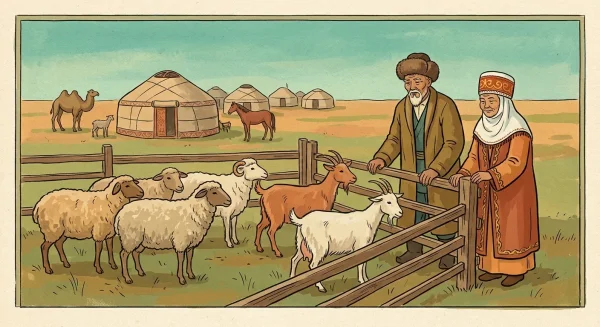
Sign in with GoogleLong ago there lived an old man and an old woman. They were poor. All the livestock they had to live on were five sheep and five goats. They drank their milk, made kurt (dried curd) and butter, and every year they killed and ate the young ones that were born. From the skins and wool they made clothes to wear. The five sheep and five goats never grew in number, and never grew fewer.
The five sheep and five goats went out to graze on their own, went to the spring to drink on their own, and came back on their own. Never once did a wild beast or a thief get them. In the evening, when they came back from the pasture, the old man and the old woman counted them and shut them in the pen, and early in the morning they counted them again and let them out. And the shepherds and watchmen who kept the five sheep and five goats safe and sound and looked after them were the ram and the billy goat.
The old man and the old woman loved the ram and the goat more than anything, as dearly as their own lives. They were not just livestock — they were like their own children. The old man and the old woman trusted the good sense of the ram and the goat. If the ram and the goat brought the sheep and goats home from the pasture early, it meant they had felt that the weather was about to turn and there would be rain or a snowstorm, and they were taking care in good time.
And if, led by the ram and the goat, the goats and sheep started to make a noise, bleating and huddling together in fright, it meant they had sensed a wolf or a thief prowling nearby on their trail, and they were taking care in good time.
The ram and the goat were the best of friends. They looked after each other and gave each other good advice. And whatever one of them lacked, the other had. The ram was simple-hearted, trusting and rather timid. But he was strong, and he relied on the goat. The goat, on the other hand, was crafty and clever, could foresee many things before they happened, and was wise. The old man and the old woman knew their natures well and thought of the ram and the goat as the luck and the guardians of their small flock, the support of their humble living.
Then one day the old man fell seriously ill and took to his bed. The old woman sat by him day and night, dripping water into his mouth. The ram and the goat understood everything and made sure the old couple did not have to worry about them: they went out of the pen to graze on their own and came back on their own. They did not stray far from home and grazed carefully.
The old man did not get better from his illness; he got worse day by day. The old woman wept rivers of tears and could do nothing but cry. While the old man lay so ill, a dark baksy — a shaman-healer who wandered from village to village — arrived. He played his kobyz, felt the old man's pulse, examined him and named the cure:
"You must kill your most beloved, most cherished animal, sprinkle the sick man with its blood and innards, and heal him that way..."
The old man and the old woman were horrified at these words: how could they send their most beloved animals, the ram and the goat, to their deaths!
"We cannot give up the ram and the goat that we cherish for this sacrifice. Please heal him with another sheep," the old man and the old woman begged the dark baksy. But the baksy dug in his heels and would not budge:
"A cure only works if you sacrifice what is dearest to you, what cuts you to the heart. I will not heal with any other animal," he said.
The old man and the old woman had no way out. They both wept bitterly. It seemed that if they did not kill the ram or the goat to heal him, the old man would not get better.
But if they did kill one, it seemed that the whole of their little flock, which they lived on and fed on, would be lost along with it.
Yet life is sweeter than anything, and a human life is precious. The old man and the old woman cried and cried, and when they could think of nothing else to do, they decided at last to kill either the ram or the goat.
The goat sensed and knew all of this. In the night he woke up the ram and told him the terrible news. Both of them wept, and both of them were angry, and then they made a pact, and that very night, without anyone knowing, they left the home where they had been born and raised, and went away. Their plan was to find a healing herb to cure the old man and the old woman.
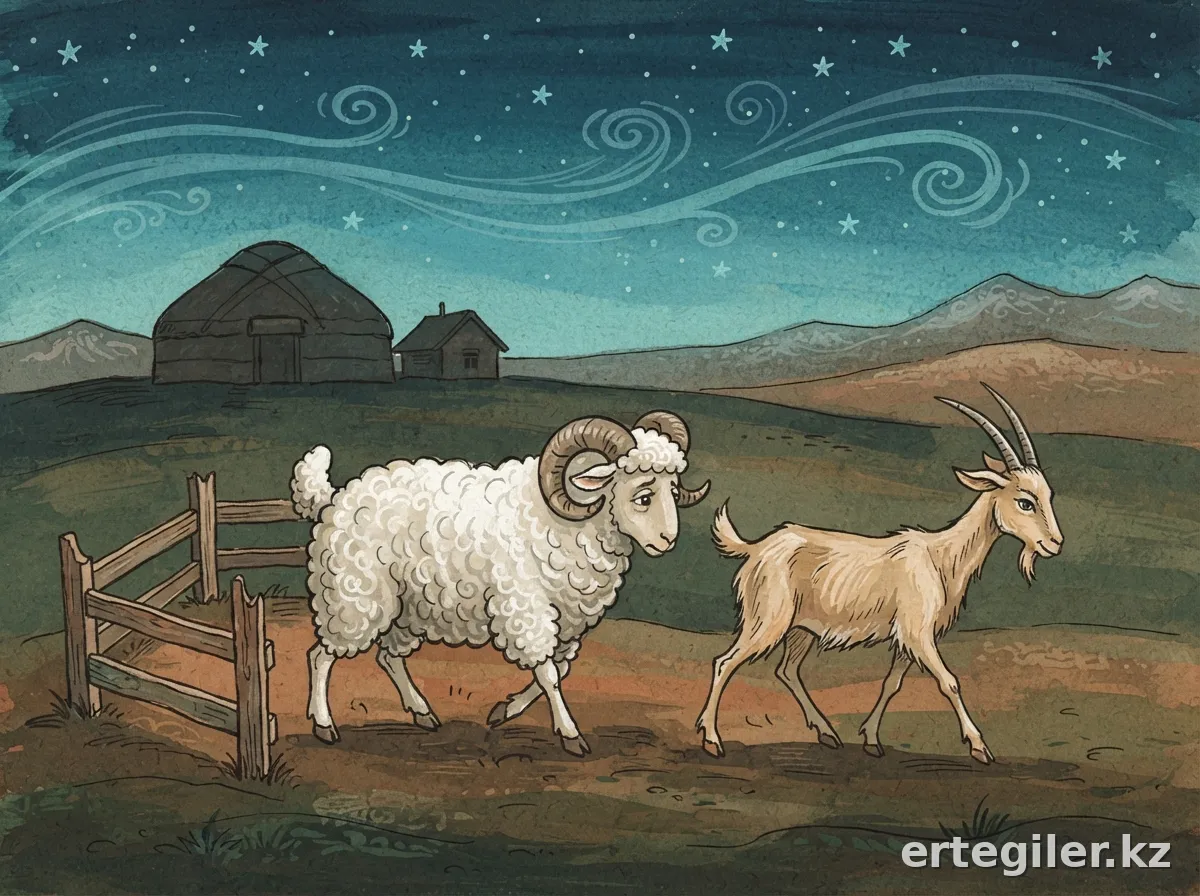
Nobody came after the ram and the goat to look for them. Who would? The old man was ill, and the old woman could not go searching for livestock on her own. And so the ram and the goat went away, and on and on they went. For several days they travelled, wandering through empty steppe, ravines and gullies, mountain forests and along rivers and streams, nibbling grass and drinking water. At every step danger met them. Sometimes they came across the tracks of prowling beasts of prey like wolves; sometimes at night they heard wolves howling all around, bears roaring and wild boars grunting, and they were so scared their hearts were in their mouths. They hid from them all and kept on going.
The ram and the goat had not yet decided where they were going or where they would settle and live. They wander through the empty steppe, the mountains and the forests, but they do not know where the healing herb grows.
If they met beasts of prey, they would surely be pounced on and torn to pieces. And if they came near people's homes and caught a man's eye, he might seize them, kill them and eat them. But both of them understood very well that they could not live in wild places without people either. The only way out was to find the healing herb that would cure the old man. Once they found it, they could go home without fear.
So they were walking across the flat steppe when the goat stopped, looked at a cloud rising from the windward side and said:
"There's going to be a terrible downpour today. Come on, Kosheke, let's build a shelter," — Kosheke was the goat's fond name for the ram. The ram said:
"Build a little shelter just big enough for yourself. My wool is thick and my meat is fat — I can lie out in the rain and nothing will happen to me," he said.
The goat went about saying "Meh! Meh!", pulled up and gathered grass, piled it under a clump of meadowsweet and made himself a warm shelter just big enough for himself. Towards evening the weather turned: thick black clouds covered the whole sky, swirled and rushed along, thunder crashed and lightning flashed. A downpour came, as if poured from buckets, and grew heavier and heavier.
Inside his warm shelter, covered with grass above, below and on every side, the goat was safe from the terrible rain and rested peacefully, dry from head to toe. But the ram lay down beside the shelter, on the side away from the wind, and turned his fat tail, as big as an upturned cauldron, to the wind and rain. But the ram could not hold out for long. Icy water streamed down on him from above and below, and the cold wind howled and whirled, went through the thick fleece on his fat skin into his flesh, and through his flesh into his bones. The ram began to shiver and shake and freeze.
At last he could bear it no longer:
"Täke, oh, Täke! I'm frozen, I was foolish. If you don't warm me up, I'll be in a bad way," the ram begged. Täke was his fond name for the goat.
The goat said:
"Don't do anything so foolish again," and although it was cramped, he let the ram into his shelter.
The next morning the rain stopped. The sun came out. The ram and the goat set off on their way again. Towards midday the goat stopped, looked hard at the clouds that had not yet cleared from the sky and watched how they moved, and said:
"There may be snow and a blizzard today. Let's build a shelter, Kosheke." But the ram was not much worried.
"Snow isn't like cold rainwater that soaks through thick wool. I'll just lie with my tail to the wind. For you, with your thin coat and thin skin, building a shelter makes perfect sense," said the ram.
The goat did not answer his friend. Saying "Meh! Meh!" he gathered grass. In the shelter of a clump of white chiy grass he heaped up grass, piled it high and made himself a warm shelter just big enough for himself.
Towards evening the weather turned. Grey, mottled clouds raced across the sky, and big flakes of snow began to fall. A cold, whirling wind blew, and a white blizzard swirled and covered both sky and earth. In such a terrible blizzard the goat lay snug and rested in his warm shelter, but the ram, who lay beside the shelter with his fat tail, as big as an upturned cauldron, turned to the blizzard, was in a sorry state. The swirling snowstorm and the howling, bitter frost froze the ram almost to death. At last the ram could bear it no longer:
"Täke! Oh, Täke! My end is coming. If you don't let me into your shelter, I'll be done for. From now on I'll always do as you say," he begged.
The goat said:
"Don't do anything so foolish again," and although it was cramped, he let his frozen friend into the shelter.
The next day the blizzard died down, the sun came out and it grew warm. The ram and the goat set off on their way again. As they went, the goat kept a careful eye on the ground. He studied the little trails where birds played and wolves and hares ran, the well-worn paths where bears and boars went, scouted, learned and took care. When evening came and dusk was falling, the goat suddenly stopped.
"Kosheke! We've come right out on top of a wolf's den — look, there are tracks running off in every direction!" he said.
"Oh no! Täke! Now we're done for," said the ram, trembling with fear. But the goat did not panic, did not fret and was not afraid.
"We can't run away from this. The wolf will pick up our scent, and wherever we go, he'll catch us and kill us. The only way to save ourselves is to hide in the wolf's den itself," he said. The ram was even more terrified at this:
"What is he saying? What is he saying?!" he kept repeating, shaking all over. But he no longer had the strength to argue with his friend's advice. He followed the goat.
The goat led the way, and soon they came to the wolf's den. On one side of the wide den a long burrow had been dug, like a cave. They both went in. The goat stood right at the narrow entrance himself, and he put the ram to one side, in a hidden corner, and gave him his advice:
"When I say 'strike', just butt the wolf with your horns as hard as you can, don't hold back. Don't be afraid," he said. They waited a long time for the wolf to come back from his night's hunting.
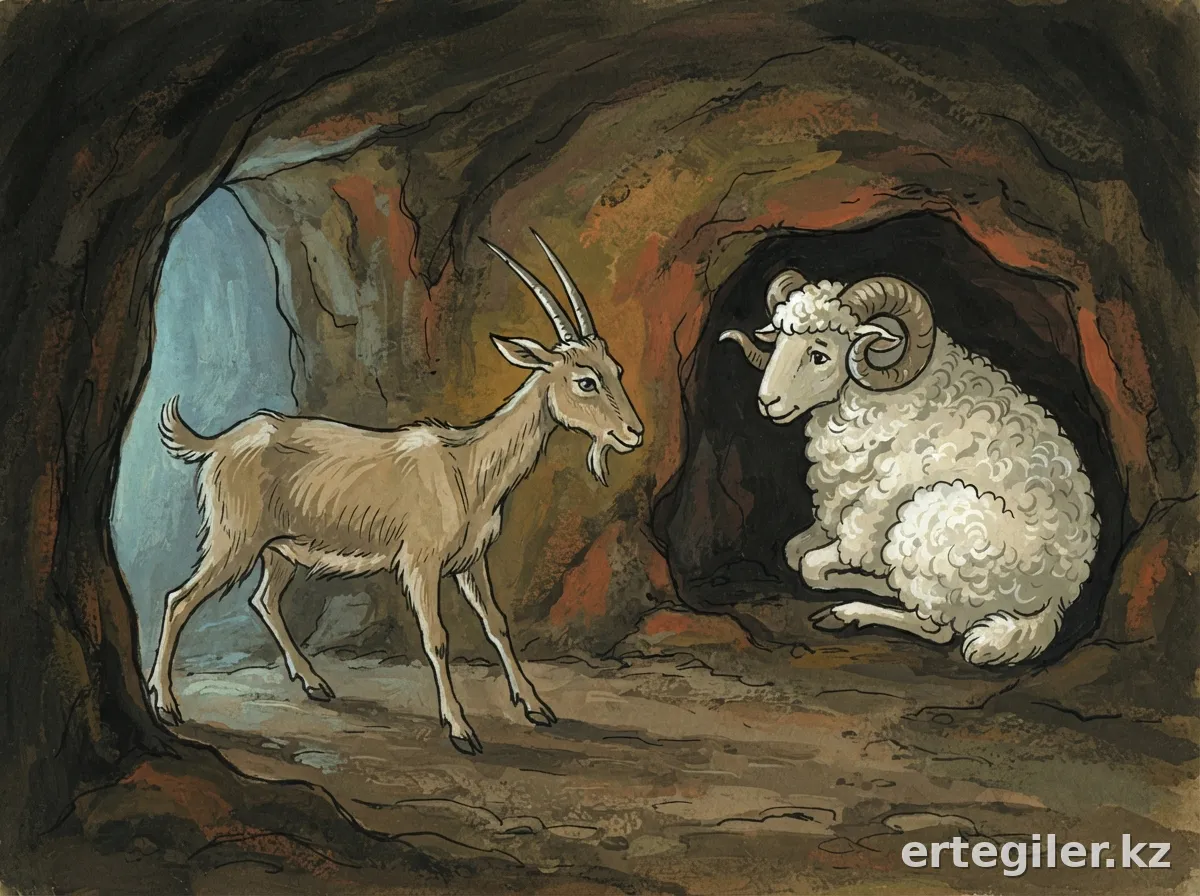
Towards dawn the wolf, suspecting nothing and worn out from his night's hunting, came plodding along lazily, jumped down into the den and went into the burrow. The goat pressed his two straight horns, sharp as spears, against the wolf's throat, pinned him to the roof of the burrow and shouted:
"My lamb, my lamb, strike!" The ram did not hesitate. Lowering his huge horns, curved like a bow and heavy as stone, he rammed the wolf in the side with all his might, again and again. The wolf, with a broken rib and an injured front leg, yelped, howled and fell down — but it is not easy to give up one's life, so he turned round and ran away, hobbling. The ram and the goat chased him a good long way. As they chased him, the goat kept saying:
"My lamb, my lamb, strike!" Hearing these words, the wolf grew even more frightened and fled as fast as he could.
The day dawned and the sun rose. The ram and the goat went on their way, nibbling grass and drinking water. Along the way they looked for the healing herb. In the middle of the morning the goat, studying the ground, the tracks and the trails, said:
"Oh dear, twelve wolves are coming after us! Let's hurry and get to that big poplar, the baiterek, over there."
As the ram and the goat came near the baiterek, which grew on a high cliff above a deep, wide river, a pack of wolves appeared far off, galloping towards them in a cloud of dust. As soon as they reached the baiterek, the goat climbed easily up onto a branch. But the ram could not lift his heavy body and fat tail and climb the tree. The goat came back down to the ground, pushed the ram up by his tail, helped him and got him onto the lowest branch of the baiterek. Then he climbed up onto a higher branch himself and sat there watching the twelve wolves arrive. One of the twelve wolves was the lame wolf whose leg had been injured in the night. They all saw the ram and the goat up in the baiterek, let their tongues hang out, drooled and gleefully set to work.
First they tried to knock the baiterek down, scratching and digging at it from every side. But the roots of the thick baiterek ran far under the ground and were thick and strong. When they had dug away the earth and reached a thick root, the wolves just shook their heads and stopped.
They tried jumping and climbing up the baiterek, but nothing came of it. They kept falling down. At last they decided to climb on top of each other like a ladder and get the ram and the goat off the branch. The lame wolf stood at the very bottom of the ladder, and the others climbed up one on top of another, and when the twelfth wolf reached the ram on the lowest branch and was just opening his jaws to bite his fat tail, the goat, who had no other trick left, could only shout:
"My lamb, my lamb, strike!" When he heard this, the lame wolf thought he was going to be kicked in the ribs again, was scared out of his wits and ran away from his place at the bottom of the ladder. The other eleven wolves rolled off the high cliff and fell into the river with a splash. They could not swim out, and bobbing under and up again they were carried away by the deep water. The ram, who had fainted from fright at the wolves climbing the baiterek, got caught on a branch by his thick, matted fleece and was saved. And the lame wolf ran off, looking back over his shoulder again and again.
The ram and the goat went on their way again, nibbling grass and drinking water. They came into rocky mountains and a thick forest. Evening came, it grew dark and dusk fell. A forest is more frightening than open steppe. As they walked along, looking around in fear, every clump of pine trees looked like a bear sitting hunched up. The rustle of a snapping branch made them think of a hungry wolf lying in wait, ready to pounce. As they were walking along so frightened, the goat suddenly stopped at the foot of a thick pine tree.
"Kosheke, do you see the head and the bones of a wolf whose skin a hunter has stripped off and taken away?" he said. The ram was scared of the dead wolf's body and could not say anything to his friend.
The goat said:
"This will come in useful," and he tied the wolf's head on top of the ram's broad tail. And off they went again.
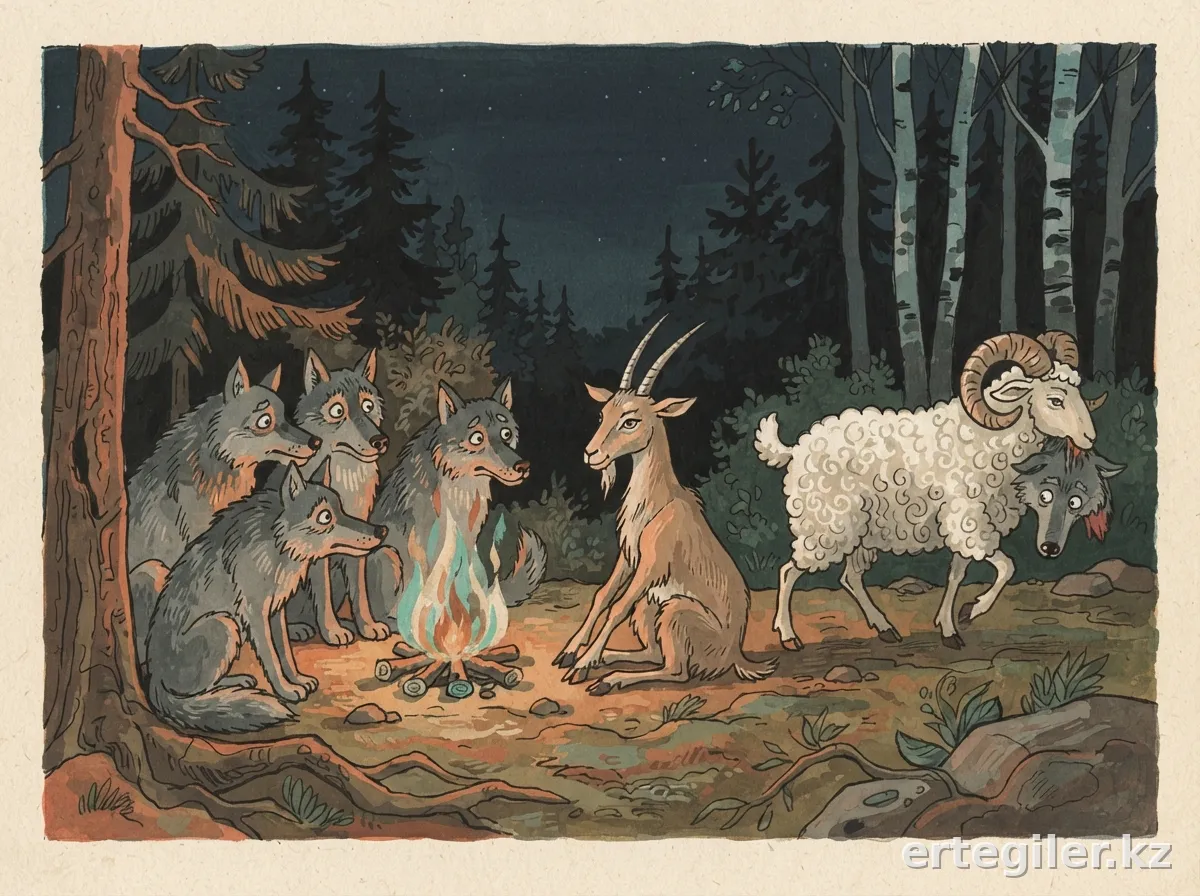
It was a pitch-black night. All around were mountains, rocks and thick forest. It seemed the only things they could hear were the soft tapping of their own hooves and the thumping of their own hearts. As they walked along like this, frightened and glancing all around, the two of them came right out upon a pack of wolves sitting in a clearing around a blazing fire. Now it was too late to run away — the wolves would notice.
The goat said to his friend the ram:
"Don't be afraid. Leave that head here and follow me," and he stepped boldly forward, right into the middle of the wolves sitting hunched around the fire.
"Peace be upon you," said the goat, making himself comfortable right beside the fire. The frightened ram stood behind the goat. The wolves were astonished, then very pleased; they looked at each other, grinned happily and laughed:
"Well, tell us, how did God drive you right into our midst?" said one of the wolves, the grey leader of the pack. The goat could see they were about to pounce on them, but he did not let it show:
"Yes, fate has brought us to you as guests. You have always had a taste for mutton, and now, by God's will, we have a taste for wolf meat," he said. The wolves looked at each other in bewilderment again. The leader said haughtily:
"Hmm! Hmm! Your guests' dinner is ready!" and he started to mock them, but the goat looked at his friend the ram, who was trembling with fear, and said:
"It doesn't look as if they're going to feed us their guests' dinner willingly. Go and pull the head off one of those eleven wolves we've got tied up over there, and we'll singe it in this fire and eat it." The ram walked slowly off towards the place where he had left the head. When the wolves heard these words, they lost all their courage. All of them kept looking anxiously in the direction the ram had gone.
"I'll go and have a look," said one or two of them, and slipped away. A little later:
"What's keeping them?" said another one or two, and off they went.
Then, when they saw the ram coming towards them into the firelight, holding up a wolf's head dripping with blood, the rest of the wolves, led by the leader, all fled in a pack. The ram put the head at the edge of the bright fire to singe, and all night the ram and the goat rested and slept in peace.
The next morning the ram and the goat set off on their way. They wandered through the thick forest. At one point the goat noticed trails and tracks crossing the forest, and in the distance he heard wolves talking loudly.
"The wolves from last night have told the bear about us. They've picked up our trail, and they're all coming to look for us. Let's hurry and climb up some handy pine tree and hide," said the goat.
He pushed and helped the ram up into a thick pine tree with dense branches, and then he jumped up after him in a single leap. Just then a huge dark-brown bear came lumbering heavily along, and behind him about ten wolves, all talking loudly, and they came right up to the pine tree where the ram and the goat were sitting.
"You fools! I've never seen such fools as you, letting go of the fat dinner that God himself drove to you. What a disgrace — brave wolves running away from a cowardly sheep!" said the bear.
"Yes, we were fools, we were disgraced, Uncle Bear!" the wolves cried all together.
"Huh! If he ever fell into my paws, hmm... hmm... I'd crush him with these spear-sharp claws... Let's have a guess right here: will we get a mouthful of fat tail today?" said the bear, and he swaggered over and sat down, leaning back, right under the pine tree where the ram and the goat were. The ten or so wolves, their eyes red and their tongues hanging out, began to sit down in a ring around the bear. When the ram saw them, he was scared out of his wits and fainted. He couldn't keep his feet steady or hold his balance, and the branch he was sitting on bent with a crack, broke, and he went tumbling down. The goat, seeing this, shouted:
"Grab the strongest! Grab the fattest!" Before he had finished, the ram came crashing down with all his weight right on top of the bear's head. The wolves scattered in all directions. The bear, his neck broken, roared, lay there a while and breathed his last. The goat helped his friend the ram, who was bruised and lying in a heap, back onto his feet, and they set off on their way again.
For several days the ram and the goat travelled through the thick forest, nibbling grass and drinking water. They still had not found the healing herb. The ram and the goat knew that the wolves who had run away had filled the forest with their howling and called each other to arms, had gone to complain even to the bear and the tiger, had cried out everywhere that they must take revenge on the ram and the goat who were roaming the forest as they pleased, and were now on their trail looking for them. One day, towards evening, the goat noticed tracks on the trails and heard faint noises and voices carried from far away, and said:
"Many enemies are on our trail and chasing us. Let's hurry. There's a cool breeze — there must be a big river ahead of us. Let's get to it."
They hurried on and came out on the bank of a big river that lay right across their way. In the middle of the river was a wide island; beyond the island was more wide water, and beyond the water was dry land again. The ram and the goat looked it all over and weighed it up. Howling, shouting and roaring, the bear, the tiger and the wolves were already coming up close behind them.
The goat said to his friend the ram:
"Now it's your turn to lead the way and save us from death. I can't swim, but you're a strong swimmer. Go into this river first, and I'll hold on to your tail and paddle along behind. We must head straight for the island."
This time the ram did not hesitate. With the goat's two legs hooked over his fat tail, he swam off across the deep river, bobbing like a boat. The beasts of prey, who had come howling and shouting after them, stopped on the bank, at a loss. The furious shaggy black bear roared:
"You won't get away, you rascals! Come on, get into the water after them and bring them to me!" he ordered the wolves.
A pack of wolves led by the very same leader who had fled in fright from the campfire that night plunged into the river with a splash and swam off. After them, one after another, other packs of wolves also went into the river and headed towards the ram and the goat. But the wolves had no skill or ease in swimming: they kept sinking and coming up again, splashing about in the water. Some of them sank into the deep water. Soon many of them lost their way, paddled off in all directions and now only thought about how to save their own lives.
But the ram and the goat swam quickly on without stopping and came straight out onto the island in the middle of the river. The ram stood staring, glad and frightened at the same time, at the wolves in the water, sinking and coming up again, struggling for their lives. Would the wolves swim across to the island? Or would they turn back? How many of them would drown? But the goat was not afraid of anything; he ran straight off to search through the grass on the island for the healing herb. There were few animals grazing on the island. All sorts of grasses had grown thick and soft, like a lamb's fleece. On a little hillock, among flat rocks, the grasses were in bloom and swaying. And right there, at the edge of those flat rocks, the goat found a bunch of the healing herb. He wrapped it in leaves and tied it firmly to the base of the ram's horn. There were a lot of wolves chasing the ram and the goat, about fifty or sixty, and even though they could not swim well and kept drowning, the bear on the bank was roaring and giving orders and sending yet another pack of wolves into the water. Some good swimmers kept together in a pack and, struggling hard, paddled straight for the island. The ram and the goat saw this too. Now it was clear: if not all the wolves, then a good many of them might reach the island. So the two of them got ready to swim to the bank on the far side of the island. As soon as the first wolves reached the island and set foot on it, the ram and the goat went back into the river and headed for the bank. The wolves, left empty-handed, gnashed their teeth, panted and, terribly angry, stood helplessly on the shore of the island once again.
The ram and the goat did not turn back again. They swam across to the far bank and, without stopping, went on. It was not yet dawn; it was still a dark night. But though it was night, on the goat's advice they did not stop — they just kept going and going.
"A pack of wolves may get across to this bank — they won't stay on the island anyway. The ones that get across will pick up our trail straight away and come after us, that's certain. Whatever happens, we must reach some shelter before dawn," the goat advised his friend the ram. The ram now trusted the goat's wisdom completely. He no longer doubted anything. Whatever his friend the goat said, the ram mostly agreed without a word and nodded his head. They came to a wide, flat clearing. But the clearing was not bare — it was crowded with haycocks made from cut hay.
The goat led the ram around every single haycock and went round each of them on all sides. The ram seemed puzzled by what the goat was doing.
"What's the point of us going round and round and not stopping at any of them?" he asked.
"We're leaving tracks. Now we'll crawl under one of the haycocks and hide. If the wolves come, they'll follow our tracks and turn over all these haycocks. They won't find us easily straight away. And besides, while they're tearing the haycocks apart, the owners of the hay may come along, mightn't they?" said the goat. The ram's heart filled with joy at how deeply wise his friend was:
"Goat, my dear! I'd give my life for your wisdom!" said the ram, and he hugged him tight and burst into tears. The goat hugged his friend too and cried. And then they both rested and fell asleep under the haycock.
Towards dawn the wolves arrived there too, howling and shouting. They followed the tracks that went round and round, turned the haycocks upside down and searched them, looking for the ram and the goat. As day began to break, the haymakers woke up at the howling and shouting of the wolves, saw the wolves wrecking their haycocks, grabbed their pitchforks, rakes and scythes, and rushed at the wolves, shouting. Just at the moment when the haymakers woke up and raised the alarm, a pack of wolves had broken open the haycock where the goat and the ram were lying and started to scatter it. One or two more armfuls of hay thrown aside, and the wolves' teeth would have reached the fat tail of the trembling ram. But as soon as they heard the haymakers' shouts, the wolves all fled in a pack.
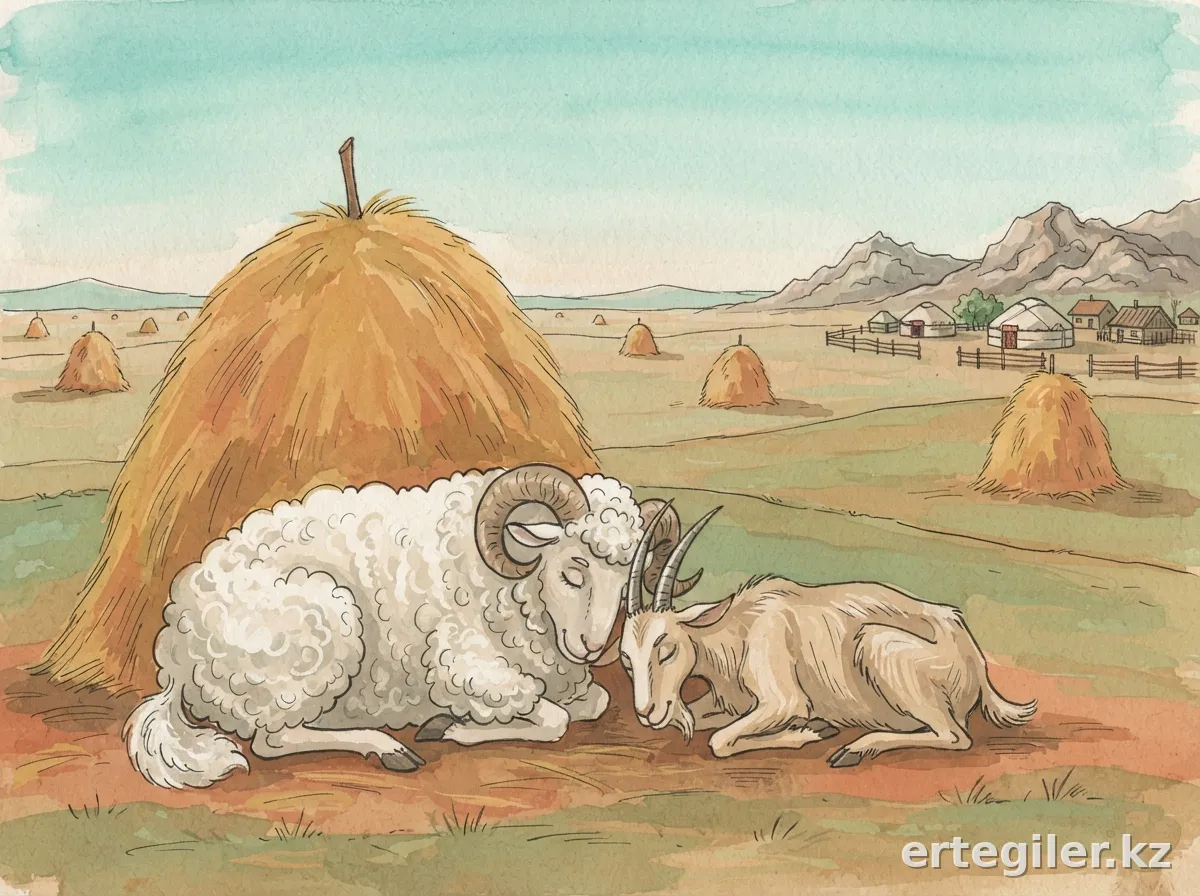
The goat and the ram came out from under the haycock as well, went up to the haymakers, cried in front of them like baby camels and threw themselves down at their feet. Now all the haymakers understood why the wolves had been wrecking the haycocks. They felt sorry for the ram and the goat, who were crying so bitterly.
"Let's not touch these two. They'll bring luck to the flock. Let's take them to the village and put them in with the sheep and goats," said one old man. When they heard this, the ram and the goat stopped crying at once, leapt about with joy, came up to the old man and bowed their heads before him.
"Well, well, these animals are clever — they understand what we say. Let's not harm the poor things," said another haymaker. The ram and the goat leapt about again and came up to him too, joyfully nodding their heads.
The haymakers stroked the ram and the goat on their heads, patted them on their backs, petted them and brought them to their camp, and there one of the haymakers who had stayed behind said:
"Oh my, these are the goat and the ram of the old man and the old woman from Akshoky! The poor things are rushing about everywhere asking after them and looking for them." That day, for the first time since they had run away from the home where they were born and raised, the ram and the goat slept peacefully, without danger or worry, to their hearts' content.
The next day the haymakers brought them both to the village and put them in with the sheep, and later they took them back to the old man and the old woman. The old man was cured by the healing herb the goat had found, and they all lived on peacefully, just as before.
Well done! The story is over!
You reached the end of the story. Great job!



Every day at 8:30 pm we'll send one bedtime tale. Just one notification a day.
On iPhone: tap Share → Add to Home Screen, open the site from that icon and turn it on here.
Done! Look out for a tale this evening 🌙
Something went wrong. Please try again later.
5 stories with your name and your picture. Show your parents!
For parents: a tale about your child for 390 ₸ — a trial week of Premium →Kazakh folk tales 27 people viewed

iPhone and Android app
All the tales, right on your phone
Read and listen at home or on the road. Free, with no ads.
- Audio tales keep playing with the screen off
- Pick up reading exactly where you stopped
- Find tales by age and by whether they have audio
- Night background and a comfortable text size

Sign in to keep reading
Today's free tales are over — 3 more are available tomorrow. Sign in with Google to continue — it is free and takes a second.
Sign in with GoogleHave an Android phone? In the app all tales are open without signing in.
Have an iPhone? In the app all tales are open without signing in.
Read in the app
Пікір қалдыру (0 пікір бар)
Әзірге пікір ешкім қалдырмаған!
Пікір қалдыру