Karamolda
Kazakh folk tales
How was the narration?
Thank you! This helps us make the narration better.
You listened to 30 seconds for free
Sign in to keep listening
Sign in with Google to listen to full fairy tales
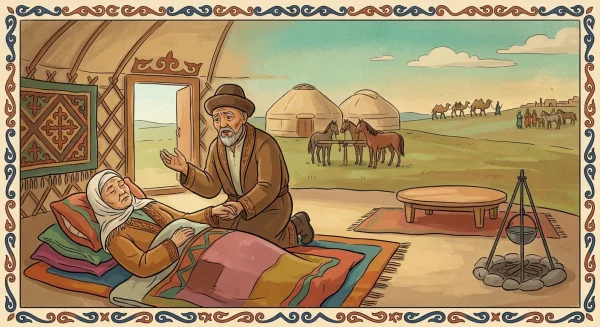
Sign in with GoogleLong, long ago there lived an old man and an old woman. They had no children. They had grown so old that death was not far off. One day, by the will of the Almighty, the old woman fell ill and lay senseless. The old man, terrified that she might die, rushed about looking for a baksy healer or a fortune-teller. And as the saying goes, "the people have fifty ears": word went round that "there is a mullah called Karamolda, and whoever he breathes his prayers over always gets well." So the old man set off to find Karamolda. This Karamolda was a man with a cold, grim face. He was rich and could do anything at all; he longed for only one thing, a son. All the children he had were three daughters. The old man searched and searched, and at last he found him. He invited the mullah, brought him home, treated him as an honoured guest and asked him to look at his wife. For a whole week the mullah stayed and healed the old woman. She got better. The mullah got ready to go home. The old man marked the calf of his only cow as the mullah's payment. The mullah said a prayer and gave his blessing.
To the old woman he said:
"In a month you will be with child. When your time comes, send for me, and I will name the baby myself."
"Very well," said the old couple. They took his blessing and stayed behind. They went on with their daily work. When nine months and nine days had passed, the old woman's labour began. Just as the mullah had told him, the old man galloped off to fetch him. He brought the mullah back. Soon after the mullah arrived, the baby was born. And it was a boy! The mullah called the azan into his ear and named him Karim. Then the mullah said:
"When the boy turns six, send him to me to study. I will teach him myself and make a fine man of him."
The mullah went home. The old couple lived on, full of thanks and hope. The boy turned six. As the mullah had said, the old man was going to take the boy to him, but the old woman wept and did not want to give him away. But the old man said:
"First by the will of God, and second by the mullah's prayers, we have come to this happiness."
He would not listen to his wife. He took the boy by the hand, led him to Karamolda and handed him over.
Karamolda said, "Don't come until I call you myself." Crying, "Oh, how I will miss my son," the old man went home. When he got there, the old woman had cried the whole day long. The old man joined her. The two of them sat and wept together. Months turned into months, and years into years. The old couple missed their son. And the old woman gave the old man no peace. It was hard for the old man: on one side, he kept thinking of his son; on the other, his wife would not let him rest. At his wits' end, the old man decided to go to his son. But then the mullah's words came back to him: "Don't come until I call you." "I'll just say I came to see him once, kiss him once and ease my longing," he thought, and he set off toward the mullah's house. He got up early for the morning prayer and came early, hoping to find the mullah at home. When he arrived, the mullah had just got up and gone out to pray. The old man greeted him and asked after his health, and then the mullah asked, "Why have you come?" "I missed my son, so I wanted to see him and kiss him just once," said the old man. The mullah scolded him: "Didn't I tell you not to come until I called you? Your son hasn't even learned his first letter yet. Don't come until I call you myself." The poor old man wept and wiped his tears with his sleeve, and he trudged off toward home. Just as he passed the mullah's palace, he saw a young man standing in front of it. The young man came up to the old man, greeted him and said, "Father, why are you crying?" "Oh, my dear boy, I had an only son, born to me in my old age. This Karamolda took him away to teach him. I missed my son and came to see him, but the mullah sent me off with harsh words. That is why I am crying," said the old man.
The young man said:
"Father, if that is so, don't cry. That son of yours is me."
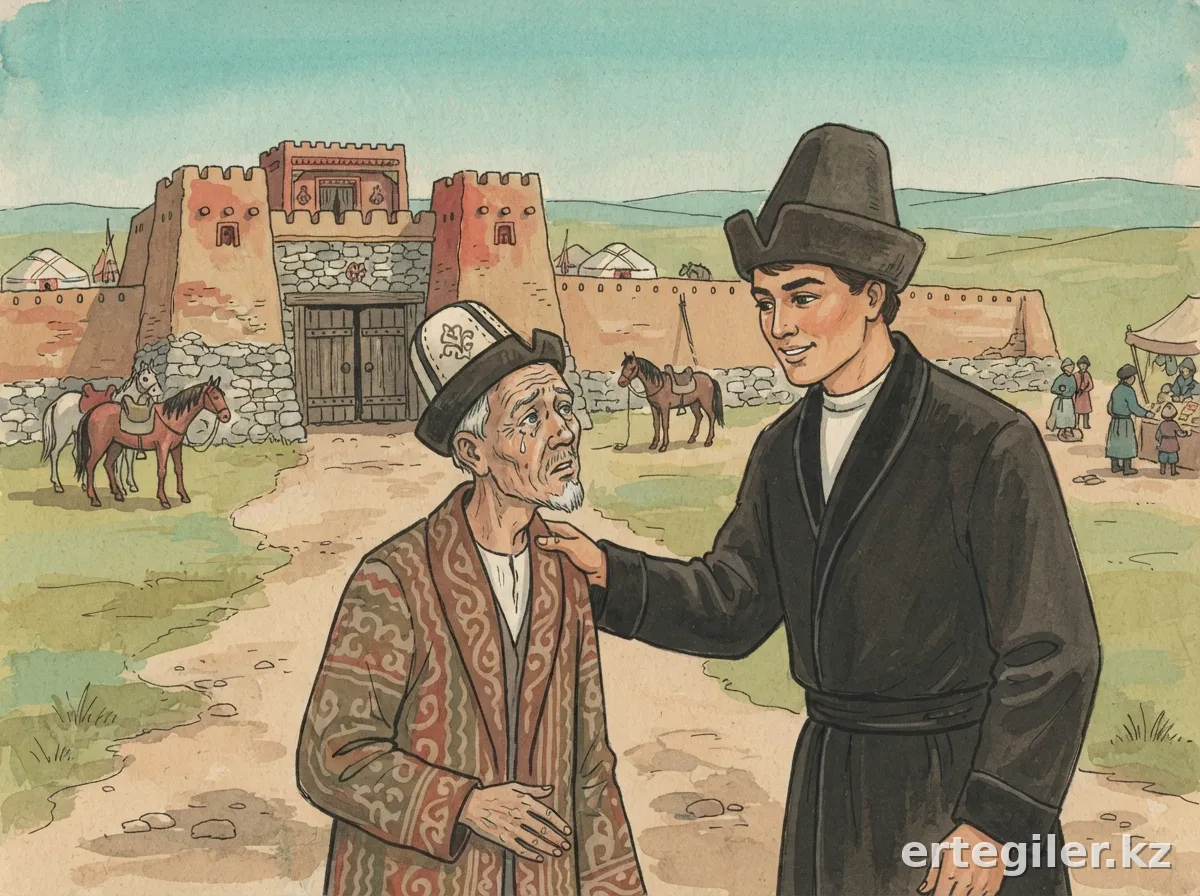
The old man was overjoyed. He kissed his son's face and eased his longing.
"My dear, how will I ever see you again?" he asked.
"Tomorrow, early in the morning, get up for prayer and come and stand by the hole in the outer wall of this palace. Four birds will fly out of the hole. Count three and let them go, but catch the fourth and don't let it go. The mullah will shout, 'Who is that bothering my bird? Let it go!' Don't listen to him; just take the bird and walk away," said the son.
"Very well," said the old man, and he went home happy. He told his wife everything he had seen and heard and made her glad. For the first time in a long while, the old man's food did him good. The next morning he got up very early, said his prayers in a hurry and hurried off to Karamolda's city. Before anyone else was up, he came to the hole on the outer side of the palace, just as his son had told him, and stood there. After a while, grey-blue doves began to fly out of the hole. He counted three and let them go, then caught the fourth and tucked it inside his coat. "Who is that bothering my bird?" the mullah shouted. The old man did not listen and walked away with the bird. It turned out that the three birds that flew out first were the mullah's three daughters. And the last one was the old man's son. Because he had no son of his own, the mullah wanted the boy to forget his father so that he could make him his own son. He was teaching the young man together with his daughters and bringing him up with them. The young man was very handsome and did very well in his lessons. The mullah's youngest daughter was in love with him. And the young man had promised to marry her. So, once the old man had gone a fair way with the bird inside his coat, the bird turned back into a young man. They talked so much that they did not even notice how they got home. At home they made the old woman happy. When they had talked a while and eased their longing, the son said to his father:
"Father, let me earn us some wealth. Tomorrow morning I will turn into a beautiful chestnut steed with a white blaze. Ride me to the market. If anyone asks, 'Will you sell him?' say, 'I will.' If they ask, 'How much do you want?' say, 'Ten thousand gold coins.' But don't sell me with the halter. Keep the halter for yourself," he said.
Morning came, and the son became a beautiful chestnut ambler with a white blaze, his coat shining like beaver fur. The old man put the halter on him and mounted. He rode him to the market at a smooth amble. At the market a man said:
"Hey, will you sell your steed?"
"I will!"
"Well, what do you want for him?"
"I want ten thousand gold coins."
"Get down and take your money," said the man.
The poor old man had never held so much money in his life. He counted the money, lost his head with excitement and walked off, forgetting the halter. In the evening his son came running.
"Father, is all the money there?" he asked.
"The money is all there, but I forgot my halter," said the old man.
"Never mind," said the son.
"Now I will turn into a black steed with a white blaze. There will be no better steed than me in the market. Only count your money carefully, and don't forget my halter," he said.
Morning came, and now he was a black steed with a blaze. He was so beautiful that there was no horse like him in the whole market. The old man had only just ridden up at an amble when two men came at him from two sides:
"Will you sell your steed?" they asked.
"I will."
"What do you want for him?"
"He costs ten thousand gold coins," said the old man.
The two men vied with each other and bought him. And the old man forgot the halter again. In the evening his son came back.
"Father, is all the money there?" he asked.
"Oh, my dear, the money is all there, but I forgot my halter again," said the old man.
"Don't forget my halter now, or Karamolda may well catch me," said the son.
This time he became a steed of deep blue-black. The earlier ones were nothing beside him: this one was more beautiful still.
But Karamolda knew about the young man's tricks. "How can I get him into my hands now?" he thought, and he kept watch. On the day the old man rode out on the horse, the mullah lay in wait, stopped him before he reached the market, paid him what he asked right there in the open steppe and took the horse away. And the poor old man forgot the halter again. Karamolda brought the steed home and tied him up in an iron house. He nailed down all four hooves and bound them with a horsehair rope so tightly that the horse could not even turn, and he locked the iron house firmly. The mullah's youngest daughter found out about it. She slipped in through a crack as a sparrow, spoke with him and said, "If you keep your promise, I will set you free."
"I won't beg you to free me or not to free me. But I will never go back on the promise I made," said the young man.
The mullah went off to travel around his lands. His three daughters sat talking. "Father has brought home a fine horse. Let's go and see it," they said. The middle and the youngest daughters said to their eldest sister:
"Ask Mother for the key. Let's have a look."
The eldest sister suspected nothing. She asked their mother for the key, and they went in. Without anyone noticing, the youngest daughter used her magic to pull the nails out of the steed's hooves. The girls led the horse outside. Once outside, the horse could not stand still. The youngest daughter said, "Let's give him water. The poor creature must be thirsty."
The youngest daughter was clever, and her sisters never went against her word. In fact, even her father asked her for advice. "All right," they said, and they led the horse to the well. While the two elder sisters were pulling up the bucket, the youngest slipped off the halter. The horse turned into a little fish and dropped into the well. The girls were at a loss and did not know what to tell their father. But the youngest daughter acted as if it had nothing to do with her. The next day the mullah came home. He was told that the horse had fallen into the well. The mullah turned into a pike, dived into the well and went after it. The little fish could find no place to hide inside the well, so it fled along the spring that fed the well. On it fled, and on came the pike behind it. Swimming along the spring, the fish came out into a great river. As it fled along the bank, it saw a girl sitting there, washing her hands in the river. The fish turned into a gold ring and slipped onto the girl's finger. The pike rose out of the water as a man and seized hold of her: "Give me my ring!" But there was no way he would get it back, for the girl was the khan's daughter. Now that the ring was on her finger, she sent her maidservants after the mullah; they laughed at him, and all the maidens kept him well away. Then the girls went home. The khan's daughter showed her father the ring and asked for a gift for her lucky find. The khan said, "Very well, my dear. It must have been meant for you." In the evening, as she was going to bed, she took the ring off her finger to put it in her pocket, and the ring began to speak.
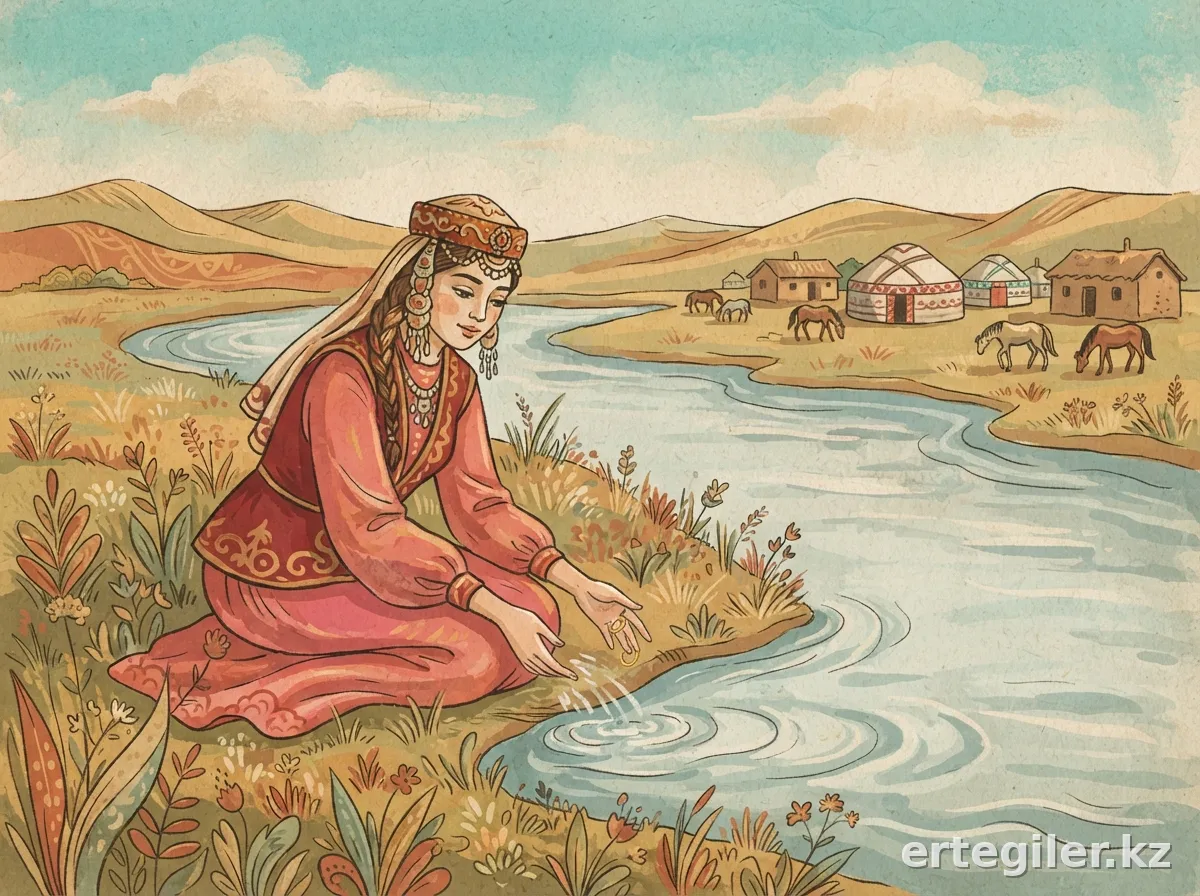
The ring said:
"I am not a ring, I am a person. If you won't be frightened, I will take my human shape again."
At first the girl was frightened, but then she was glad and let him become a man again. And there stood a handsome young man: call him the moon, and his face was like the moon; call him the sun, and his eyes shone like the sun. He and the girl talked and laughed together freely. The young man said to the girl:
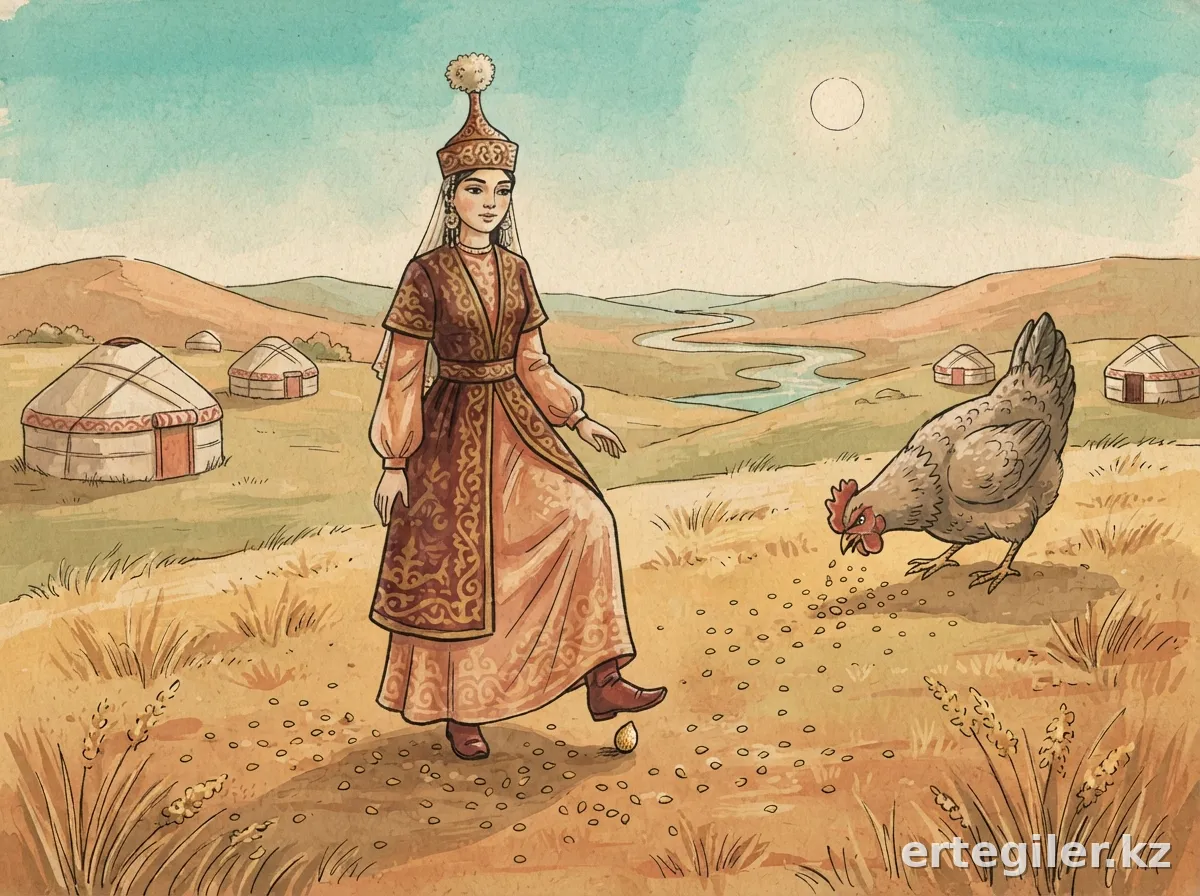
"The man from yesterday has not gone away. Tomorrow he will come and meet you. Tomorrow, when you go out for a walk, take only one maid with you. That man is Karamolda, and if the Karamolda I know is still alive, he will come to meet you tomorrow. When he asks for his ring, say, 'Away with your ring, and away with you!' and throw it down. I will scatter as grains of millet. One grain will roll off to the side and lie apart from the rest. Press that lone grain under your foot! The mullah will turn into a hen and peck up the millet. When he has eaten all the other grains, he will come to the grain under your foot. He won't be able to reach it, and then he will turn into a mouse and start to dig. At that moment, lift your foot," he said.
"Very well!" they agreed. That night passed in fun and merriment. As dawn was breaking, she put the ring on her finger and lay down to sleep. When the sun was up, the girl went out for a walk. She took only one maid with her. Just as the young man had said, Karamolda came hurrying up and asked for his ring. The girl said:
"Away with your ring, and away with you!" And she threw the ring down. The ring scattered as grains of millet. The mullah turned into a hen and began to peck up the millet. The girl pressed one lone grain under her foot. When the hen had eaten all the other grains, it came to the grain under the girl's foot. It came at it from this side, then from that side. When it could not reach it, it turned into a mouse and began digging under her foot. As soon as the girl lifted her foot, the grain turned into a bobtailed cat, sprang at Karamolda and bit through his neck. Then the girl came to her father arm in arm with the young man and said:
"My ring has turned into a young man! Give me a suyinshi, a gift for good news!"
The khan was so happy that he said, "For your suyinshi, I give you to this young man as his wife." The girl gladly agreed. And on top of that, the khan gave the young man his throne. So the young man ruled as khan for a while.
Days passed, and one day he remembered his father. He asked his father-in-law for leave to visit his father and mother. His father-in-law not only gave him leave, but also loaded nine camels with a bride's dowry and goods and saw them off. The young man made his father and mother happy, and when he came to Karamolda's city, it stood just as it had before. Karamolda's youngest daughter was waiting for him there. When she saw that the young man had married another, the girl was heartbroken and said to him, "If you marry me as you promised before, then marry me. If you don't, I will burn this whole city to the ground." The young man could not go against her words. He took her as his second wife, had two white yurts put up on either side of his father's humble old home, sat on the khan's throne and got everything his heart desired.
Well done! The story is over!
You reached the end of the story. Great job!





Every day at 8:30 pm we'll send one bedtime tale. Just one notification a day.
On iPhone: tap Share → Add to Home Screen, open the site from that icon and turn it on here.
Done! Look out for a tale this evening 🌙
Something went wrong. Please try again later.
5 stories with your name and your picture. Show your parents!
For parents: a tale about your child for 390 ₸ — a trial week of Premium →Kazakh folk tales 18 people viewed

iPhone and Android app
All the tales, right on your phone
Read and listen at home or on the road. Free, with no ads.
- Audio tales keep playing with the screen off
- Pick up reading exactly where you stopped
- Find tales by age and by whether they have audio
- Night background and a comfortable text size

Sign in to keep reading
Today's free tales are over — 3 more are available tomorrow. Sign in with Google to continue — it is free and takes a second.
Sign in with GoogleHave an Android phone? In the app all tales are open without signing in.
Have an iPhone? In the app all tales are open without signing in.
Read in the app
Пікір қалдыру (0 пікір бар)
Әзірге пікір ешкім қалдырмаған!
Пікір қалдыру