Mukhtar Auezov
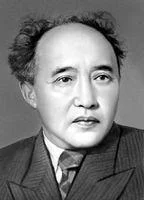
Mukhtar Omarhanuly Auezov (September 28, 1897 – June 27, 1961) was a classic of Kazakh literature, a public figure, a Doctor of Philology, a professor, an academician of the Academy of Sciences of the Kazakh SSR (1946), and an honored figure in science of the Kazakh SSR (1957).
Born on September 28 in the former Semey district, in a place called Kaskabulak in the Shyngys region, his childhood was spent in a nomadic village. The future writer witnessed the rich and contradictory life of Kazakh society, which was so deeply and multifacetedly depicted by the great Abai in his works. He received his education at a madrasa in Semey, then at a five-grade Russian school, and from 1915 to 1919 at a teachers' seminary. While studying at the seminary in 1917, he wrote the play "Enlik-Kebek," based on a popular folk legend. This was the first spark of Kazakh national drama. Through this play and his first short story "The Day of the Defenseless," written in 1921, he clearly demonstrated his exceptional talent as a writer. During those years, while working in various positions in Semey and Orenburg, he became close to the leaders of the Alash Party, such as Alihan Bokeikhanov, Akhmet Baitursynov, and Mirzhakyp Dulatov, as well as other prominent figures in literature and culture. He participated in the publication of the "Abai" magazine. The movement that proclaimed "Awaken, Kazakh!" and their democratic ideas became a foundation for Auezov to define his life’s goals. After the Alashorda leaders began to be pushed out of government and official politics, starting in 1923, he devoted all his energy to the field of fiction and began to work productively. From 1923 to 1926, he wrote the stories "Educated Citizen," "Pictures of the Steppe," "Marriage," "In the Shadow of the Past," "The Fault-Finding Young Woman," and "The Mourning Beauty."
From 1923 to 1928, he studied at Leningrad University, graduating from the Faculty of Language and Literature. After that, he specialized in